



In a groundbreaking advancement poised to redefine the fields of neurobiology and bioelectronics, scientists at Northwestern University have engineered a revolutionary wireless device capable of transmitting information directly into the brain using light. This innovative technology effectively bypasses the body’s traditional sensory pathways, delivering targeted signals straight to neurons with unprecedented precision and minimal invasiveness. The implications of this breakthrough, detailed in the prestigious journal Nature Neuroscience, are vast, ranging from restoring lost senses and enhancing prosthetic control to fundamentally altering our understanding of brain function.
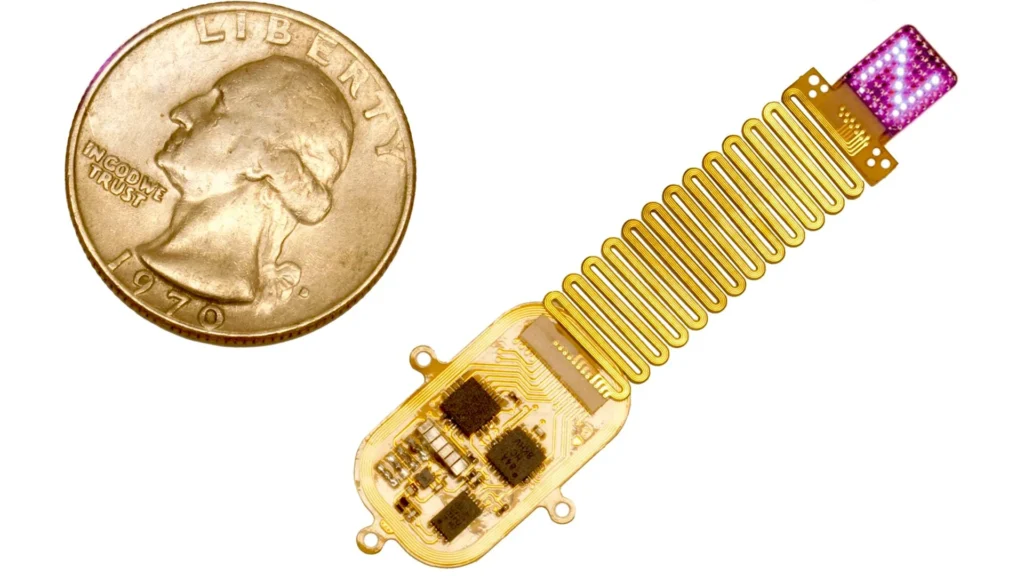
The newly developed device represents a significant leap in neurotechnology, characterized by its soft, flexible form factor designed for subdermal implantation. Positioned discreetly beneath the scalp and resting gently on the skull, it operates by emitting precisely controlled patterns of light. These optical signals penetrate the cranial bone, activating specific groups of neurons across various regions of the cortex. This novel approach opens up entirely new avenues for direct communication with the brain, sidestepping the complex and often compromised mechanisms of natural sensory input.
A New Paradigm in Brain-Computer Interfacing
The research team, co-led by Northwestern neurobiologist Yevgenia Kozorovitskiy and bioelectronics pioneer John A. Rogers, meticulously validated the device’s efficacy in animal models. During rigorous testing phases, researchers deployed minute, precisely timed bursts of light to stimulate targeted populations of neurons located deep within the brains of genetically modified mice. These specialized neurons had been engineered to exhibit light-responsive properties, a cornerstone of the burgeoning field of optogenetics. Remarkably, the mice swiftly demonstrated an ability to interpret these specific light patterns as meaningful cues. Independent of conventional sensory inputs like sound, sight, or touch, the animals adeptly utilized this incoming information to make informed decisions and successfully execute complex behavioral tasks. This tangible evidence of artificial perception underscores the profound potential of direct neural communication.
The spectrum of potential medical applications for this technology is extensive and transformative. It promises to provide sophisticated sensory feedback for advanced prosthetic limbs, offering users a more intuitive and natural experience. Furthermore, it could pave the way for next-generation hearing or vision prostheses, delivering artificial inputs directly to the brain, thereby bypassing damaged sensory organs. Beyond sensory restoration, the device holds promise for controlling robotic limbs with unparalleled precision, significantly improving rehabilitation outcomes for individuals recovering from severe injuries or stroke by re-establishing neural pathways, and even modifying pain perception without reliance on pharmaceutical interventions. The study’s full findings are slated for publication on Monday, December 8, in Nature Neuroscience, marking a pivotal moment in the ongoing quest to unlock the brain’s mysteries and harness its capabilities.
Understanding Optogenetics: The Foundation of Light-Based Control
To fully appreciate the significance of this Northwestern breakthrough, it is crucial to understand the scientific bedrock upon which it stands: optogenetics. This revolutionary neuroscientific technique involves genetically engineering specific neurons to express light-sensitive proteins, typically derived from algae or bacteria. Once these proteins, called opsins, are present, researchers can precisely control the activity of these neurons by exposing them to light of specific wavelengths. Shining light on these opsin-expressing neurons can cause them to either fire an electrical impulse (excite) or cease firing (inhibit), effectively turning them on or off with unprecedented temporal and spatial resolution.
The field of optogenetics emerged in the early 2000s, with pioneering work by scientists like Karl Deisseroth and Ed Boyden, who successfully demonstrated the ability to control neural activity in living animals using light. Before optogenetics, neuroscientists relied on electrical stimulation, which is less specific, or pharmacological agents, which often have widespread effects. Optogenetics offered a game-changing level of precision, allowing researchers to isolate and study the functions of specific neural circuits with a clarity previously unimaginable. Its development has been hailed as one of the most important advances in neuroscience in decades, leading to a deeper understanding of brain disorders ranging from Parkinson’s disease to depression and addiction.
However, a persistent challenge in early optogenetics was the delivery of light to deep brain structures. This often required implanting rigid fiber optic cables directly into the brain, which could restrict animal movement, cause tissue damage, and limit long-term studies. The Northwestern team’s earlier work, and especially this latest iteration, directly addresses these limitations, propelling optogenetics into a new era of wireless, minimally invasive application.
From Single LED to Advanced Cortical Arrays: A Chronology of Innovation
The current achievement is not an isolated discovery but rather the culmination of years of iterative research and technological refinement by the Northwestern team. Their journey into wireless, light-based neural control began to gain significant traction with a prior breakthrough reported in 2021. At that time, the same research group unveiled the first fully implantable, programmable, wireless, and battery-free device capable of controlling neurons with light. That earlier system utilized a single micro-LED probe, which proved effective in influencing specific social behaviors in mouse models. Crucially, this wireless design liberated the mice from cumbersome fiberoptic wires that had traditionally restricted their movement, allowing them to behave naturally within their social environments – a critical step for studying complex behaviors without experimental artifacts.
The new device represents a substantial expansion and enhancement of this foundational technology. Where the 2021 iteration employed a solitary micro-LED, the updated system now incorporates an array of up to 64 programmable micro-LEDs. Each of these miniature light sources, individually no larger than a single strand of human hair, can be controlled independently in real time. This advanced capability enables researchers to deliver intricate sequences of light patterns that closely mimic the distributed activity patterns naturally produced by the brain during genuine sensory experiences. The significance of this multi-site approach is profound: real-world sensations typically activate broad, interconnected neural networks rather than isolated neurons. By replicating this distributed activation across the cortex, the new device provides a much more biologically realistic and sophisticated means of interfacing with the brain’s inherent functional architecture.
John A. Rogers, a leading figure in bioelectronics and the architect behind the technology development, elaborated on the engineering challenges and solutions. "Developing this device required rethinking how to deliver patterned stimulation to the brain in a format that is both minimally invasive and fully implantable," Rogers stated. "By integrating a soft, conformable array of micro-LEDs – each as small as a single strand of human hair – with a wirelessly powered control module, we created a system that can be programmed in real time while remaining completely beneath the skin, without any measurable effect on natural behaviors of the animals. It represents a significant step forward in building devices that can interface with the brain without the need for burdensome wires or bulky external hardware. It’s valuable both in the immediate term for basic neuroscience research and in the longer term for addressing health challenges in humans."
Creating New Brain Signals with Micro-LED Technology
The ability to generate and deliver these complex, novel brain signals is at the heart of the Northwestern innovation. "Our brains are constantly turning electrical activity into experiences, and this technology gives us a way to tap into that process directly," explained Yevgenia Kozorovitskiy, who led the experimental portion of the study. "This platform lets us create entirely new signals and see how the brain learns to use them. It brings us just a little bit closer to restoring lost senses after injuries or disease while offering a window into the basic principles that allow us to perceive the world."
The device’s design prioritizes both capability and minimal invasiveness. Despite its enhanced functionality, the implant remains remarkably compact, approximately the size of a postage stamp and thinner than a credit card. A key innovation lies in its method of light delivery: instead of requiring a probe to be inserted directly into brain tissue, the new version gently conforms to the skull’s surface and transmits light through the bone. "Red light penetrates tissues quite well," Kozorovitskiy affirmed, explaining how this particular wavelength can reach deep enough to activate neurons even through the cranial barrier. This non-penetrating approach significantly reduces the risks associated with brain surgery and makes the technology more viable for long-term applications.
Mingzheng Wu, the study’s first author and a postdoctoral researcher, highlighted the exponential increase in communication complexity. "In the first paper, we used a single micro-LED," Wu noted. "Now we’re using an array of 64 micro-LEDs to control the pattern of cortical activity. The number of patterns we can generate with various combinations of LEDs – frequency, intensity, and temporal sequence – is nearly infinite." This capacity for highly varied and dynamic stimulation patterns is critical for mimicking the rich and diverse signals processed by the natural brain.
Training the Brain to Recognize Synthetic Patterns
To rigorously evaluate the system’s ability to convey meaningful information, the research team conducted a series of sophisticated behavioral experiments. They worked with mice specifically engineered to possess light-responsive neurons within their cortex. The animals underwent extensive training to associate a particular pattern of optical stimulation with a specific reward, typically dispensed at a designated port within a specialized testing chamber.
Throughout these experiments, the subdermal implant delivered a defined pattern across four distinct cortical regions. This process was akin to tapping a coded message directly into the brain, bypassing all conventional sensory pathways. The mice, through repeated exposure and reinforcement, successfully learned to identify this target pattern amidst a multitude of alternative, irrelevant patterns. Upon detecting the correct artificial signal, they consistently navigated to the appropriate port to receive their reward, demonstrating a clear understanding and interpretation of the light-encoded information.
"By consistently selecting the correct port, the animal showed that it received the message," Wu explained. "They can’t use language to tell us what they sense, so they communicate through their behavior." This behavioral validation is crucial, as it provides objective evidence that the brain is not merely reacting to light but is actively processing it as meaningful, actionable information, thereby forming artificial perceptions.
Broader Impact and Future Horizons
The implications of Northwestern’s wireless light-based brain interface extend far beyond the laboratory, promising to revolutionize both basic neuroscience research and clinical applications. For basic science, this device offers an unprecedented tool for dissecting the fundamental principles of brain function. Researchers can now precisely control and observe how the brain learns new forms of input, how it encodes and decodes information, and how distributed neural activity gives rise to perception, cognition, and behavior. This could lead to profound insights into neural plasticity, memory formation, and the mechanisms underlying various neurological and psychiatric disorders.
In the clinical realm, the potential is equally transformative. Consider individuals with profound sensory loss. While cochlear implants have restored hearing for many, and retinal prostheses offer some visual input, these technologies often rely on external sensors and complex signal processing that aim to mimic natural inputs. A direct neural interface could potentially offer a more direct, perhaps even richer, form of sensory restoration by communicating directly with the brain’s processing centers. For prosthetic limbs, the ability to provide direct sensory feedback—allowing a user to "feel" the texture or temperature of an object through their artificial hand—would dramatically enhance functionality and embodiment, bridging the gap between human and machine. In neurological rehabilitation, this technology could bypass damaged neural pathways, creating new routes for motor control or sensory processing after stroke or spinal cord injury, potentially accelerating recovery and improving quality of life. Furthermore, by directly modulating neural circuits involved in pain perception, the device could offer a powerful, non-addictive alternative for chronic pain management, a significant public health challenge affecting millions globally.
Looking ahead, the research team is already charting the course for future development. Having definitively demonstrated that the brain can interpret patterned light stimulation as meaningful information, their immediate next steps involve testing more sophisticated patterns and meticulously determining the maximum number of distinct signals the brain can reliably learn and process. Future iterations of the device are envisioned to incorporate an even greater number of LEDs, with smaller spacing between them to achieve higher spatial resolution. Larger arrays covering more extensive cortical regions are also on the roadmap, as are advancements in light wavelengths that can penetrate even deeper into brain tissue, expanding the reach of this innovative technology.
This monumental study, titled "Patterned wireless transcranial optogenetics generates artificial perception," underscores the power of interdisciplinary collaboration. It received substantial support from a consortium of leading institutions and funding bodies, including the Querrey Simpson Institute for Bioelectronics, the NINDS/BRAIN Initiative, the National Institute of Mental Health, the One Mind Nick LeDeit Rising Star Research Award, the Kavli Exploration Award, the Shaw Family Pioneer Award, the Simons Foundation, the Alfred P. Sloan Foundation, and the Christina Enroth-Cugell and David Cugell Fellowship. Such broad backing highlights the recognized importance and transformative potential of this research for both fundamental science and human health. The work from Northwestern University represents not just a technological advancement, but a conceptual leap in our ability to interact with and understand the most complex organ known – the human brain. It opens a new chapter in bioelectronics, bringing us closer to a future where direct neural interfaces could profoundly reshape human experience and capabilities.