

The pursuit of Turkish language proficiency represents a strategic endeavor for millions of expatriates, business professionals, and cultural enthusiasts worldwide. As the official language of Turkey and one of the most widely spoken Turkic languages, Turkish offers a unique grammatical framework that rewards systematic study. Linguistic experts suggest that mastery of the most common vocabulary serves as the primary catalyst for effective communication, allowing learners to navigate daily interactions and comprehend the core themes of complex conversations. By focusing on a high-frequency lexicon—comprising essential nouns, verbs, and social markers—students of the language can establish a functional foundation that facilitates the transition from basic survival phrases to advanced fluency.
Historical Context and the Evolution of Modern Turkish
To understand the current state of the Turkish language, one must examine the profound linguistic transformation initiated in the early 20th century. Following the establishment of the Republic of Turkey in 1923, Mustafa Kemal Atatürk spearheaded the "Harf Devrimi" or Letter Revolution in 1928. This reform replaced the Persian-Arabic script with a modified Latin alphabet, designed to better suit the phonetic requirements of the Turkish language.
This shift was not merely orthographic; it was accompanied by a "Language Revolution" (Dil Devrimi) aimed at purifying the lexicon of excessive Persian and Arabic loanwords. The resulting modern Turkish is highly phonetic and follows a logical, rule-based structure. For the contemporary learner, this history means that once the basic sounds of the 29-letter alphabet are mastered, reading and pronunciation become exceptionally consistent compared to languages like English or French.
The Linguistic Architecture of Turkish Social Interaction
Social etiquette in Turkey is deeply rooted in hospitality and respect, making the mastery of greetings and polite formulas a priority for any newcomer. The language distinguishes clearly between formal and informal addresses, a reflection of the sociolinguistic hierarchy prevalent in Turkish culture.
Essential Greetings and Salutations
The most common point of entry into a Turkish conversation is "Merhaba" (Hello), a versatile greeting suitable for almost any setting. For more casual interactions, "Selam" (Hi) is frequently employed among peers. Time-of-day greetings are also critical for social integration:
- Günaydın: Good morning.
- İyi akşamlar: Good evening.
- Görüşürüz: See you later.
Inquiry into a person’s well-being requires a choice between the informal "Nasılsın?" and the formal "Nasılsınız?" (How are you?). The standard response, "İyiyim" (I am fine), typically precedes a reciprocal inquiry.
The Grammar of Politeness and Hospitality
Turkish culture places significant emphasis on acknowledging the efforts of others through specific linguistic formulas. "Teşekkür ederim" remains the standard for "Thank you," while the informal "Sağ ol" (literally "stay healthy") is common among friends.
Unique to the Turkish experience are phrases like "Kolay gelsin" (May it be easy for you), used when approaching anyone engaged in work, from a shopkeeper to a colleague. Similarly, "Elinize sağlık" (Health to your hands) is a mandatory compliment offered to a cook after a meal, acknowledging the labor involved in food preparation. When someone is ill or has faced a misfortune, "Geçmiş olsun" (May it be past) serves as a compassionate acknowledgment of their situation.
Categorical Nouns: Navigating the Physical and Social World
Building a robust vocabulary requires the categorization of nouns into functional groups. Data from linguistic frequency lists indicate that food, family, and navigation are the three most critical sectors for foundational noun acquisition.
Culinary Lexicon and the "Pasta" Pitfall
Given the central role of gastronomy in Turkish life, understanding food-related nouns is essential for daily survival. Basic staples include "Ekmek" (Bread), "Su" (Water), "Et" (Meat), and "Süt" (Milk). However, learners must be wary of "false friends"—words that look similar to English but carry different meanings. A primary example is the word "Pasta." While an English speaker might expect a plate of noodles (which is "Makarna" in Turkish), "Pasta" actually refers to cake. Ordering "pasta" at a restaurant will result in a dessert rather than a savory meal.
The Complexity of Kinship Terms
Turkish kinship terminology is significantly more descriptive than its English counterpart. The language distinguishes between maternal and paternal relatives, reflecting a historical emphasis on lineage. For instance, a paternal uncle is "Amca," while a maternal uncle is "Dayı." Similarly, a paternal aunt is "Hala," whereas a maternal aunt is "Teyze." Respect for seniority is further codified in terms like "Abi" (Older brother) and "Abla" (Older sister), which are frequently used even with non-relatives as a mark of respect and endearment.
Navigation and Spatial Awareness
For those residing in or visiting urban centers like Istanbul or Ankara, the following nouns are indispensable:
- Havaalanı: Airport.
- Hastane: Hospital.
- Eczane: Pharmacy.
- Banka: Bank.
- Otel: Hotel.
Temporal Markers and Chronology
The ability to discuss schedules and timeframes is vital for professional and social coordination. Turkish temporal vocabulary follows a logical progression from the smallest unit to the largest:
- Saniye / Dakika / Saat: Second / Minute / Hour.
- Bugün / Dün / Yarın: Today / Yesterday / Tomorrow.
- Hafta / Ay / Yıl: Week / Month / Year.
The word "Şimdi" (Now) and "Sonra" (Later) act as critical connectors in planning daily activities.
The Mechanics of Action: Essential Turkish Verbs
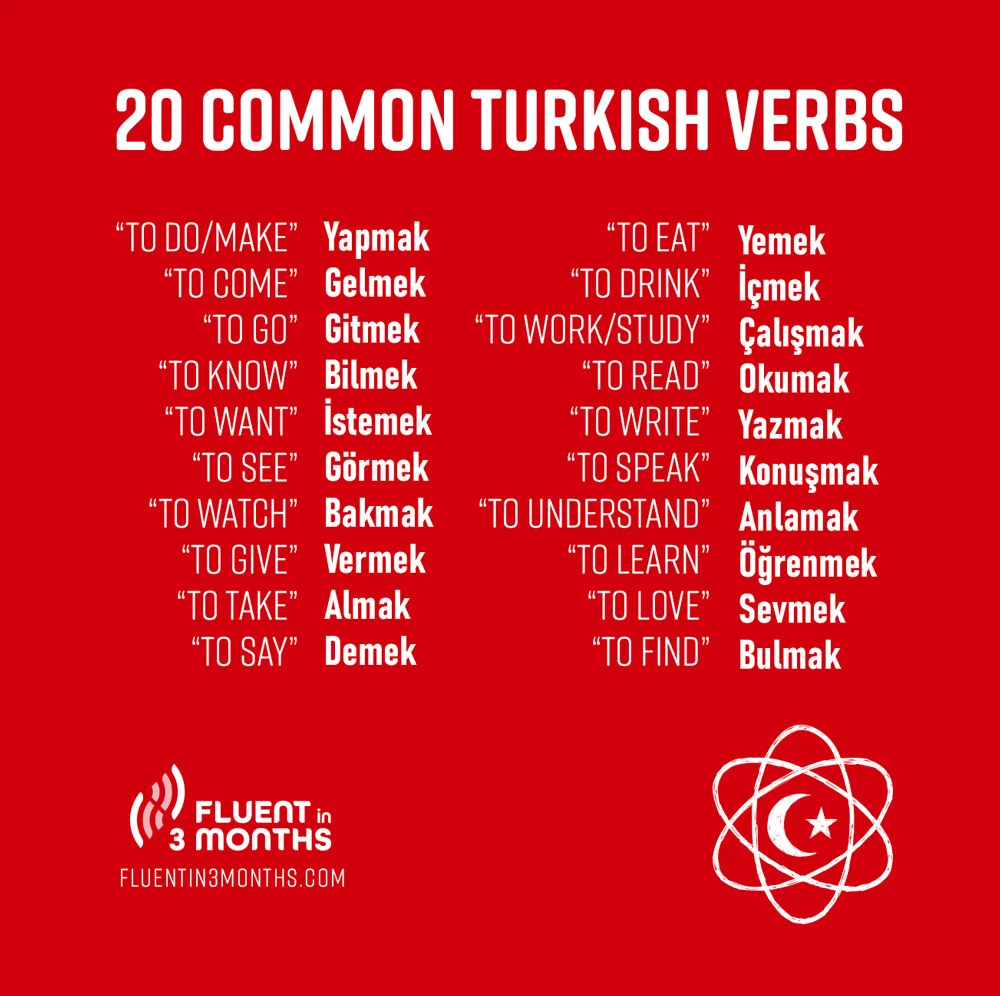
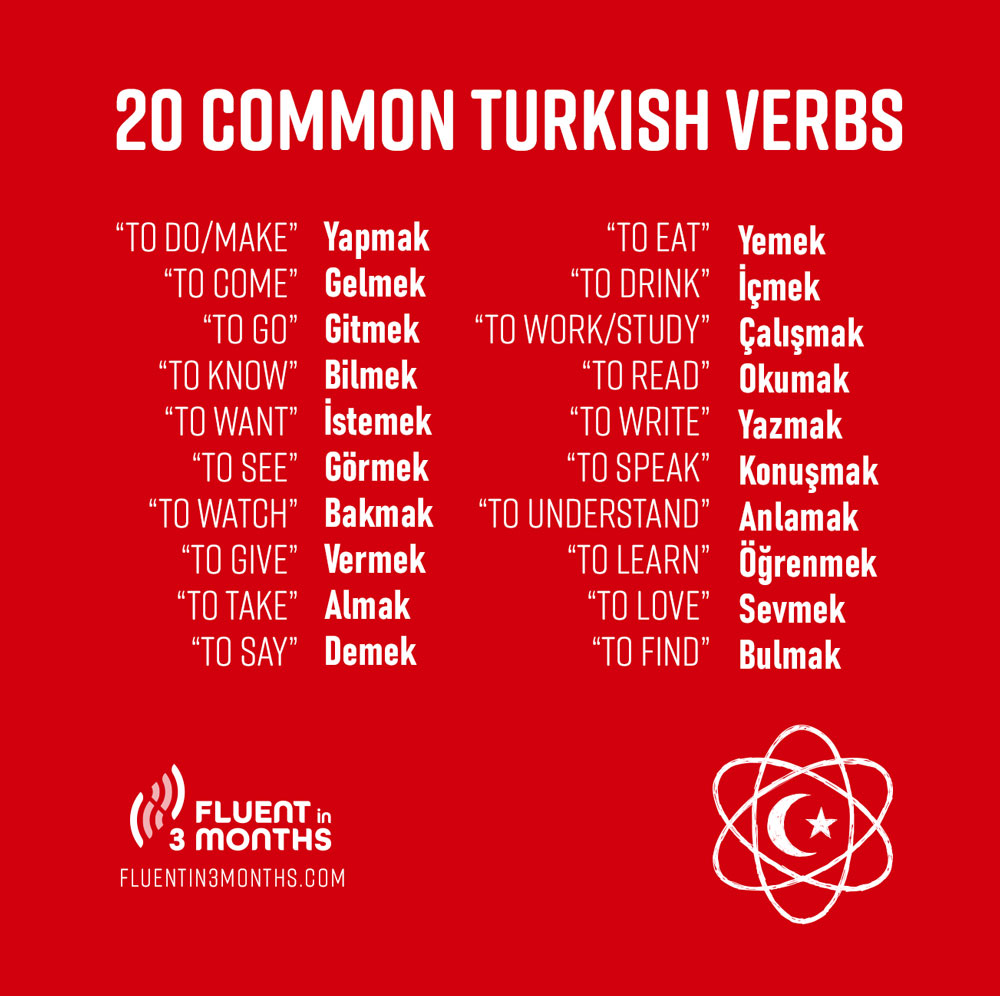
Turkish is an agglutinative language, meaning that meanings are built by adding suffixes to a root word. Verbs are the primary vehicles for this process. The infinitive form of a Turkish verb always ends in "-mak" or "-mek" (e.g., "Yapmak" – To do; "Gelmek" – To come).
Syntax and Word Order
Unlike English, which follows a Subject-Verb-Object (SVO) pattern, Turkish typically utilizes a Subject-Object-Verb (SOV) structure. For example, the sentence "I am learning Turkish" is rendered as "Ben Türkçe öğreniyorum" (I Turkish learning-am). This placement of the verb at the end of the sentence requires a cognitive shift for Indo-European language speakers but provides a consistent rhythm to the language.
Possession and Existence
A notable feature of Turkish is the absence of the standalone verbs "to be" and "to have." These concepts are instead expressed through suffixes and the words "Var" (There is/exists) and "Yok" (There is not/does not exist). To say "I have a cat," one says "Benim bir kedim var" (My one cat-my exists). This structural difference highlights the importance of learning "Var" and "Yok" early in the acquisition process.
Descriptive Language: Adjectives and Colors
Adjectives in Turkish are placed before the noun they modify, similar to English. Common descriptors include "Büyük" (Big), "Küçük" (Small), "Güzel" (Beautiful), and "Yeni" (New). The language also distinguishes between "Eski" (Old for objects) and "Yaşlı" (Old for people).
Colors serve as essential adjectives in daily commerce and description:
- Kırmızı: Red.
- Mavi: Blue.
- Yeşil: Green.
- Beyaz / Siyah: White / Black.
Connecting Thoughts: Conjunctions and Question Words
To move beyond isolated words, learners must utilize connectors. "Ve" (And), "Ama" (But), and "Çünkü" (Because) allow for the construction of complex sentences. Furthermore, the ability to seek information is facilitated by the "5W1H" question words:
- Ne: What.
- Kim: Who.
- Neden: Why.
- Nasıl: How.
- Nerede: Where.
- Ne zaman: When.
The "Dizi" Effect: Media and Global Language Trends
The global proliferation of Turkish television dramas, known as "Dizis," has significantly impacted language learning trends. Turkey is currently the world’s second-largest exporter of television series, trailing only the United States. This cultural export has introduced international audiences to "filler" words and emotional expressions that are ubiquitous in Turkish speech.
Words like "İnşallah" (God willing), "Valla" (I swear), and "Canım" (My dear) are frequently heard in these series, providing learners with a sense of the language’s emotional cadence. Experts note that "Dizi" viewers often develop better listening comprehension and a more natural grasp of "Hadi" (Come on) and "Tamam" (Okay) through immersion in these narratives.
Analysis of Implications for New Learners
The structural consistency of Turkish offers a distinct advantage: there are very few irregular verbs or grammatical exceptions compared to English or Spanish. Once a learner internalizes the rules of vowel harmony—a system where suffixes change their vowels to match the root of the word—the language becomes highly predictable.
Data suggests that a vocabulary of approximately 1,000 to 2,000 high-frequency words is sufficient for a "threshold" level of proficiency, enabling the speaker to handle most travel and social situations. By prioritizing the categories outlined in this guide, learners can maximize their communicative ROI (Return on Investment), focusing on the building blocks that appear most frequently in both spoken and written Turkish.
The journey toward Turkish fluency is more than a linguistic exercise; it is an entry point into a rich historical tapestry and a modern, dynamic society. As Turkey continues to play a pivotal role in global geopolitics and tourism, the value of Turkish language skills continues to appreciate, making this core vocabulary more relevant than ever for the global citizen.