




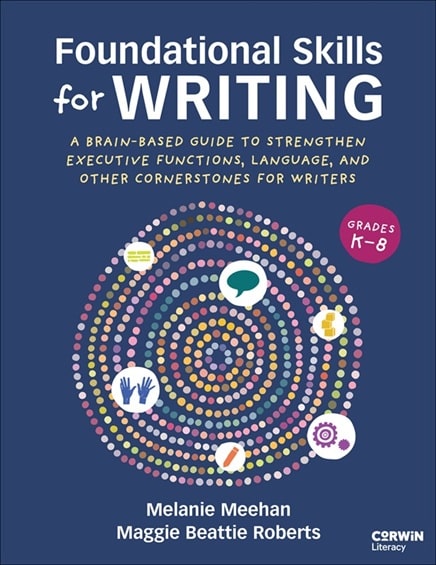
The landscape of educational discourse has long been dominated by the critical subject of literacy, particularly reading. While debates surrounding phonics, fluency, and reading comprehension frequently capture headlines and policy attention, a crucial component often remains conspicuously absent: writing instruction. Despite the undeniable symbiotic relationship between reading and writing, the latter receives disproportionately less focus in curriculum development, teacher training, and public conversation. This significant oversight is precisely what two prominent educators, Melanie Meehan and Maggie Roberts, aim to rectify with the release of their new book, Foundational Skills for Writing: A Brain-Based Guide to Strengthen Executive Functions, Language, and Other Cornerstones for Writers. Their work seeks to shift the paradigm, advocating for a holistic approach that acknowledges the intricate cognitive processes underpinning effective written communication.
The Unsung Pillar of Literacy: Addressing a Critical Educational Gap

For years, educational reformers and policymakers have grappled with persistent challenges in literacy, often framed through the lens of reading proficiency. The "reading wars," for instance, have seen decades of fervent debate over instructional methodologies, from whole language to phonics-first approaches, ultimately leading to a renewed emphasis on the "Science of Reading." This movement, grounded in cognitive science and empirical research, has undeniably brought valuable insights into how children learn to decode and comprehend text. However, as Meehan and Roberts highlight, this intense focus has inadvertently overshadowed the equally complex and critical domain of writing.
National assessments consistently reveal a concerning trend in students’ writing abilities. According to the National Assessment of Educational Progress (NAEP), often referred to as "The Nation’s Report Card," writing scores for students across various grade levels have shown little improvement, and in some instances, have declined over the past decade. The 2011 NAEP Writing Assessment, for example, indicated that only 27% of eighth and twelfth graders performed at or above the "proficient" level. More recent data continues to paint a stark picture, suggesting that a significant portion of students struggle with the fundamental skills required to compose clear, coherent, and compelling written pieces. Educators report feeling unprepared to teach writing effectively, often lacking comprehensive training or robust curriculum resources. This persistent struggle underscores a systemic issue: writing is not merely a byproduct of reading but a distinct cognitive function demanding explicit, systematic instruction.
A Brain-Based Blueprint for Proficient Writers
Meehan, a former curriculum coordinator who has since founded an in-person writing center, and Roberts, a literacy consultant with nearly two decades of experience supporting teachers in middle school classrooms, recognized this glaring omission. Their collaboration stems from a shared conviction that to truly cultivate proficient writers, educators must first understand the neurological demands of the writing process. Their book, Foundational Skills for Writing, delves into the intricate interplay of cognitive functions required for writing, breaking down the seemingly monolithic task into three core skill categories:
- Transcription Skills: These are the mechanical aspects of writing, including legible handwriting, efficient keyboarding, accurate spelling, and the development of both large and small motor skills necessary for forming letters and manipulating writing tools. The automatization of these skills is crucial, as it frees up cognitive resources for higher-level thinking.
- Oral Language: Often overlooked as a precursor to written expression, oral language encompasses speaking and listening abilities, including vocabulary development, sentence construction, and the ability to articulate thoughts coherently. A strong foundation in oral language directly translates to improved written output.
- Executive Functions: These are the higher-order cognitive processes that govern our ability to plan, focus, remember instructions, and juggle multiple tasks simultaneously. Key executive functions critical for writing include working memory (holding information in mind while processing it), cognitive flexibility (adapting to new information or changing strategies), and inhibitory control (filtering out distractions and resisting impulsive responses). When these functions are underdeveloped, the cognitive load of writing becomes overwhelming.
The authors assert that by explicitly addressing and developing these foundational skills, teachers can unlock students’ full writing potential, enabling them to move beyond mere transcription to engage in genuine ideation and sophisticated composition.
Introducing "Minute Moves": High-Impact Strategies for the Classroom

Central to Meehan and Roberts’ practical framework is their concept of "Minute Moves" – concise, flexible activities designed to be integrated seamlessly into the daily classroom routine. These short exercises, typically lasting only a couple of minutes, can serve as warm-ups, transition activities, or quick interventions, requiring minimal preparation but yielding significant cumulative benefits. The philosophy behind "Minute Moves" is rooted in the understanding that consistent, targeted practice of foundational skills helps students automatize these processes, thereby reducing cognitive load and reserving mental energy for the more complex demands of generating ideas, organizing thoughts, and crafting compelling narratives or arguments.
The book offers a comprehensive collection of these strategies, eight of which were recently highlighted during an interview. These "Minute Moves" are categorized by the foundational skill they target, providing teachers with a clear roadmap for intentional skill development.
Spelling Minute Moves: Cultivating Orthographic Awareness

Spelling is often perceived as a rote memorization task, yet Meehan and Roberts emphasize its profound connection to linguistic understanding and cognitive processing. Their spelling "Minute Moves" are designed to foster curiosity about words and build robust neurological pathways for orthographic retrieval.
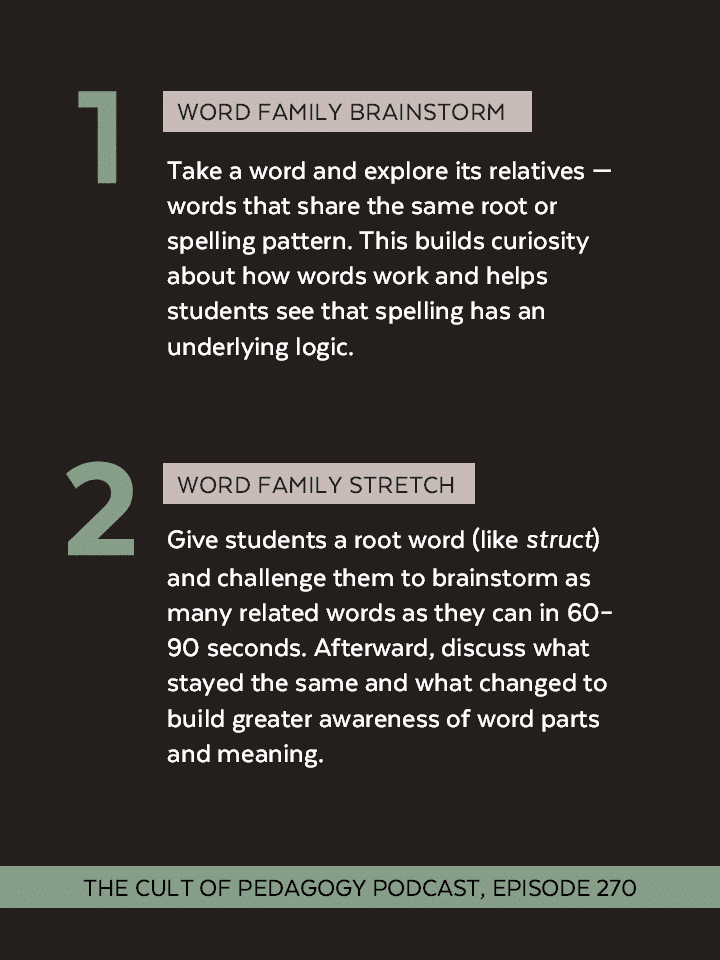
- Word Family Brainstorm: Inspired by spelling researcher Rebecca Treiman, this activity encourages students to explore the etymological and morphological connections between words. Instead of treating homophones like two, to, and too in isolation, students might investigate the "tw-" pattern in two, connecting it to words like twin, twine, and twenty, revealing a shared semantic root related to duality. Similarly, struggling with decision can lead to an exploration of its Latin root "caedere" (to cut) by linking it to decide, incision, concise, and even scissors. This approach transforms spelling from a memory drill into an exciting linguistic detective game.
- Word Family Stretch: This variation builds on the brainstorm concept. Given a root word like struct (meaning "to build"), students are challenged to rapidly generate as many related words as possible within a 60-90 second timer. Words like structure, destruction, construct, structural, instruct, and instruction emerge. The subsequent debrief focuses on analyzing how prefixes and suffixes alter meaning and how consistent patterns reinforce spelling. The distinction between "bound roots" (like struct, which cannot stand alone) and "free roots (like form*, which can) further deepens students’ morphological awareness.
- Prefix Swap: Directly targeting morphology, this activity focuses on the impact of prefixes on a base word’s meaning and spelling. Students take a word like form and experiment with prefixes to create reform, transform, inform, and deform. This not only reinforces spelling patterns but also expands vocabulary and enhances comprehension, particularly benefiting multilingual learners who may recognize prefixes from their native languages, such as bene- and mal- in benevolent and malevolent. These exercises collectively strengthen the neural networks responsible for word recognition and retrieval.
Sentence Construction Minute Moves: Building Syntactic Fluency
Moving beyond individual words, the book provides strategies to help students master the art of sentence construction, a crucial step in developing coherent written expression. These activities are designed to build an "internalized understanding of sentence patterns."
- Sentence Scramble: This tactile activity involves breaking a sentence into its component words or phrases, written on index cards. Students then physically rearrange them to reconstruct the original sentence. The post-activity discussion is vital, prompting students to articulate their reasoning: What clues guided their order? Which word groupings were inviolable? Variations include removing punctuation, adding distractor words, or challenging students to expand the sentence. This concrete manipulation helps students grasp grammatical structures intuitively.
- Sentence Expander: Starting with a simple "kernel sentence" (e.g., The cat purrs), students collaboratively expand it by answering a series of "wh-" questions: Which cat? What color? Where? When? Why? Meehan advocates using accessible terms like "doer" and "doing" instead of "subject" and "predicate" to make grammar less abstract. The process culminates in a rich sentence (e.g., The orange cat is sleeping on the couch in the afternoon because he is tired), which students then experiment with rearranging to create stylistic variations, fostering an understanding of how to craft more complex and descriptive sentences.
- Sentence Combining: Hailed by Roberts as a "high-impact, quick way" to elevate sentence complexity, this activity presents students with two or three short, simple sentences and challenges them to merge them into one more sophisticated sentence. For instance, My cat is orange. My cat is big. becomes My big orange cat…. Scaffolding can involve underlining key words to be "harvested." As students progress, they learn to employ various conjunctions (because, and, but) to alter meaning and create nuanced connections between ideas. This practice directly translates into students’ independent writing, enabling them to move beyond choppy prose.
Executive Functioning Minute Moves: Enhancing Cognitive Agility for Writing
The final category of "Minute Moves" directly addresses the executive functions that underpin effective writing, particularly cognitive flexibility—the ability to adapt, shift perspectives, and revise thinking.
- What’s Another Way?: This activity directly targets cognitive flexibility at the sentence level. Students are given a sentence and tasked with rewriting it in multiple ways: starting with a different clause, substituting a noun with a pronoun, or intentionally shortening it for impact. Meehan stresses that effective writing isn’t solely about complexity; it’s about intentional variation. Providing students with the metacognitive language to describe this skill as "cognitive flexibility" can be profoundly empowering, especially for those who have previously struggled, validating their efforts as sophisticated cognitive work.
- New Angle: Zooming out to the narrative level, this "Minute Move" asks students to retell a familiar scene or story from a different character’s perspective. Whether it’s a passage from a class text, a shared experience, or a short film, adopting an alternative viewpoint demands holding multiple perspectives simultaneously, making deliberate choices about voice, selecting pertinent details, and interpreting events anew. Roberts vividly recalls a high school food fight and how retelling it from the perspective of the applesauce-drenched teacher completely transforms the narrative. Meehan often uses short animated films, like Pixar’s "Snack Attack," which depicts the same event from two distinct points of view, to facilitate this exercise. This practice not only enhances writing skills but also cultivates empathy, critical thinking, and the ability to understand diverse viewpoints – skills essential for civic engagement and personal growth.
Broader Implications for Educational Practice and Future Outlook
The work of Melanie Meehan and Maggie Roberts arrives at a crucial juncture in educational discourse. As schools continue to grapple with post-pandemic learning gaps and the evolving demands of a communication-driven world, the need for robust writing instruction has never been more pressing. Their "brain-based" guide and "Minute Moves" offer a practical, research-informed pathway for teachers to integrate explicit writing instruction without overhauling existing curricula or demanding excessive time commitments.
The implications of this approach are far-reaching. By demystifying the cognitive components of writing and providing actionable strategies, Foundational Skills for Writing empowers teachers to address the root causes of writing difficulties, rather than simply correcting surface-level errors. It advocates for a paradigm shift where writing is viewed not as a secondary skill, but as an integral, co-equal partner to reading in the development of comprehensive literacy. This integrated understanding can lead to more balanced literacy programs, improved teacher efficacy, and ultimately, a generation of students who are not only proficient readers but also confident, articulate, and flexible writers—equipped to navigate the complexities of academic, professional, and personal communication. The ongoing advocacy for writing instruction, informed by cognitive science and championed by educators like Meehan and Roberts, promises to elevate this essential skill to its rightful place at the heart of effective education.