



The widespread adoption of Artificial Intelligence (AI) across large organizations has reached a critical juncture. While many companies have diligently completed the foundational steps—deploying enterprise AI tools, establishing governance frameworks, addressing legal and compliance concerns, and even announcing initiatives with optional training—a significant disconnect persists. This gap is not in access to technology, but in the readiness of the workforce to effectively and consistently leverage these powerful tools, a challenge that learning leaders are now confronting head-on.
The Promise vs. The Reality of Enterprise AI
The narrative surrounding AI has been dominated by its transformative potential, often quantified as a "10x or even 100x" improvement in productivity, creativity, and speed. However, the reality within many organizations paints a more nuanced picture. The initial wave of AI adoption has seen a select group of early adopters experimenting, integrating, and innovating at a rapid pace. These pioneers are demonstrating the tangible benefits of AI, pushing the boundaries of what’s possible. Yet, this progress is not mirrored across the broader workforce.
A substantial segment of employees remains hesitant, uncertain about how AI integrates into their specific roles, when its application is appropriate, or how to wield it responsibly in real-world scenarios. This results in uneven usage, a wide spectrum of confidence levels, and a palpable hesitation from the organizational "middle." The promised enterprise-wide transformation, fueled by AI, has yet to materialize at scale, revealing that the primary obstacle is no longer technological access but human capability and confidence.
Documenting the Widening Readiness Gap
This emerging pattern is no longer anecdotal; it is increasingly validated by industry research. A significant divergence is becoming evident between the rate of AI adoption and the realization of its full impact.
McKinsey’s 2025 "State of AI" report underscores this trend, revealing that while a staggering 88 percent of organizations now utilize AI in at least one business function, a considerably smaller fraction has translated this widespread adoption into meaningful improvements in enterprise performance. This suggests that the mere presence of AI tools does not automatically translate into enhanced business outcomes.
Further solidifying this observation, the Forbes Technology Council recently highlighted that most organizations report less than 5 percent of their earnings are currently attributable to AI. This statistic starkly illustrates the persistent difficulty in moving beyond initial experimentation to achieve measurable business impact. The challenge lies in operationalizing AI in a way that demonstrably contributes to the bottom line.
Workforce data corroborates these findings. A comprehensive 2026 Gallup workforce survey, encompassing over 22,000 employees, found that only about 12 percent of workers report using AI daily in their jobs, despite the widespread deployment of AI tools across enterprises. This data suggests a critical lag: organizations are rapidly providing access to AI technologies, but the majority of employees are still in the nascent stages of learning how to effectively integrate these tools into their daily workflows. The core issue has shifted from providing access to the technology to cultivating the necessary confidence, capability, and judgment required for its effective and responsible application in actual work. In essence, organizations possess the tools, but they lack a scalable and reliable method to empower their people to perform exceptionally with those tools, consistently, responsibly, and at scale.
Defining Workforce Readiness in the AI Era
Workforce readiness, in the context of AI, is not an abstract concept. It manifests as demonstrated competence and unwavering confidence in performing real work. This goes beyond mere inferred competence based on course completion or assumed confidence derived solely from survey responses. True readiness is observable, honed through consistent preparation, decisive action, iterative feedback, critical reflection, and continuous improvement over time.
Historically, learning organizations have relied on indirect indicators to gauge readiness. Metrics such as course completion rates, certifications, employee tenure, or test scores served as proxies for an individual’s preparedness. However, the advent of AI, when applied intentionally, transforms this paradigm. Readiness becomes not only observable but also longitudinal and scalable, offering a more accurate and actionable understanding of employee capabilities.
This shift holds profound implications for both individuals and their employers. For employees, enhanced readiness translates into more rewarding work characterized by less guesswork, greater confidence, and increased fluency in navigating complex challenges. For organizations, a ready workforce signifies improved performance, sounder judgment in uncertain environments, and mitigated risks as new capabilities are integrated. This dual value proposition—personal growth and organizational advantage—is the defining characteristic of workforce readiness in an AI-enabled future.
The Overlooked Shift: From Transactional Use to Collaborative Iteration
A significant factor contributing to the lag in AI readiness is the prevailing "one-step" mental model of AI usage. This approach, mirroring traditional search engine behavior, involves posing a question, receiving an answer, and moving on. While efficient and appealing for its transactional nature, it fundamentally limits the potential of AI.
True collaboration with AI, however, necessitates a multi-step, iterative approach. This involves phases of planning, drafting, testing, refining, and revisiting decisions. In this iterative process, judgment becomes paramount, and learning extends beyond the initial preparation to encompass the entire action cycle. This distinction is crucial because reflection and strategic pivoting are only possible within multi-step workflows.
When AI is framed solely as a tool to "find me the answer," employees are less likely to pause and reflect on the outcomes or adjust their approach. However, when AI is conceptualized as a collaborative partner, a natural and powerful feedback loop emerges:
- Plan: Define the objective and how AI can assist.
- Do: Utilize AI to execute tasks, generate content, or analyze data.
- Reflect: Evaluate the AI’s output, assess its effectiveness, and identify areas for improvement or refinement.
- Pivot: Adjust the approach based on reflections, iterating with AI to achieve better results.
This "Plan-Do-Reflect" loop, and the pivot it enables, represents the fundamental human mechanism that transforms mere access to AI into tangible performance gains. Without this iterative process, AI remains a sophisticated tool employed in superficial ways. With it, AI becomes a potent catalyst for continuous learning and improvement in real-world work.
The Practice-Perform-Learn Framework: A Foundation for AI Readiness
At the core of a robust AI readiness strategy lies the Practice-Perform-Learn framework. This established learning architecture, which has demonstrated success in enterprise settings for years, predates the widespread adoption of generative AI. It emphasizes a structured approach to skill development:
- Learn: Acquiring foundational knowledge and understanding.
- Practice: Applying learned concepts in simulated or controlled environments.
- Perform: Executing tasks and responsibilities in real-world work scenarios.
- Reflect: Analyzing performance, identifying strengths and weaknesses, and planning for future improvement.
AI does not replace this framework; rather, it acts as a powerful accelerator. AI can enable repeatable practice, deliver personalized feedback, and guide reflection without the constant intervention of instructors or managers. The efficacy of this framework has been recognized through prestigious awards, including Gold and Silver Brandon Hall Awards for HCM innovation, simulations for learning, and advancements in business strategy and technology. These accolades are contingent upon demonstrated performance improvement, not just compelling design.
Case Study: Operationalizing Readiness in a Regulated Enterprise
To illustrate the practical application of these principles, consider a case study involving a global, highly regulated enterprise with thousands of employees and established access to enterprise AI tools.
Context: The organization had invested significantly in AI tools, making them readily available to its workforce.
Challenge: Despite this access, employee confidence and competence in utilizing AI were uneven. While a vanguard of early adopters was making rapid progress, a substantial portion of the workforce remained hesitant, hindering enterprise-wide impact and slowing the momentum towards meaningful AI adoption.
Approach: Instead of launching another tool-centric initiative, the organization opted for a more human-centered approach. They introduced a dedicated, AI-powered environment designed to facilitate learning, practice, and performance. This environment specifically focused on enabling employees to explore the application of their existing AI tools within their actual workflows.
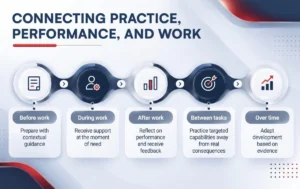
This initiative operationalized the Learn-Practice-Perform framework. Employees engaged in structured learning modules, practiced realistic scenarios tailored to their roles, and prepared for or reviewed real work moments. Crucially, throughout this experience, they received personalized feedback and guided reflection—an approach termed "reflective intelligence."
Measures of Success: The organization tracked changes in confidence distribution over time, the depth of engagement in practice activities, and the emergence of reflective insights derived from real work.
Tangible Outcomes: Accelerating Confidence and Judgment
The implementation of this readiness-focused approach yielded rapid and sustained positive outcomes.
Accelerated Confidence: Within 60 days, the organization observed a fourfold increase in the number of employees self-identifying within the high-confidence group. Importantly, this surge in confidence was not a fleeting trend; it remained elevated beyond the initial pilot period, indicating a lasting impact.
Bridging the Middle: Concurrently, there was a twofold decrease in the number of participants reporting low confidence. This demonstrates progress not only at the upper echelon of confidence but, critically, across the broader workforce – the segment that determines whether readiness ultimately scales or stalls.
Improved Judgment and Restraint: Employees also exhibited enhanced judgment in their AI usage. They developed a clearer understanding of when AI provided genuine value, how to employ it responsibly, and, perhaps most importantly, when to refrain from relying on it entirely. In highly regulated and high-stakes environments, this discernment and restraint are powerful indicators of true readiness.
Reflective Intelligence: A Dual Value Proposition
Reflection was not an ancillary component of this strategy; it was the central engine driving improvement.
For Employees: Guided reflection fostered deeper insights, leading to increased accuracy, greater fluency, and a more direct path toward mastery. Individuals began to understand not just that a particular approach was effective, but why it worked, empowering them to adapt more effectively over time.
For the Organization: The reflective input generated actionable intelligence for leadership. Visibility was gained into workflow dynamics, persistent friction points, and emerging opportunities for process innovation. In some instances, these insights revealed that perceived skills gaps were, in fact, rooted in workflow inefficiencies or cultural challenges.
This dual value—personal growth for employees and strategic organizational insight—is what distinguishes reflective intelligence from traditional feedback mechanisms. It transforms passive learning activities into an active mechanism for continuous adaptation and strategic refinement.
Why Traditional Playbooks Fall Short in the AI Age
Traditional technology adoption playbooks often prioritize access, utilization, and scalability. While these elements remain important, AI demands a more nuanced approach. The true value of AI is unlocked through sound judgment, not merely through increased usage. This judgment cannot be mandated or inferred from superficial metrics; it must be cultivated through experience—a continuous cycle of learning, practice, reflection, and strategic pivoting.
Maximizing AI utilization does not inherently guarantee workforce readiness. Broad exposure to AI tools does not automatically translate into confidence or competence. Scaling AI without fundamentally redesigning how individuals learn and adapt risks amplifying noise and inefficiency rather than enhancing true capability. Organizations that are witnessing genuine progress are not abandoning their existing playbooks entirely but are actively evolving them to meet the unique demands of the AI era.
Rethinking Pilots: From Proof of Concept to Discovery of Best Fit
In this evolving landscape, the purpose of pilot programs is undergoing a transformation. Instead of merely proving that a solution "works," effective pilots are now designed to discover "best fit." This involves understanding how learning and practice integrate seamlessly with existing organizational culture, workflows, and workforce capabilities. Leaders are approaching these pilots with courageous curiosity, embracing a spirit of collaborative learning alongside their teams.
Many organizations are beginning by leveraging the AI tools they already possess, employing text-based scenario practice to build initial momentum. As confidence grows, they then expand into richer, multimodal AI experiences. The pilot itself is not the ultimate objective; the invaluable insights gleaned from it are the true measure of success.
The Accelerating Pace of AI: Near-Term Urgency and Future Trajectory
The urgency surrounding AI readiness is amplified by the relentless pace of technological advancement. While many organizations are still grappling with building readiness for text-based AI, multimodal AI—encompassing video, avatars, voice, and sophisticated simulations—is already arriving at enterprise scale, often without the fanfare of a traditional rollout. These advanced capabilities simply become available, demanding immediate adaptation.
If mindsets and workflows have not evolved in tandem with these technological leaps, employees will inevitably continue to apply outdated approaches to new tools. This perpetuates the readiness gap, causing it to reappear with each new wave of AI innovation.
Redefining "10x": From Usage to Demonstrated Competence
The promise of AI is frequently articulated as a "10x or 100x" improvement. For learning leaders, clarity in defining these metrics is paramount. In terms of workforce readiness, a "10x improvement" does not signify a tenfold increase in AI usage. Instead, it represents a tenfold increase in the number of individuals who can demonstrably exhibit competence and confidence in AI-enabled workflows. This is the pathway to moving the organizational "middle," enabling readiness to scale effectively, and transforming the promise of AI into tangible, proof-backed performance.
The Leadership Opportunity in AI Readiness
Organizations do not need to predict every future AI capability with perfect accuracy. Instead, they require robust systems that empower individuals to explore with curiosity, practice in safe environments, reflect deeply, and adapt continuously. This approach begins with leveraging existing tools and expands organically as new capabilities emerge.
For Chief Learning Officers (CLOs) and other learning leaders, this presents a pivotal moment to lead from the forefront of change. The opportunity lies in designing workforce readiness strategies that not only keep pace with accelerating technology but also make work more rewarding for employees and more valuable for the organization. This is how AI will transition from a promise of transformation to demonstrated readiness, and ultimately, from aspirational potential to undeniable performance.