


We tried abstinence. It is not working. The contemporary landscape of talent development—spanning from the ivory towers of elite graduate schools to the high-stakes boardrooms of Fortune 500 companies—is currently defined by a profound misalignment in how artificial intelligence is integrated into the workflow of human cognition. In academia, administrators have largely turned to prohibition, deploying AI detection software and stringent academic integrity policies to wall off the classroom from Large Language Models (LLMs). Conversely, corporate leaders have leaned into aggressive, often unsequenced adoption, prioritizing fluency training and rapid deployment to maintain competitive parity. Both approaches share a fundamental, systemic flaw: they treat AI as a binary choice—to ban or to embrace—rather than a design challenge centered on the preservation of human cognitive function.
The stakes of this impasse are no longer merely academic or operational; they are neurological. Recent data from the MIT Media Lab, specifically the study titled Your Brain on ChatGPT: Accumulation of Cognitive Debt when Using an AI Assistant for Essay Writing Task, has provided empirical weight to the concerns held by cognitive scientists. By tracking the EEG activity of 54 university students, researchers led by Nataliya Kosmyna observed that reliance on LLMs during knowledge-based tasks leads to a demonstrable reduction in neural connectivity within regions responsible for critical thinking and memory. This state, termed cognitive debt, suggests that habitual outsourcing of thought to AI creates an underengagement pattern that persists even when the technology is removed.
A Chronology of the AI Integration Crisis
The trajectory of this crisis began in late 2022, following the public release of ChatGPT. Almost immediately, the academic sector reacted with a defensive posture. By early 2023, major universities across the United States updated their syllabi to include "zero-tolerance" clauses for AI-generated text. This period was marked by the proliferation of AI detection tools, many of which were later found to have high rates of false positives, fueling an environment of distrust between faculty and students.
In the corporate sector, the timeline was marked by a scramble for productivity gains. Throughout 2023 and 2024, chief learning officers (CLOs) pushed for "AI-first" internal cultures. Organizations deployed wide-reaching, often ungoverned AI access, focusing on volume of usage—measured by adoption dashboards—rather than the quality of the cognitive output.
By 2025, the disparity between these two responses began to converge into a single, shared failure. Both sectors realized that prohibition in universities simply drove AI usage into the shadows, while indiscriminate corporate adoption led to "shadow AI"—where sensitive, proprietary data began leaking into consumer-grade, non-secure LLM platforms.

The Neuroscience of Cognitive Debt
The MIT Media Lab study serves as a critical junction for learning leaders. The research participants were divided into three cohorts: those utilizing ChatGPT, those using standard search engines, and those relying solely on their own cognitive faculties. The findings were stark. The group utilizing AI displayed the weakest neural engagement. Most alarming was the "carry-over" effect: when students were asked to complete tasks without AI after a period of heavy reliance, their brains failed to return to baseline levels of activation.
This neurological underengagement mirrors the behavioral findings of the study. Participants in the AI-assisted cohort reported significantly lower "ownership" of their work. They struggled to articulate the reasoning behind their own essays and, in many cases, could not accurately cite or defend the content they had submitted. This indicates that AI, when introduced prematurely into the cognitive process, does not merely accelerate work; it bypasses the neural scaffolding necessary for deep learning and knowledge retention.
The Abstinence Error and the Myth of Protection
The reliance on prohibition in academic and corporate spheres draws a direct, if unintended, parallel to the abstinence-only models of public health. Much like abstinence-only education, the prohibition of AI does not stop the utilization of the technology; it merely removes the structure, oversight, and ethical guidance that would allow users to engage with it productively.
In the corporate environment, the risk is amplified by security concerns. When organizations block access to sanctioned AI tools, employees inevitably gravitate toward personal, unauthorized accounts to handle their workloads. This creates a "shadow IT" environment where confidential corporate strategies, financial projections, and HR data are processed by third-party models without enterprise-grade security, data retention, or audit trails. Prohibition is not a security measure; it is a catalyst for data leakage.
The Bot Check Method: A Framework for Agency
To resolve this, educators and business leaders must pivot toward a "third frame": agency. The Bot Check Method, a structured pedagogical and operational sequence, provides a scalable solution to the current dysfunction. It is built upon the Community of Inquiry (CoI) framework, which identifies four stages of cognitive presence: triggering, exploration, integration, and resolution.
The Bot Check Method mandates a four-phase sequence:
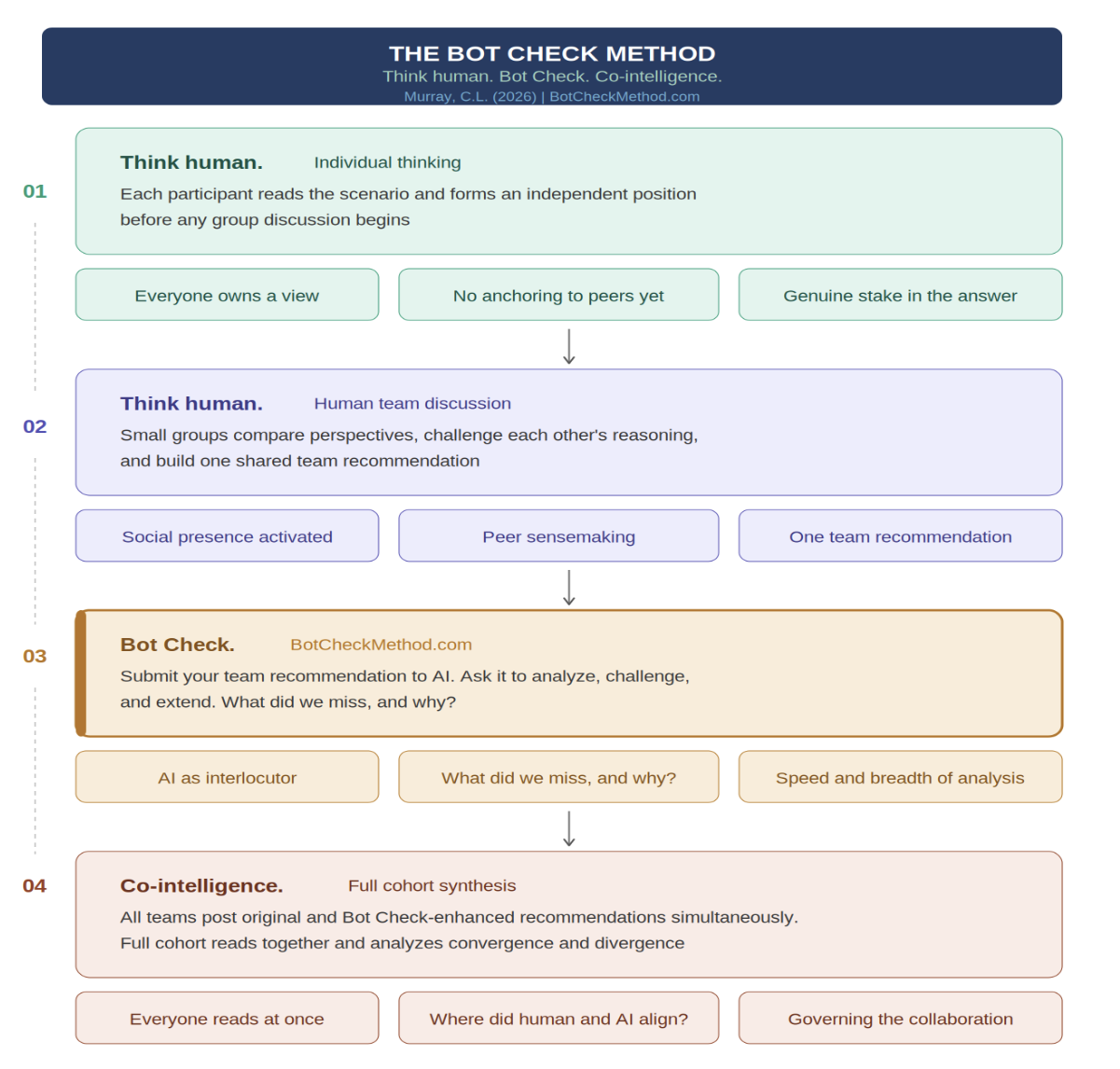
- Think Human: Before any interaction with an LLM, the individual must independently analyze the problem. This establishes the "triggering" event and ensures that the learner develops a baseline cognitive stake in the outcome.
- Think Human Together: Participants collaborate in small groups. This social presence is vital; it forces the articulation of ideas, the testing of hypotheses, and the development of interpersonal consensus.
- Bot Check: Only after the human team has reached a defensible conclusion is the AI introduced. The AI acts as an interlocutor—not an authority. It is tasked with identifying gaps, challenging assumptions, and offering alternative perspectives.
- Co-Intelligence: The final phase involves the synthesis of human insights and AI critique. The team compares their original logic against the AI’s feedback, leading to a refined, high-ownership result that neither the human nor the machine could have produced in isolation.
Scaling Through the SHINE Framework
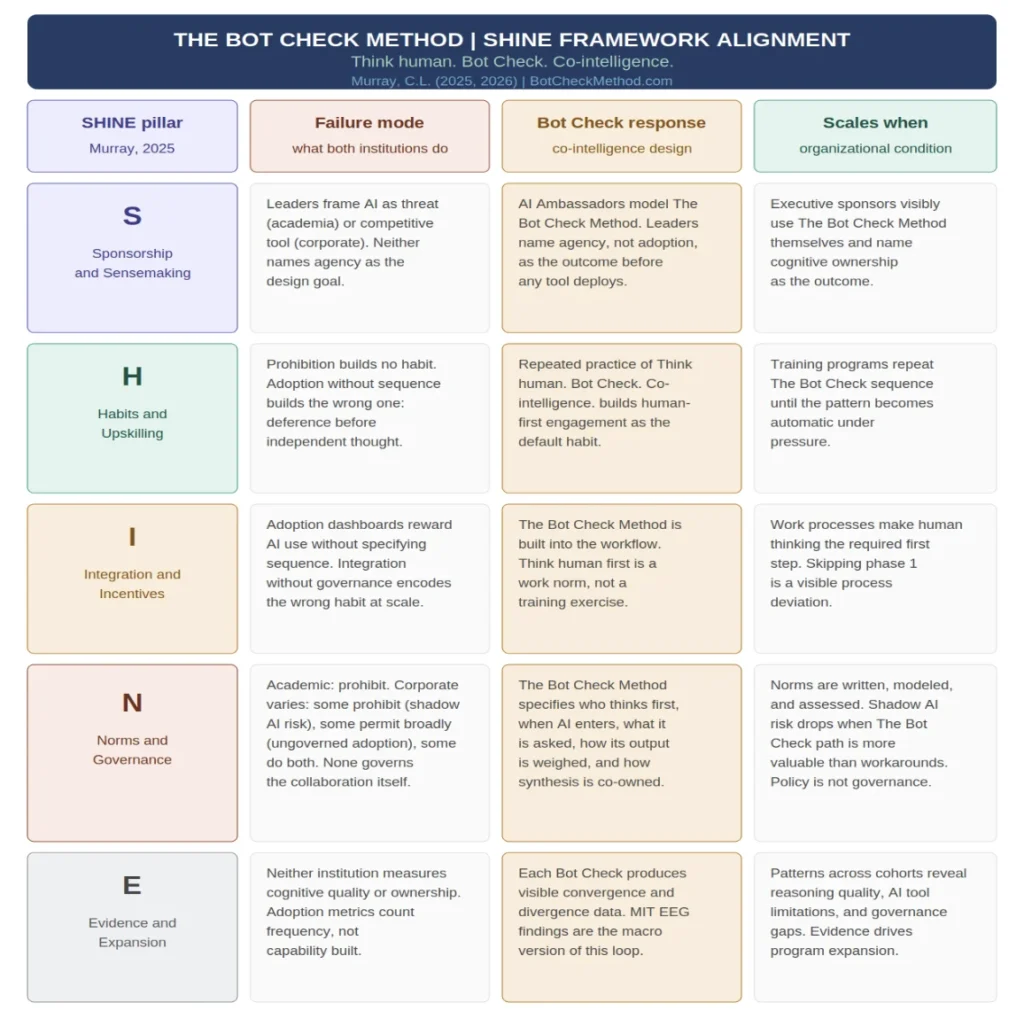
For large-scale adoption, the Bot Check Method integrates with the SHINE (Sponsorship, Habits, Integration, Norms, Evidence) framework. This structural approach ensures that AI is treated as a component of the organizational "operating system" rather than a standalone tool.
- Sponsorship: Leaders must act as AI ambassadors, modeling the "think human" process rather than merely mandating usage quotas.
- Habits: Upskilling must focus on the behavioral pattern of the sequence. Mastery is defined not by the ability to prompt an LLM, but by the ability to know when to delay the prompt.
- Integration: The workflow must prioritize the human element. For example, internal policy should mandate that documentation is drafted before an AI tool is consulted for synthesis or review.
- Governance: Governance should be redefined as the architecture of collaboration. It involves setting the rules of engagement—how humans and AI think together—rather than simply setting rules for usage.
- Evidence: Organizations must treat each AI-assisted project as a data point. By analyzing where AI and human reasoning diverge, companies can create feedback loops that continuously improve the efficacy of their teams.
Implications for the Future of Work and Education
The shift from abstinence to agency represents a fundamental change in the design of learning environments. It moves the conversation away from the false choice between total prohibition and unbridled automation. The evidence from the MIT Media Lab is clear: human cognitive architecture is not designed to outsource the triggering and exploration phases of thinking. When these phases are ceded to machines, the brain undergoes a process of atrophy that limits future independent judgment.
The implications for professional development are profound. If corporations and universities continue to ignore the necessity of sequencing, they risk cultivating a workforce that is technically proficient at managing software but fundamentally incapable of original analysis. The "cognitive debt" incurred today will manifest as a skill deficit tomorrow.
Ultimately, the Bot Check Method offers a path forward that preserves the uniquely human capacity for critical thought while leveraging the computational power of modern AI. It requires a departure from the reactive policies that currently dominate the landscape and a commitment to a new standard of design. Whether in a graduate seminar or an executive strategy session, the mandate remains the same: the human must come first, the AI must come second, and the resulting co-intelligence must be earned through the deliberate, sequenced application of both. The technology is not the problem; the design is. And until leaders recognize the importance of the sequence, the cognitive debt will continue to compound.