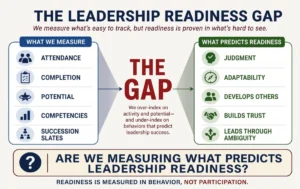




For decades, the standard curriculum for leadership development has operated on a foundational promise: equip an aspiring executive with a balanced toolkit of financial fluency, operational discipline, strategic framework design, and robust communication skills, and they will be inherently prepared to command. This pedagogical model assumes that the organizational environment is a stable landscape where variables are predictable and strategic plans can be executed with linear precision. However, this foundational promise has effectively expired.
The global operating environment is no longer merely uncertain; it has become profoundly unstable. The bedrock assumptions that once allowed for long-term planning—democratic continuity, the global rule of law, climate stability, reliable institutional trust, and the projection of Western soft power—are no longer fixed features of the landscape. Leaders today find themselves navigating an era characterized by systemic volatility that renders traditional, present-tense management practices increasingly obsolete.
A Global Climate of Declining Stability
The structural integrity of the global order is currently facing a period of intense pressure. According to the Freedom House report for 2025, global freedom has suffered a decline for the 20th consecutive year, marking a two-decade erosion of the norms that facilitate international business and cooperation. This is corroborated by the V-Dem Institute’s 2026 Democracy Report, which notes a widening gap between the rise of autocracies and the contraction of democratic influence. Furthermore, the International IDEA 2025 Global State of Democracy report highlights that the rule of law is now the weakest-performing category among democratic institutions, creating a "legal gray zone" for multinational corporations and global organizations.
These metrics are not mere geopolitical commentary; they represent the raw data that must inform modern strategic decision-making. When a company’s operational success depends on the protection of minority rights, the predictability of regulatory bodies, or the integrity of supply chains, the degradation of these institutional pillars poses an existential risk. Leaders who continue to rely on the assumption that the "background conditions" of the 20th century will persist are essentially operating without a map.
The Erosion of Durable Assumptions
Traditionally, scenario planning was treated as an elective exercise, often sequestered in the backrooms of corporate planning departments or relegated to annual offsite workshops. This approach is no longer viable. In a world where supply chains have become geopolitical instruments and public health systems are subject to sudden, overwhelming stress, scenario planning must be elevated to a core leadership competency.
The historical reliance on durable drivers—demographics, infrastructure cycles, and technological diffusion—is being challenged by the fragility of what was once considered social infrastructure. For instance, the World Meteorological Organization (WMO) confirmed that the decade between 2015 and 2025 was the hottest on record. This environmental shift is not just a climate issue; it is a fundamental disruption to labor availability, logistics, insurance risk modeling, and food systems.
Similarly, the concept of "soft power" is undergoing a recalibration. Pew Research Center’s 2025 data indicates that global perceptions of the United States have deteriorated while opinions of China have improved in several key jurisdictions. For a global enterprise, this shift is an operational reality. Market access, the flow of specialized talent, procurement protocols, and data localization requirements are all subject to the fluctuations of geopolitical perception. When the "social license to operate" can vanish faster than a quarterly planning cycle, the ability to anticipate alternative futures is the only hedge against sudden disruption.
AI and the Paradox of Foresight
The advent of generative AI has created a double-edged sword for strategic planning. On one hand, AI tools provide unprecedented capabilities to scan massive datasets, map stakeholder relationships, and generate dozens of plausible future vignettes in minutes. On the other hand, this ease of production risks flooding boardrooms with sophisticated but strategically useless narratives.
The primary goal of scenario planning is not to increase the volume of potential futures, but to challenge the current conviction of leadership teams. AI can produce a compelling description of a future, but it cannot exercise the judgment required to interpret that future. If leadership programs teach the use of AI without the discipline of curation and interrogation, they risk producing "elegant distractions"—rich descriptions of imaginary worlds that offer no guidance on where to invest, what to protect, or how to redesign operational models.
The danger lies in the "dystopia trap." When leaders view the future solely through a lens of apocalyptic collapse—cyber warfare, climate catastrophe, or institutional failure—they inadvertently foster a sense of helplessness. Conversely, utopian thinking leads to an over-reliance on technology as a panacea. The task for modern leaders is to master the art of narrative construction that balances these extremes, tracing the pathways from the present to a potential "becoming."
Transforming Scenarios into Strategic Action
For scenario planning to be effective, it must move beyond being an "artifact" of planning and become a "practice" of collective sensemaking. The most significant deliverable of a scenario exercise is not the document itself, but the strategic conversation it forces among executive teams.
This practice requires a structured methodology that includes:
- Stress-testing current assumptions: Identifying which strategies rely on conditions that are currently in decline.
- Identifying second-order effects: Mapping how a shift in one area (e.g., climate policy) cascades into another (e.g., labor migration or insurance availability).
- Moral and ethical mapping: Analyzing who gains power and who loses protection within a given scenario.
- Resilience auditing: Testing which commitments remain robust across multiple, disparate futures.
This process must be collaborative. By bringing together diverse perspectives, organizations can use "distributed intelligence" to identify latent needs and constraints that a homogeneous leadership team might miss. This social function of foresight is critical; it builds a shared language for uncertainty, which helps to mitigate the knee-jerk panic that often follows an unexpected market shift.
The Requirement for Strategic Literacy
Leadership programs must evolve to prioritize "scenario literacy" as a baseline capability. This does not mean transforming every manager into a professional futurist. It does mean ensuring that leaders are capable of:
- Curating signals: Distinguishing between transient noise and structural trends.
- Challenging the "Official Future": Having the institutional courage to question why a strategy is deemed "safe."
- Translating narratives to mechanics: Moving from abstract scenario descriptions to concrete operational changes.
- Governing uncertainty: Creating organizational structures that can pivot without losing their core purpose.
The distinction between "aspiration" and "mechanics" is paramount. Aspiration without the mechanics of scenario planning is merely branding; mechanics without the aspiration to imagine a better future is merely administration. True leadership requires the synthesis of both.
The Cost of Present-Tense Management
Organizations are rarely destroyed by the uncertainty of the future; they are destroyed by leaders who manage as if uncertainty were an inconvenience rather than a fundamental condition of reality. A leader who has never practiced scenario planning is prone to "optimism bias," where strategy is overfitted to recent, favorable experiences. When surprise occurs—as it inevitably will—these leaders are likely to respond with paralysis, blame, or the "theatrical decisiveness" that often characterizes a failing institution.
In the final analysis, scenario planning does not provide a crystal ball, nor does it eliminate risk. Instead, it provides multiple maps, a disciplined imagination, and a vocabulary for strategic dialogue. It allows leaders to move with enough clarity to make decisions in the face of the unknown. As the global environment continues to shift, the ability to look past the current horizon will separate organizations that endure from those that merely wait for the next disruption. Any leadership development curriculum that fails to emphasize this capability is essentially training leaders to execute the strategies of a world that no longer exists.