



The modern corporate landscape has undergone a seismic shift in how organizations track employee development. For decades, learning management systems functioned as passive repositories for completion certificates and compliance records. Today, these platforms have evolved into high-fidelity behavioral engines. Equipped with artificial intelligence, modern learning ecosystems now ingest granular telemetry—search queries, hesitation patterns, assessment retry rates, and even the nuances of natural language interactions with AI tutors. While this visibility promises unprecedented personalization in career development, it has sparked a growing debate among human resources executives, data privacy advocates, and legal experts regarding the boundary between supportive coaching and automated performance judgment.
The Technological Evolution of Employee Monitoring
The current state of learning analytics is the result of a rapid technological convergence that began in earnest around 2018. As companies moved their HR infrastructure to the cloud, the integration of Learning Experience Platforms (LXPs) with broader Talent Management Systems (TMS) became a standard operational goal. Initially, the objective was to break down departmental silos. By 2021, the widespread adoption of remote and hybrid work models accelerated this trend, as companies sought digital proxies for the informal feedback and mentorship that previously occurred in physical office environments.
According to a 2023 report by the Association for Talent Development (ATD), over 65% of large enterprises now utilize AI-driven analytics to identify skill gaps. However, the sophistication of these tools has outpaced internal governance frameworks. What began as a tool to recommend a leadership course is now frequently repurposed to feed "skills inference" engines. These engines, often operating as "black boxes," assign proficiency scores based on engagement metrics, which are then synced—frequently by default—into broader HR databases that inform succession planning and promotion cycles.
Chronology of Data Integration
The trajectory of this integration can be viewed in three distinct phases:
- The Repository Era (Pre-2015): Learning data was static. It focused on "check-the-box" compliance, such as workplace safety or regulatory training. Data was siloed, and its primary purpose was legal documentation.
- The Personalization Era (2015–2020): Platforms introduced recommendation algorithms. Learning data was used to suggest relevant content based on user history. The focus shifted from compliance to individual growth.
- The Predictive Era (2020–Present): AI systems began inferring competency and intent. Learning data is now routinely pushed to talent marketplaces and performance management software, creating a persistent, often permanent, digital footprint of an employee’s learning journey.
The Dilemma of the "Unfinished" Employee
A central tension exists between the organizational desire for data-driven insights and the human necessity for trial and error. Psychologists have long established that learning is a non-linear process characterized by frustration, curiosity, and failure. When AI systems track these moments—such as an employee struggling with an assessment or browsing content outside their current job description—they often lack the context to interpret these actions correctly.
An employee who abandons a course may be overextended, not uninterested. An employee who fails a test three times might demonstrate a higher level of grit and eventual mastery than a peer who passed on the first attempt. Yet, when these "struggles" are converted into quantitative data points, they risk being misinterpreted as evidence of low aptitude or lack of commitment. This creates a "chilling effect," where employees, fearing that their digital breadcrumbs will be held against them, cease to engage authentically with learning resources. They may avoid asking difficult questions of AI tutors or refrain from exploring new topics for fear that their exploration will be flagged as a lack of focus or an intention to exit the firm.
Frameworks for Responsible Governance
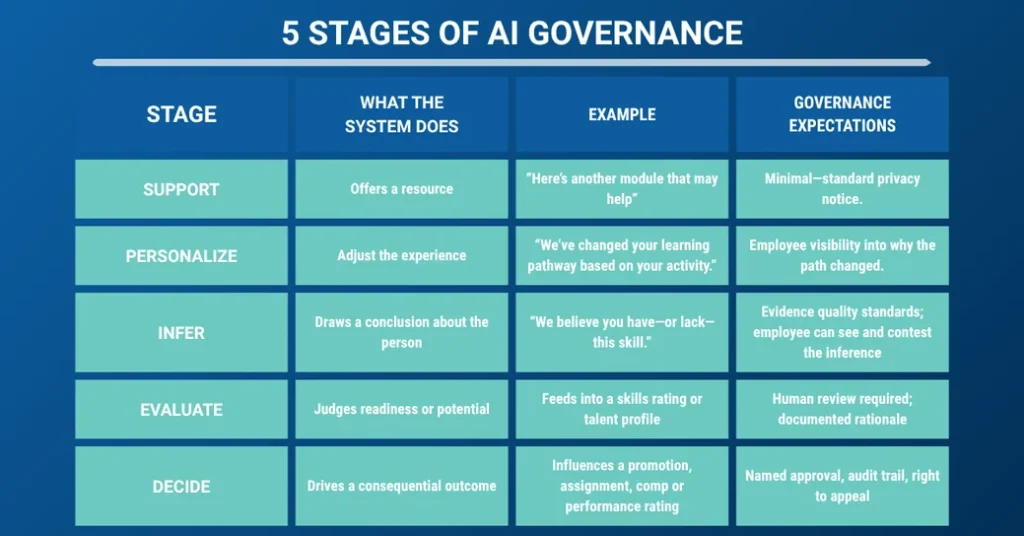
To address these concerns, industry leaders are increasingly advocating for a structured governance model. A common proposal involves categorizing data usage into five distinct tiers, ranging from "Support" to "Decide."

In the "Support" phase—such as a system suggesting a relevant article—the governance requirements are minimal. However, as data moves toward the "Evaluate" and "Decide" tiers, where scores directly impact promotions, bonuses, or performance ratings, the standards must rise. Industry experts argue that at these higher levels, human intervention is mandatory. A system-generated inference should never be the sole driver of an employment decision; rather, it should serve as one data point in a broader, human-led review process.
Legal and Ethical Implications of Data Drift
The legal risks of this data drift are substantial. Under various international regulations, including the General Data Protection Regulation (GDPR) in Europe and emerging AI legislation in the United States, employees have a right to understand how their data is being used to make decisions about their livelihood. "Data drift"—the phenomenon where information collected for one purpose (e.g., training) is used for another (e.g., performance evaluation)—poses significant transparency challenges.
If an organization fails to notify an employee that their AI-tutor interactions are being logged and synced to their permanent HR file, it may violate principles of informed consent. Furthermore, if these systems rely on biased training data, the resulting inferences could lead to systemic discrimination in talent development, disproportionately affecting certain demographics under the guise of "objective" machine learning.
Corporate Strategy: Moving Toward Transparent Integration
Leading organizations are beginning to revise their vendor contracts to address these pitfalls. Instead of accepting default "all-or-nothing" data synchronization, progressive firms are demanding granular control. This allows companies to decide which data points—such as final certifications—sync with HR systems, while shielding transient, exploratory, or failed attempts from the gaze of management.
The strategic shift is toward "employee-controlled visibility." In this model, the employee is granted agency over their learning record. For instance, an employee might choose to share their progress on a stretch project with a mentor, while keeping their exploratory AI queries private. This preserves the integrity of the learning environment while still allowing for the benefits of cross-platform connectivity.
The Final Test for Learning Leaders
As organizations continue to integrate AI into their talent infrastructure, the responsibility falls on learning and development leaders to act as stewards of this information. The ultimate litmus test for any new data-driven initiative is not its technical capability, but its transparency. If a policy or data-sharing practice cannot be clearly and comfortably explained to an employee in plain language—without reliance on complex legal jargon—it is likely an indication that the practice is ethically compromised.
The value of AI in the workplace lies in its ability to unlock human potential, not to curate a permanent, judgmental record of every developmental misstep. As the boundary between the "learning environment" and the "employment record" continues to blur, the most effective organizations will be those that protect the psychological safety of their workforce. By distinguishing between the data required to document achievement and the data that should remain private, leaders can foster a culture that values growth, curiosity, and the inherent, messy process of becoming competent.
The future of corporate learning will not be defined by how much data an organization can collect, but by how wisely it chooses to use it. The challenge for the next decade is to ensure that while our systems become smarter, they do not become less human. Protecting the space for employees to be "unfinished" is not merely a moral imperative—it is a business necessity for building a resilient, adaptable, and trusting workforce in an era of constant change.