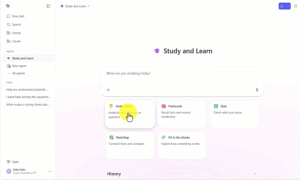



The landscape of modern education is currently navigating a pivotal transition as generative artificial intelligence moves from a controversial novelty to a permanent fixture in the academic toolkit. Microsoft has announced the general availability of its "Study and Learn Agent," a first-party AI tool integrated within Microsoft 365 Copilot, specifically engineered to shift the focus of AI from a source of immediate answers to a facilitator of deep cognitive engagement. This new agent is now accessible to Microsoft 365 Education customers at no additional cost, providing a structured, learning-focused environment for students aged 13 and older. By prioritizing the "learner does the thinking" principle, the initiative seeks to address the growing concerns of educators and administrators who have witnessed students utilizing general-purpose AI tools that prioritize speed over conceptual mastery.
The Evolution of AI in the Classroom: From Prohibition to Integration
The introduction of the Study and Learn Agent marks a significant milestone in a timeline that began in late 2022 with the public release of ChatGPT. Following the initial surge of AI adoption, many school districts globally—including major systems like the New York City Department of Education—initially moved to block AI access due to concerns over academic integrity and the potential for "answer-bot" behavior. However, by mid-2023, the narrative began to shift as institutions recognized that prohibition was an ineffective long-term strategy. The focus transitioned toward "AI literacy" and the development of guardrails that would allow students to benefit from the technology without bypassing the essential labor of learning.
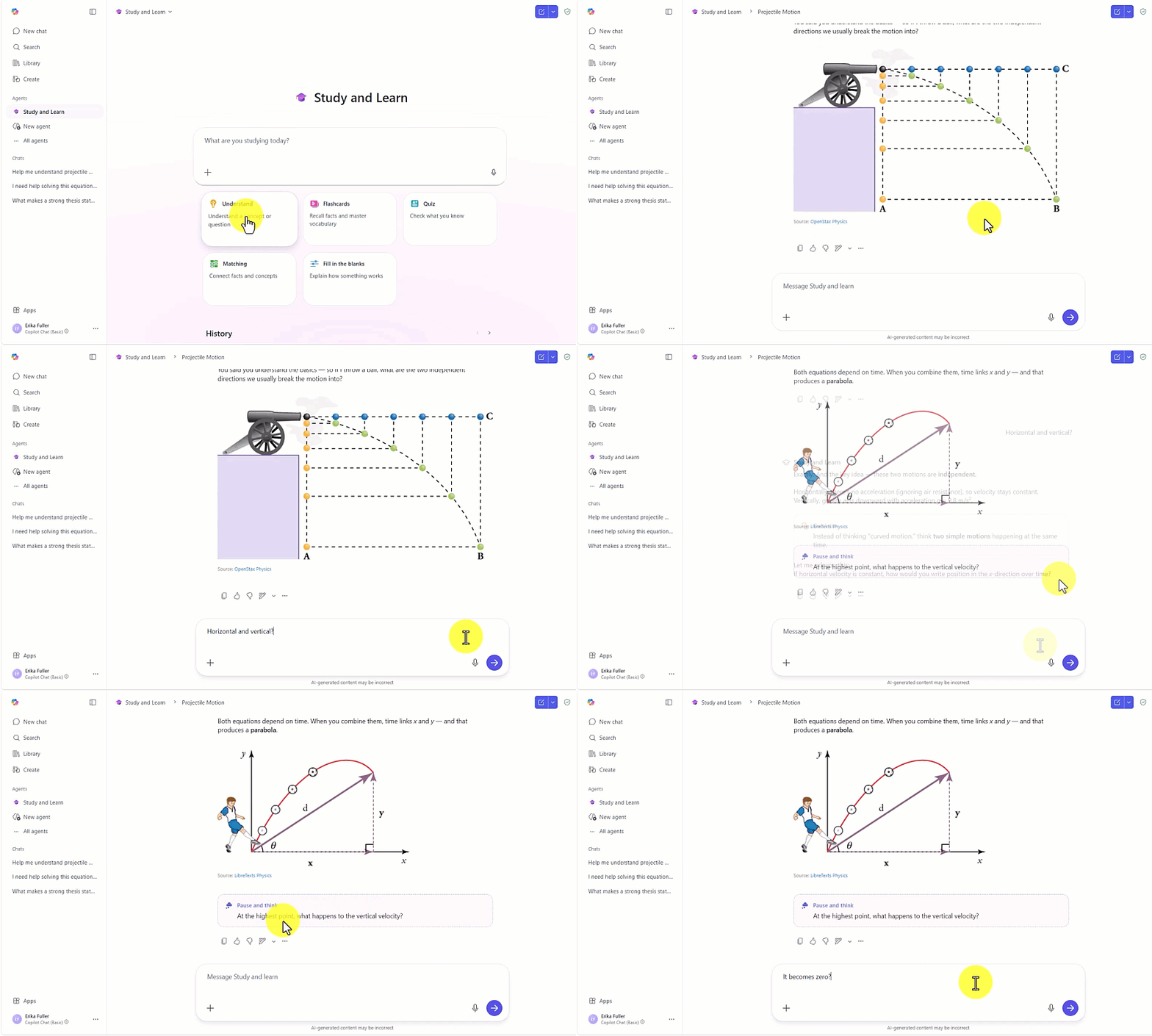
Microsoft’s development of the Study and Learn Agent is a direct response to this institutional demand. Unlike standard large language models (LLMs) that are designed to provide the most probable completion of a prompt, the Study and Learn Agent is tuned to act as a Socratic tutor. It is designed to recognize when a student is asking for a shortcut and instead redirects the interaction toward a guided discovery process. This shift represents a broader movement in the EdTech industry to move away from "generative" outputs toward "interrogative" and "scaffolding" interactions.

Pedagogical Foundations: The Science of Effective Study
The Study and Learn Agent is not merely a conversational layer atop an LLM; it is built upon established principles of learning science intended to maximize retention and comprehension. The experience is grounded in four specific research-based pillars:
- Scaffolding: The tool provides temporary support that is tailored to the student’s current level of understanding. As the student demonstrates mastery, the agent gradually reduces its intervention, encouraging independent problem-solving. This aligns with Lev Vygotsky’s "Zone of Proximal Development," ensuring students are challenged but not overwhelmed.
- Active Retrieval and Practice: Instead of allowing students to passively read information, the agent prompts them to recall facts and concepts through generated flashcards and matching activities. This combats the "forgetting curve" and strengthens long-term memory.
- Metacognitive Reflection: The agent encourages students to think about their own thinking. By asking questions such as "How did you arrive at that conclusion?" or "What part of this concept is most confusing?", the tool helps students develop self-awareness regarding their learning process.
- Immediate, Targeted Feedback: Rather than simply marking an answer correct or incorrect, the agent provides explanatory feedback that helps students identify the logic behind their errors, fostering a "growth mindset" as defined by Carol Dweck.
By integrating these principles, the agent transforms the Copilot Chat interface into a dynamic coaching experience. For instance, a student struggling with a complex physics equation will not be handed the solution; instead, the agent will guide them through the underlying variables, providing visual illustrations and step-by-step coaching to ensure the student can replicate the process independently.
Data and Market Context: The Scale of the AI Challenge
The urgency for a purpose-built educational AI is underscored by recent data. According to a 2024 survey by the Pew Research Center, approximately 19% of U.S. teens who have heard of ChatGPT say they have used it to help them with schoolwork. However, more telling is the fact that nearly 60% of educators express concern that AI will make it harder for students to develop critical thinking skills.
Microsoft’s strategy targets this "trust gap." By embedding the Study and Learn Agent within the existing Microsoft 365 ecosystem, the company leverages its established enterprise-grade security and privacy protocols. For K-12 institutions, Copilot Chat remains off by default for students, requiring a deliberate "opt-in" from IT administrators. This granular control allows schools to align AI deployment with their specific digital citizenship policies and curriculum goals.

The economic impact is also notable. By including the Study and Learn Agent at no additional cost for existing M365 Education license holders, Microsoft is positioning itself against specialized EdTech startups that often require separate, costly subscriptions. This "all-in-one" approach simplifies the procurement process for underfunded districts and ensures that advanced AI tools are not restricted to elite private institutions, thereby addressing concerns regarding the "digital divide."
Administrative Governance and Responsible AI Implementation
For IT administrators and school leaders, the deployment of the Study and Learn Agent involves a structured protocol designed to maintain safety and compliance. The agent is available on both web and desktop versions of the Microsoft 365 Copilot app, accessible through Microsoft Entra ID (formerly Azure Active Directory) school credentials. This ensures that all data generated during study sessions remains within the institution’s tenant, protected by Microsoft’s Responsible AI principles, which prohibit the use of student data for training underlying public models.
The configuration process for K-12 accounts is particularly stringent. Administrators must navigate to the Microsoft 365 Admin Center to enable the service, and students must be 13 or older to access the feature, adhering to COPPA (Children’s Online Privacy Protection Act) standards. Microsoft has also released comprehensive video walkthroughs and documentation to assist IT departments in managing these permissions at scale.
The Broader Ecosystem: The "Teach" and "Study" Synergy
The Study and Learn Agent does not exist in a vacuum; it is part of a dual-agent strategy that includes the "Teach" agent for educators. While the Study and Learn Agent focuses on the student experience, the Teach agent assists educators in curriculum design, lesson planning, and the creation of assessment rubrics.
This synergy is intended to create a closed-loop educational environment. An educator might use the Teach agent to develop a unit on the French Revolution, and subsequently, students use the Study and Learn Agent to quiz themselves on the material or talk through their essay arguments. This holistic approach ensures that AI serves as a bridge between the instructor’s goals and the student’s outcomes, rather than a wedge that separates them.
Analysis of Implications and Future Outlook
The launch of the Study and Learn Agent signals a maturing of the AI industry. We are moving past the "Wild West" phase of generative AI, where tools were released without specific context, into an era of specialized, "agentic" AI. The implications for the future of education are profound:
- Personalization at Scale: Historically, one-on-one tutoring has been the "gold standard" for academic improvement but was too expensive for most students. The Study and Learn Agent provides a scalable version of this personalized attention.
- The Changing Role of the Teacher: As AI takes over the role of "content delivery" and "basic tutoring," human educators can pivot toward more complex tasks, such as mentorship, social-emotional learning, and facilitating collaborative projects.
- Global Accessibility: Currently optimized for English (United States), Microsoft has confirmed that the agent will expand to include additional languages in the coming weeks. This expansion is critical for ESL (English as a Second Language) learners and for global adoption in diverse linguistic markets.
Despite these advancements, challenges remain. The efficacy of the Study and Learn Agent will depend heavily on the quality of the prompts provided by students and the ability of the AI to maintain its "Socratic" guardrails under pressure. Furthermore, institutions must invest in professional development to ensure that both teachers and students understand how to interact with the agent effectively.
In conclusion, the Study and Learn Agent represents a sophisticated attempt to reconcile the raw power of generative AI with the rigorous requirements of the classroom. By grounding the technology in learning science and providing robust administrative controls, Microsoft is offering a credible path forward for schools that wish to embrace the future of technology without sacrificing the integrity of the educational experience. As the tool rolls out globally, its success will likely be measured not by how many questions it answers, but by how many students it empowers to find the answers themselves.