
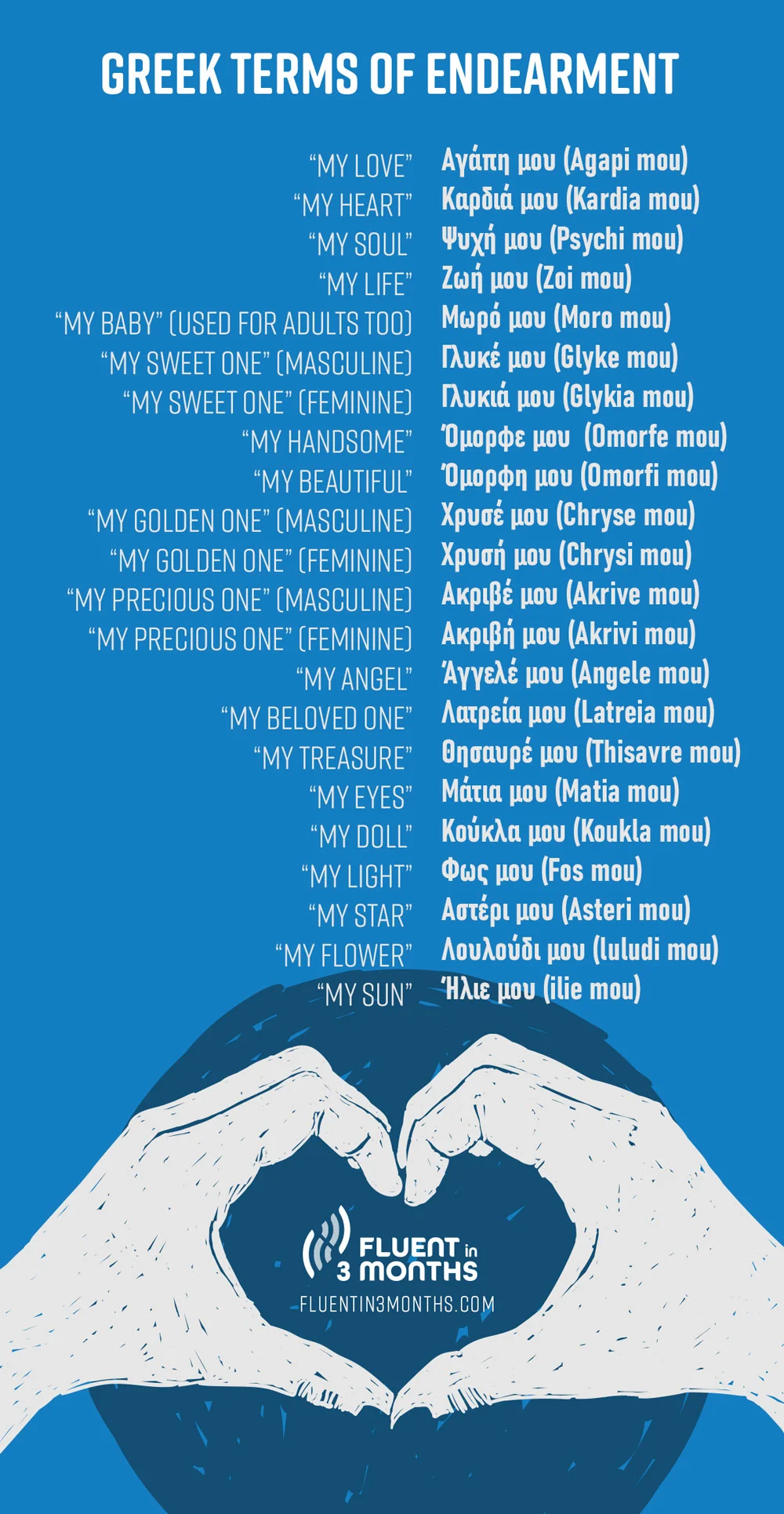
The Hellenic language, one of the oldest recorded living languages in the Indo-European family, possesses a sophisticated lexicon specifically dedicated to the expression of affection, intimacy, and social cohesion. Central to this linguistic framework is the phrase "S’agapo" (Σ’ αγαπώ), a contraction of "Se agapo," which serves as the primary declaration of love. However, the depth of Greek emotional expression extends far beyond a single phrase, utilizing a complex system of possessive pronouns, diminutive suffixes, and metaphorical nouns to navigate the nuances of romantic, familial, and platonic relationships. By examining the structural and cultural foundations of these terms, one can gain a comprehensive understanding of how the Greek language reinforces social bonds and preserves cultural identity through specific terminological choices.
The Structural Mechanics of Greek Affection
To understand Greek endearment, one must first address the grammatical role of the possessive pronoun "mou" (μου), meaning "my." In the Greek syntax of affection, this pronoun is almost invariably placed after the noun. For example, "agapi mou" (my love) follows a rigid order that prioritizes the object of affection before the possessor. This linguistic habit is more than a grammatical rule; it serves as a rhythmic marker in speech, signaling a transition from formal discourse to intimate communication.
Linguistic data indicates that the addition of "mou" transforms standard nouns into emotive identifiers. Common examples include:
- Kardia mou (Καρδιά μου): Literally "my heart," this term is utilized across various demographics to signify that the person is vital to the speaker’s existence.
- Psychi mou (Ψυχή μου): Meaning "my soul," this expression carries deep metaphysical weight, suggesting a connection that transcends the physical realm.
- Zoi mou (Ζωή μου): Translating to "my life," this term is frequently used in high-stakes emotional contexts, particularly between romantic partners or toward children.
A Chronology of Hellenic Affection: From Ancient Philosophy to Modern Usage
The modern Greek vocabulary of love is the descendant of a philosophical tradition that categorized affection into distinct archetypes. Ancient Greek thinkers identified eight specific types of love, a classification system that continues to influence modern endearments.
- Eros: Romantic, passionate love.
- Philia: Deep friendship or brotherly love.
- Storge: Familial love, particularly between parents and children.
- Agape: Unconditional, selfless love.
- Ludus: Playful or flirtatious affection.
- Pragma: Long-standing, enduring love built on duty and reason.
- Philautia: Self-love or self-respect.
- Mania: Obsessive or possessive love.
In the contemporary era, these distinctions have merged into a versatile set of terms. While "agapi" (from Agape) remains the most common root for "love," the modern usage of "moro mou" (my baby) reflects the "Ludus" or "Eros" aspects, often applied to adults in romantic settings to denote playfulness and protection.
Categorical Analysis of Romantic Endearments
In the sphere of romantic partnerships, the Greek language offers a gendered and highly descriptive range of terms. These are often used to highlight specific attributes of the partner or to reinforce the exclusivity of the relationship.

Masculine Romantic Terms
For male partners, terms such as "agori mou" (my boy) or "omorfe mou" (my handsome) are standard. A more traditional term, "antra mou" (my man), is often used by spouses to denote both affection and a sense of belonging. The term "glyke mou" (my sweet) is the masculine vocative form of "sweet," used to soften communication during intimate moments.
Feminine Romantic Terms
Conversely, female partners are frequently addressed as "koritsia mou" (my girl) or "omorfi mou" (my beautiful). The term "koukla mou" (my doll) is a ubiquitous endearment in Greek culture, used not only by partners but also as a general compliment, though its meaning shifts significantly based on the proximity of the speakers. "Glykia mou" serves as the feminine counterpart to "glyke mou," maintaining the theme of sweetness as a primary descriptor of affection.
Familial Bonds and the Diminutive Suffix
Family is the cornerstone of Greek social structure, and the language reflects this through the extensive use of diminutives. Diminutives in Greek are not merely used to describe smallness in size; they are primarily used to express "micro-affection," making a word sound warmer and more approachable.
The transition from formal titles to endearing nicknames follows a predictable linguistic pattern through suffixes:
- -aki (–άκι): A neutral suffix used for children or objects (e.g., "paidaki" for a small child).
- -oula (–ούλα): A feminine diminutive often added to names or titles (e.g., "manoula" for mommy).
- -oulis (–ούλης): A masculine diminutive (e.g., "baboulis" for a cute version of dad).
- -itsa (–ίτσα): A common feminine suffix for names (e.g., "Elenitsa" for Elena).
For instance, the word for mother, "mitera," is formal and often reserved for official contexts. In the domestic sphere, "mama" is the standard, but "manoula" represents the peak of affectionate address. Similarly, "pateras" (father) becomes "baba," which can be further softened to "baboula" or "babouli."
Socio-Platonic Endearments and Friendship
Greek culture is characterized by high-contact social interactions where terms of endearment are frequently extended to friends and even casual acquaintances. This practice serves to reduce social distance and establish an immediate rapport, a concept linked to the Greek value of "philoxenia" (hospitality).
In platonic settings, "file mou" (my friend) is the baseline. However, it is common for friends to use "agapi mou" or "psychi mou" without romantic connotations, particularly among female friends. The term "moro mou" is also occasionally used between close friends in a lighthearted, colloquial manner. In masculine circles, the term "re file" is often used; while "re" is a particle that can sometimes be perceived as blunt, when combined with "file," it denotes a level of brotherhood and shared history.
Linguistic Data: Frequency and Phonetic Nuances
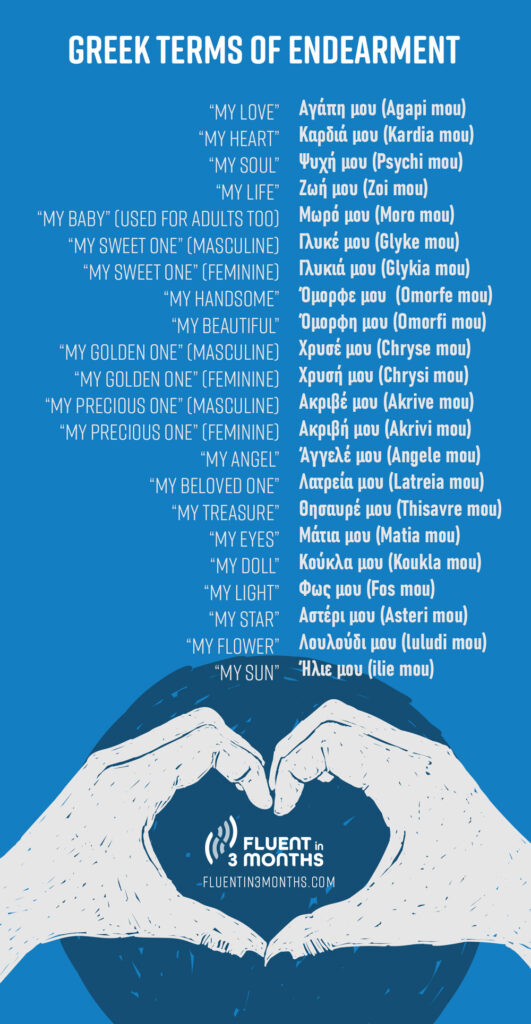
Phonetic precision is vital in the delivery of Greek endearments. The "gh" sound in "agapi" (voiced velar fricative) and the "th" sound in "thisavre" (voiced dental fricative) require specific articulatory positioning that non-native speakers often find challenging.
| Term | Phonetic IPA | Primary Usage |
|---|---|---|
| Agapi mou | aˈɣapi mu | Universal / Romantic |
| Kardia mou | karˈðʝa mu | Deep Emotional Bond |
| Matia mou | ˈmatia mu | Literally "my eyes" |
| Fos mou | fos mu | Literally "my light" |
| Asteri mou | aˈsteri mu | Literally "my star" |
The term "matia mou" (my eyes) is particularly significant in Mediterranean cultures, where the eyes are viewed as the windows to the soul. To call someone "my eyes" is to suggest that the speaker views the world through the lens of the other person’s existence.
Expert Perspectives on Cultural Implications
Sociolinguists argue that the prolific use of endearments in Greece and Cyprus is a defense mechanism against social alienation. Dr. Eleni Katsarou, a researcher in Hellenic linguistics, notes that "the Greek language is inherently communal. By utilizing possessive endearments, the speaker creates a verbal embrace that reinforces the ‘we’ over the ‘I’."
This communal aspect is also evident in the Greek diaspora. In communities in New York, Melbourne, and London, these terms of endearment serve as linguistic "connective tissue," allowing individuals to maintain a cultural link to their heritage even when the rest of their speech has transitioned to English. The retention of "mou" after English names (e.g., "George mou") is a documented phenomenon in bilingual households.
Broader Impact and Global Perception
The global perception of the Greek language is often tied to its perceived musicality and emotional warmth. Tourism data from the Greek Ministry of Tourism suggests that the "hospitable language" of locals is a significant factor in visitor satisfaction. When a traveler is addressed as "pedi mou" (my child) by an elder or "filos" (friend) by a shopkeeper, it creates a sense of belonging that transcends the typical consumer-provider relationship.
Furthermore, the influence of Greek endearments has permeated popular culture, from international cinema to literature, often used to signify a character’s passion or deep-rooted family values. The "S’agapo" phrase, in particular, has become a global shorthand for Mediterranean romance.
Conclusion: The Enduring Power of the Affectionate Word
The Greek system of endearment is a testament to the language’s ability to evolve while remaining anchored in its philosophical roots. Whether through the surgical precision of a diminutive suffix or the grandiosity of a metaphorical noun like "treasure" (thisavre mou), the language provides its speakers with a vast toolkit for emotional expression. These terms do more than just communicate feelings; they define the boundaries of relationships, uphold familial hierarchies, and maintain the warmth of a culture that has long prioritized human connection above all else. As the language continues to adapt to the digital age, these foundational expressions of love remain unchanged, serving as a constant in the ever-shifting landscape of modern communication.