



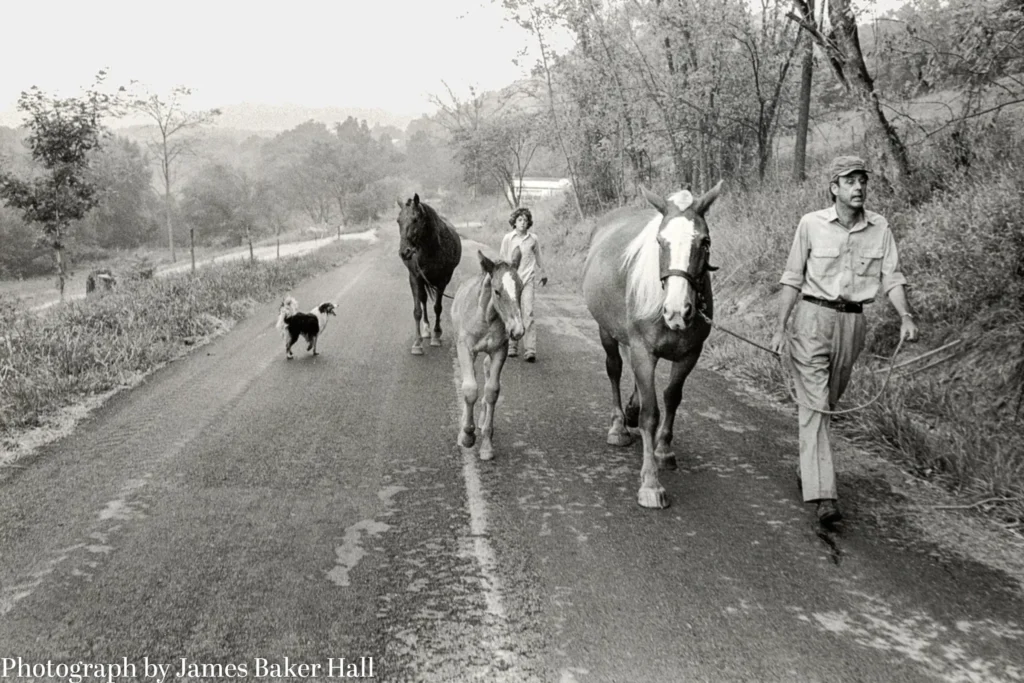
The literary and environmental communities are mourning the loss of Wendell Berry, the iconic agrarian writer, poet, and cultural critic who passed away last week at his home in Port Royal, Kentucky, at the age of 92. Berry spent nearly a century cultivating both the rolling hills of his native Henry County and an expansive body of work that challenged the foundational tenets of modern American industrialization. Operating largely outside the mechanisms of contemporary media—writing his manuscripts by hand with pencil and paper inside a remote cabin devoid of electricity—Berry became a singular voice for ecological stewardship, localized economies, and the moral imperative of human scale. While his agrarian polemics are frequently studied in the context of rural preservation and sustainable farming, his broader legacy offers a profound template for intentional living in an era dominated by hyper-connectivity, corporate dislocation, and digital saturation.
A Conventional Ascent and a Radical Departure
Berry’s path to becoming America’s preeminent defender of the rural landscape was preceded by a conventional and accelerated ascent through the echelons of elite academia. Born in 1935, Berry pursued his foundational education at the University of Kentucky, where he earned both his Bachelor of Arts and Master of Arts degrees. Demonstrating exceptional promise as a writer and intellectual, he subsequently traveled west to Stanford University to study creative writing under the prestigious Stegner Fellowship program.
His academic and creative credentials were further burnished by international travel, facilitated by a Guggenheim Fellowship that enabled him to live and work in Italy and France. Upon returning to the United States, Berry secured a position as an assistant professor of English at New York University’s Heights campus in the Bronx. By his late twenties, he had achieved what many ambitious young intellectuals considered the quintessential markers of success: a secure post at a major metropolitan university, critical recognition within literary circles, a growing family, and an open horizon within the traditional American professoriate.
Yet, beneath the trappings of professional upward mobility, a profound ideological friction was taking root. In 1964, at the age of 29, Berry made a decision that baffled his academic peers and defied the trajectory of his generation: he resigned his professorship at New York University, packed up his young family, and returned permanently to Henry County, Kentucky, reconnecting with the ancestral farmlands that his family had worked for generations.
The Confrontation at NYU and the Rejection of Metropolitan Success
The magnitude of Berry’s departure is perhaps best captured by the testimonies of those who witnessed his exit from the academic establishment. As chronicled by contemporary observers and cultural historians, the day Berry formally tendered his resignation, he was summoned to the office of his department supervisor.
The senior faculty member, operating from the consensus values of the mid-20th-century American intelligentsia, assumed that the young scholar simply miscalculated the value of the platform he was abandoning. The meeting served as a final, urgent appeal from the metropolitan establishment, warning Berry against trading the visibility, prestige, and institutional security of an Ivy-adjacent academic career for what was perceived as the intellectual obscurity and physical hardship of agrarian Kentucky.
According to retrospective accounts of Berry’s life and letters, the academic establishment viewed his relocation as a form of intellectual suicide—an act of self-imposed exile from the cultural centers of power and discourse. During that parting interview, his supervisor famously invoked Thomas Wolfe’s enduring literary maxim, warning Berry that “you can’t go home again.”
Despite the gravity of the warning and the unanimous consensus of his peers, Berry remained unmoved. Driven by an urgent conviction that his creative and moral obligations lay in the tactile defense of “people and place,” he finalized his departure. He operated under the firm belief that an authentic writer could not diagnose or accurately critique the displacement of human communities from a safe, detached distance in the urban metropolis.
The Agrarian Philosophy and Empirical Grounding
Berry’s return to Kentucky was not merely a nostalgic retreat, but the foundational act of a rigorous, lifelong intellectual project. Over the subsequent six decades, he published dozens of volumes of poetry, fiction, and essays that scrutinized the social, economic, and ecological consequences of industrial agriculture, corporate consolidation, and consumer capitalism.
In a 2018 interview with the national press, Berry articulated the epistemological necessity of his physical rootedness. “The landscape was there to check me if I was wrong,” he explained. “I could never go away and make up stuff at cocktail parties about the backwoods of Kentucky. I worked with people here in all walks of life and learned from them. It’s been a very rich experience.”
By embedding himself directly within the community he wrote about, Berry maintained a standard of radical accountability. His criticisms of modern supply chains, synthetic fertilizers, and soil depletion were grounded in empirical, daily observation rather than abstract sociological theory. He demonstrated that true authority over a subject requires enduring its consequences, weathering its economic strains, and sharing in the physical labor of its maintenance.
Contemporary Relevance: Confronting the Digital Edifice
While Berry’s specific focus was the preservation of agrarian culture and small-town communal life, the underlying critique of modern existence he advanced has acquired urgent relevance in the twenty-first century. Contemporary society is increasingly defined by institutional numbness, frictionless conveniences, and a pervasive reliance on digital mediation.
In the modern white-collar workspace, human agency has been largely supplanted by administrative theater—endless digital communication loops, redundant virtual meetings, automated transcriptions, and corporate reporting structures designed to simulate productivity while draining meaningful engagement. Simultaneously, the proliferation of algorithmic entertainment and generative artificial intelligence has provided instantaneous mechanisms to bypass even the mildest forms of cognitive strain, numbing anxiety while eroding the capacity for sustained, deep thought. In the political sphere, complex systemic challenges have been reduced to polarized spectacles, encouraging citizens to perform ideological radicalism from the safe, dislocated remove of social media platforms.
Berry recognized these psychological temptations decades before the advent of the smartphone. He understood that human beings possess an innate desire to evade discomfort, physical strain, and local responsibility. However, his life’s work argued persistently that the systematic evasion of difficulty does not liberate the individual; rather, it produces fragility, spiritual disorientation, and social isolation.
Implications and the Promise of the Deep Life
The passing of Wendell Berry prompts a broader analytical assessment of how contemporary individuals navigate structural alienation. While moving to a rural Kentucky farm and writing by candlelight is neither practical nor desirable for the vast majority of the global population, Berry’s life offers a portable, conceptual framework for living deliberately.
The core implication of Berry’s philosophy is that meaningful satisfaction is inextricably linked to commitment, friction, and place-based responsibility. When an individual consciously rejects the ambient pressures of hyper-acceleration, digital distraction, and careerist conformity, they open up the possibility of what can be termed the "deep life." This paradigm requires:
- Deliberate Constraint: Voluntarily limiting exposure to dislocating technologies and endless optionality in favor of depth and mastery within a specific domain.
- Tangible Accountability: Aligning one’s labor and creative output with real-world consequences rather than abstract, remote metrics.
- Communal Fidelity: Investing deeply in local institutions, physical neighborhoods, and face-to-face relationships rather than disembodied digital networks.
As public figures, environmentalists, and readers reflect on Berry’s ninety-two years, his legacy transcends the specific genre of agrarian literature. He stands as a monumental historical counterweight to the acceleration of modern life—a living demonstration that a human being can consciously step off the conveyor belt of metropolitan success and construct a life of profound integrity, intellectual rigor, and enduring purpose.