

The widespread apprehension surrounding artificial intelligence and its potential to displace human labor has been a dominant theme in technological discourse for the past several years. Initially, many leading figures within the AI industry painted a stark picture, comparing their nascent technologies to the industrial automation that once rendered jobs requiring physical strength obsolete. The implication was clear: just as machines replaced brawn, AI would soon replace brains, leading to a significant overhaul, if not outright elimination, of white-collar professional roles. However, a noticeable shift in this narrative is now emerging, with some of these same influential voices beginning to temper their earlier, more alarmist predictions.
The Initial Wave of Automation Fears and Early Predictions
The initial fervor around AI’s job-displacing capabilities was fueled by rapid advancements in machine learning, particularly the emergence of large language models (LLMs) and generative AI. These technologies demonstrated unprecedented abilities in tasks requiring cognitive functions, such as writing, coding, data analysis, and creative ideation, which were traditionally considered exclusive domains of human intellect.
Among the most prominent proponents of the "AI will automate jobs" thesis was Dario Amodei, CEO of Anthropic, a leading AI safety and research company. On multiple occasions, Amodei suggested that AI-based tools would automate a substantial portion—specifically, "half"—of entry-level white-collar jobs. His remarks, often cited in major news outlets, underscored a prevailing fear that the very roles associated with knowledge work, often seen as secure and requiring higher education, were now vulnerable. This sentiment resonated with historical anxieties surrounding technological unemployment, from the Luddite rebellions of the 19th century to the rise of robotics in manufacturing in the late 20th century.
Not to be outdone in the scale of his predictions, Mustafa Suleyman, CEO of Microsoft AI and co-founder of DeepMind and Inflection AI, offered an even more ambitious timeline. In February, Suleyman famously predicted that AI would achieve "human-level performance on most if not all professional tasks" within a remarkably short timeframe of twelve to eighteen months. Such statements, coming from individuals at the helm of companies actively developing and deploying these powerful technologies, naturally amplified concerns among the global workforce and policymakers alike. These predictions were often supported by various consultancy reports, such as those from McKinsey & Company and Goldman Sachs, which, while offering a range of scenarios, frequently highlighted the potential for millions of jobs to be automated or significantly transformed. For instance, a 2023 Goldman Sachs report estimated that generative AI could expose 300 million full-time jobs to automation across major economies, with white-collar workers in law and administrative sectors facing the highest risks.
A Shifting Narrative: From Apocalypse to Augmentation
Despite these dire initial forecasts, a nuanced recalibration of expectations has begun to manifest within the AI leadership itself. The discourse is subtly but significantly moving away from a narrative of widespread job displacement towards one of job transformation and augmentation. This shift reflects a growing understanding of how AI is being integrated into real-world work environments, often in ways that are more collaborative than competitive with human capabilities.
A notable inflection point in this evolving conversation came recently from Sam Altman, CEO of OpenAI, the company behind ChatGPT. While appearing at a conference in Australia just a few weeks ago, Altman expressed his "delight" at being wrong about AI creating a "jobs apocalypse." This admission from one of AI’s most influential figures marked a significant departure from the previous rhetoric, suggesting that the initial fears of mass unemployment might have been overblown. Altman’s revised perspective, while not entirely dismissing the transformative power of AI, signaled a more optimistic outlook on the future of work.
Following suit, Dario Amodei, who previously spoke of automating half of entry-level white-collar jobs, has also adjusted his position. He is now emphasizing that AI is unlikely to replace entire jobs but will instead replace large parts of existing jobs. This distinction is crucial, as it suggests that AI will primarily serve as a tool to streamline specific tasks, enhance efficiency, and alter the nature of work within a given role, rather than making the role itself redundant. The focus shifts from substitution to modification, implying that human workers will adapt by collaborating with AI, leveraging its capabilities to perform their jobs differently and, potentially, more effectively. This refined perspective aligns with a growing body of research that indicates AI’s primary impact, at least in the short to medium term, will be on task automation rather than whole job automation.
Cal Newport’s Alternative Framework: AI as a "Quick-and-Dirty" Tool
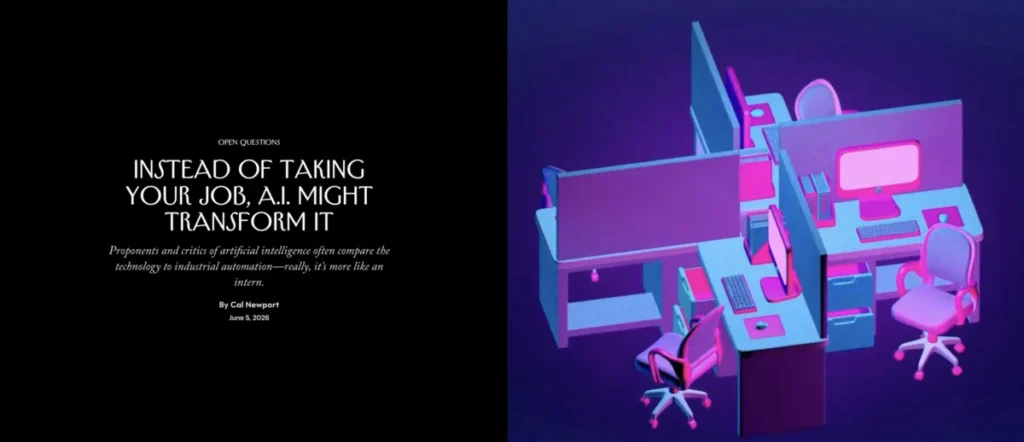
This evolving understanding is precisely what author and computer science professor Cal Newport explores in his recent article for The New Yorker, provocatively titled "Instead of Taking Your Job, A.I. Might Transform It." Newport posits that the prevailing analogy of AI to industrial automation—comparing it to a power loom that makes human jobs superfluous—is fundamentally flawed. He argues for a different, more granular analogy: AI as a versatile tool for "hacking together whatever is useful."
Newport illustrates this alternative framework by drawing on a personal anecdote from his high school years. During a summer job at a corporate office park, he was tasked with programming custom web-based applications for internal use at a management consulting firm. These weren’t polished, enterprise-grade software solutions; rather, they were "quick-and-dirty" tools, cobbled together rapidly to solve specific, annoying problems. One application managed timesheets, another tracked IT department inventory. Crucially, these bespoke solutions, though rudimentary, significantly simplified operations and made consultants’ efforts "a little deeper" without putting anyone out of work.
Fast forward to the present, Newport’s investigations into how small business owners are actually deploying AI reveal a striking parallel to his high school experience. Through interviews, he discovered that these entrepreneurs were not implementing AI to replace staff or automate entire workflows in a grand, industrial fashion. Instead, they were using AI to "vibe code" quick, custom tools to address specific operational bottlenecks and simplify various parts of their businesses. For instance, an entrepreneur might use an LLM to generate personalized email responses for customer inquiries, draft preliminary marketing copy, or analyze sales data for quick insights. Another might deploy a simple AI script to automate routine data entry or to summarize lengthy reports, freeing up human employees for more complex, strategic tasks.
As Newport articulates in his article, "These examples were not the digital equivalent of a power loom, making large numbers of human jobs superfluous. Turns out, A.I. was assisting these small businesses in roughly the same way that my teen-age self had helped that consulting company—by hacking together whatever was useful." This perspective suggests that AI, particularly for many businesses, is functioning not as a wholesale replacement mechanism but as an enabler of micro-efficiencies and personalized solutions. It empowers individuals and small teams to create custom tools that address their unique needs without requiring extensive programming expertise or large-scale IT investments.
The Emergence of "Freestyle Work" and Its Implications
This practical application of AI, as observed by Newport, gives rise to a concept he terms "freestyle work." Freestyle work describes a paradigm where individuals are empowered to leverage AI tools to custom-build solutions that optimize their specific workflows and enhance their productivity. It blurs the traditional lines between users and developers, enabling knowledge workers to become "citizen developers" or "AI whisperers," crafting their own digital assistants and tools on the fly.
This approach has several profound implications for the future of work:
- Skill Transformation: The emphasis shifts from performing routine, automatable tasks to developing skills in prompt engineering, critical evaluation of AI outputs, problem-solving, and adaptive learning. Workers will need to understand how to effectively communicate with AI, integrate its outputs into their work, and troubleshoot issues.
- Increased Productivity and Value Creation: By offloading mundane or repetitive tasks to AI, human workers can focus on higher-order cognitive functions, creativity, strategic thinking, and interpersonal interactions. This can lead to increased individual and organizational productivity, allowing companies to achieve more with existing resources or to tackle new challenges.
- Empowerment of the Individual: Freestyle work democratizes access to sophisticated computational power. An individual can, with relative ease, create tools that previously required a team of specialized developers. This empowerment can foster innovation from the ground up, allowing solutions to emerge directly from the people facing the problems.
- Redefinition of Roles: Instead of eliminating roles, AI transforms them. A marketing professional might spend less time drafting initial copy and more time refining AI-generated content, developing brand strategy, and engaging with customers. A legal professional might use AI to review documents faster, dedicating more time to complex legal reasoning and client advocacy.
Supporting Data and Economic Analysis on AI’s Labor Impact
The evolving narrative from AI leaders and observations like Newport’s are increasingly supported by broader economic data and academic research. Despite initial fears, macroeconomic data has not shown a significant surge in unemployment directly attributable to AI. Global unemployment rates have largely remained stable or even declined in many developed economies, even as AI adoption has accelerated.
Studies by institutions such as the International Monetary Fund (IMF) and the World Economic Forum (WEF) have begun to project a more balanced view of AI’s impact on jobs. While acknowledging that certain tasks and even entire roles are susceptible to automation, these reports often highlight the potential for significant job creation and augmentation. The WEF’s "Future of Jobs Report 2023" suggested that while 23% of jobs are expected to change in the next five years, with 69 million new jobs created and 83 million eliminated, the net impact is not a catastrophic loss. Moreover, the report emphasized that many roles would see a significant portion of their tasks automated, leading to a need for upskilling and reskilling rather than outright redundancy.
Economists and labor market experts frequently point to several factors explaining this nuanced reality:
- The Laggard Effect: The full economic impact of a transformative technology often takes decades to materialize. While AI is advancing rapidly, its widespread integration and the resulting systemic changes in the labor market are still in their early stages.
- The Jevons Paradox: This economic principle suggests that increased efficiency in resource use can lead to increased overall consumption of that resource. In the context of AI, making certain tasks cheaper and faster might not reduce the demand for human labor but could instead create new opportunities or increase the demand for related services that still require human oversight and creativity. For instance, if AI makes content creation faster, there might be an increased demand for content strategy, editing, and distribution, which still require human input.
- Human Complementarity: Many tasks require a unique blend of human judgment, empathy, creativity, and critical thinking that current AI systems cannot fully replicate. AI excels at specific, well-defined cognitive tasks, but integrating these into complex, real-world scenarios often requires human oversight and intervention.
- New Job Creation: AI is directly creating new job categories, such as AI trainers, prompt engineers, AI ethicists, data scientists, machine learning engineers, and AI integration specialists. Beyond these direct roles, the increased productivity enabled by AI could also stimulate economic growth, leading to job creation in other sectors.
Broader Implications and Perspectives
The shift in understanding AI’s impact extends beyond mere job numbers. It has significant implications for education, workforce development, and societal planning.
- Educational Reform: Educational institutions are under pressure to adapt their curricula to prepare students for an AI-augmented future. This means emphasizing critical thinking, problem-solving, creativity, digital literacy, and collaboration, alongside foundational knowledge in AI tools and concepts.
- Lifelong Learning: The concept of continuous learning and reskilling becomes paramount. Workers will need to regularly update their skill sets to remain relevant in a rapidly evolving technological landscape. Governments and corporations are increasingly investing in retraining programs to help workers transition to new roles or enhance their existing capabilities with AI tools.
- Ethical Considerations: While the "jobs apocalypse" might be receding, other ethical challenges posed by AI remain pertinent. These include concerns about algorithmic bias, data privacy, the potential for deepfakes, and the responsible deployment of autonomous systems. Addressing these issues requires robust regulatory frameworks and a strong emphasis on AI ethics in development and deployment.
- Policy Responses: Policymakers are grappling with how to foster innovation while ensuring equitable distribution of AI’s benefits and mitigating potential negative impacts. This includes exploring universal basic income (UBI) as a potential social safety net (though less urgent if mass unemployment is avoided), investing in public education and infrastructure, and developing policies that encourage responsible AI development and deployment.
- Sector-Specific Impacts: While white-collar jobs are often the focus, AI is also transforming other sectors. In healthcare, AI assists in diagnosis, drug discovery, and personalized treatment plans, enhancing the capabilities of medical professionals rather than replacing them. In manufacturing, AI-powered robotics work alongside human workers, improving efficiency and safety. Even in creative industries, AI is used as a generative tool, empowering artists and designers to explore new possibilities.
In conclusion, the initial alarmist predictions about AI causing a widespread "jobs apocalypse" appear to be giving way to a more nuanced and, arguably, less dire reality. The shift in discourse from AI leaders like Sam Altman and Dario Amodei, coupled with observations from experts like Cal Newport, suggests that AI’s primary impact on the knowledge sector is one of transformation and augmentation rather than mass displacement. By acting as a powerful, flexible tool for "freestyle work" and "vibe coding" custom solutions, AI is empowering individuals to enhance their productivity and reshape their roles. While undeniable challenges remain in adapting to this new technological frontier, the current trajectory points towards a future where human ingenuity, coupled with AI’s capabilities, leads to deeper insights and more impactful efforts, rather than a hollowed-out workforce. The future of work, it seems, will be weirder and more complex than initially predicted, but perhaps also more hopeful.