


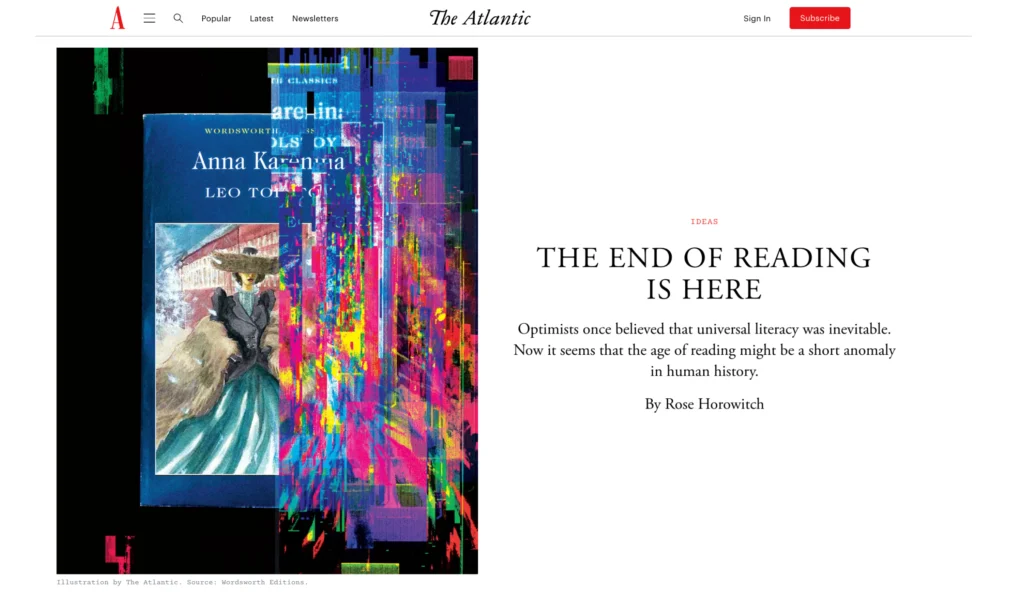
In a recent compelling analysis, Rose Horowitch ignited a significant discussion within intellectual circles with her Atlantic article, provocatively titled “The End of Reading is Here.” Published in August 2026, the extensive piece, ironically weighing in at over 8,500 words, posits that the pervasive influence of digital technology is orchestrating a profound and rapid decline in reading habits across society. This argument echoes concerns articulated by various commentators, including James Marriott, who has also explored similar themes in his work, highlighting a societal shift towards a post-literate era.
Horowitch’s investigation delves into a wealth of data points to substantiate her claim regarding the radical reduction in reading engagement. For instance, studies indicate a measurable decrease in the time adults and adolescents dedicate to reading books and long-form articles. Data from various educational and sociological surveys reveal a consistent downward trend in literacy scores and reading comprehension among younger demographics. A 2025 report by the National Endowment for the Arts (NEA), for example, showed that the percentage of American adults reading literature for pleasure had fallen by nearly 15% over the past two decades. Concurrently, average daily screen time, particularly on social media and video platforms, has surged, with adolescents reportedly spending upwards of six hours daily interacting with digital content, often at the expense of sustained reading. Further statistics from library associations reflect a decrease in borrowing rates for physical books, even as digital consumption of short-form content continues to rise exponentially. This confluence of data paints a stark picture of a society increasingly disengaged from the deep, sustained cognitive effort that traditional reading demands.
The Historical Trajectory of Literacy and Its Decline
The debate surrounding the decline of reading is not merely a contemporary lament but is rooted in a deeper understanding of literacy’s historical role. For millennia, human communication was predominantly oral, shaping cultures and cognitive processes in distinct ways. The invention of writing, and later the printing press, marked a series of revolutionary shifts that fundamentally altered human consciousness, societal structures, and the very architecture of knowledge.
The transition from oral to literate societies, as extensively documented by scholars like Walter Ong in his seminal work Orality and Literacy, was not simply a technological upgrade but a cognitive evolution. Ong argued that literacy fosters abstract thought, logical reasoning, linear progression of ideas, and the development of an independent, introspective self. It enabled the codification of laws, the systematic pursuit of science, the flourishing of complex philosophical traditions, and the preservation of intricate historical narratives beyond the fallibility of human memory. The advent of widespread literacy, propelled by the Gutenberg printing press in the 15th century, democratized knowledge and catalyzed the Enlightenment, scientific revolution, and the rise of modern democratic states.
For centuries, the printed word remained the primary conduit for serious intellectual engagement, critical discourse, and cultural transmission. However, the late 20th and early 21st centuries introduced a new paradigm: the digital age. The proliferation of personal computers, the internet, and subsequently smartphones and social media platforms, began to reshape information consumption patterns with unprecedented speed. Initially hailed for its potential to democratize information even further, the digital environment has, ironically, begun to challenge the very foundations of deep reading and sustained attention. The constant stream of notifications, the algorithmic curation of bite-sized content, and the pervasive culture of instant gratification have created an ecosystem that, many argue, is antithetical to the slow, deliberate process of reading complex texts.
The Critical Role of Reading in Human Experience
The central question arising from these observations is not whether reading habits are changing, but whether these changes matter. Is this merely a natural evolution of communication technology, akin to the decline of radio listenership in the age of television, or does it signify a more profound and concerning shift? Horowitch firmly argues for the latter, emphasizing that reading occupies a uniquely privileged and critical position in the human experience.
As she articulates, “The advent of reading and writing transformed society. It altered people’s consciousness and politics, along with the intellectual feats they were capable of. The decline of reading will bring about changes of the same magnitude. It will affect our innermost thoughts, our society’s politics and culture, and how we tell the history of our civilization.” This perspective underscores the belief that literacy is not merely a skill but a foundational technology that shapes our cognitive abilities, our capacity for empathy, and our understanding of the world.
Cal Newport, a prominent technology theorist and author, fervently echoes this conclusion. Drawing upon his recent New York Times op-ed on cognitive fitness and his study of works like Ong’s Orality and Literacy, Newport argues that many celebrated cultural attributes—from the concept of human rights and justice to the principles of logic, the pursuit of progress, and even the very notion of an independent, self-aware individual—are conceptual descendants born directly from the mind-shaping power of the written word. He contends that literacy is, in essence, the technology that enabled the complex cognitive world we often take for granted. A reduction in our engagement with grappling with words, therefore, represents a step backward, a regression that could have far-reaching societal consequences. James Marriott’s forthcoming book, tellingly titled The New Dark Ages, further encapsulates this apprehension, suggesting a potential societal regression if the decline in deep reading continues unchecked.
Broader Implications and Expert Concerns
The implications of a post-literate society extend far beyond individual reading habits, touching upon the very fabric of democratic governance, critical thinking, and cultural cohesion.
Cognitive Impact: The shift from deep reading to shallow, fragmented digital consumption is believed to have significant cognitive repercussions. Neuroscientific research suggests that sustained reading strengthens neural pathways associated with attention, concentration, critical analysis, and empathy. The constant context-switching and superficial engagement prevalent in digital environments may, conversely, lead to reduced attention spans, diminished capacity for complex problem-solving, and a preference for immediate gratification over delayed understanding. Experts warn that this could impact cognitive resilience and mental agility.
Societal and Political Impact: An informed citizenry is often considered the bedrock of a healthy democracy. Deep reading allows individuals to engage with complex arguments, understand nuances, and critically evaluate information, fostering an informed and discerning public discourse. A decline in this capacity could make societies more susceptible to misinformation, propaganda, and simplistic narratives, potentially exacerbating political polarization and hindering rational decision-making. The ability to engage with differing viewpoints and understand historical contexts, crucial for civic engagement, is intrinsically linked to the analytical skills cultivated through reading.
Cultural and Historical Impact: Reading is the primary vehicle for transmitting cultural heritage, historical knowledge, and philosophical traditions across generations. A diminished capacity for deep reading could lead to a shallower understanding of history, a weakening of cultural memory, and a reduced appreciation for the complexities of human civilization. The narratives we consume shape our collective identity, and a shift towards ephemeral, visually-driven content may alter how we perceive and interpret our past and future.
Technology theorists like Cal Newport, often characterized as critical of new tools, argue that their concerns regarding the digital assault on literacy are not reactionary but self-evidently justified by the potential scale of these implications. They emphasize that this is not about rejecting technology but understanding its cognitive costs and mitigating negative externalities.
Towards a "Cognitive Fitness" Solution
Given the potential severity of these challenges, the crucial question becomes: what actionable steps can be taken? Newport, drawing parallels with public health initiatives, suggests a proactive approach akin to how societies addressed the decline in physical health in the latter half of the 20th century. Just as campaigns promoted exercise, balanced diets, and regular check-ups to combat sedentary lifestyles and poor nutrition, a similar societal push is needed for "cognitive fitness."
This approach advocates for the deliberate adoption of specific routines around information consumption. It involves treating highly distracting digital content—often likened to "digital junk food"—as something to be largely avoided. Instead, individuals and institutions should purposefully schedule a non-trivial amount of time each day for activities that foster advanced literacy: reading complex texts, engaging in structured writing, and practicing self-reflection. This intentional allocation of time mirrors the dedication now given to physical activities like walking, jogging, or weight lifting.
Educational institutions, policymakers, and even technology developers have a role to play. Curricula could place a renewed emphasis on critical reading and analytical writing. Public awareness campaigns could highlight the cognitive benefits of deep reading. Technology companies might explore ethical design principles that encourage focused engagement rather than endless scrolling and distraction. The goal is not to abandon digital tools but to cultivate a more balanced and intentional relationship with them, ensuring they serve human flourishing rather than undermining it.
As Horowitch concludes in her Atlantic piece, “An astonishing wealth of information and wisdom has been bequeathed to us. What we’ll do with this inheritance is up to us.” This sentiment encapsulates the urgency and agency required in addressing the unfolding challenges to literacy. The current juncture presents a critical choice: to passively observe the erosion of foundational cognitive capacities or to actively implement strategies that safeguard the intellectual and cultural inheritance of humanity. The time for deliberation is past; it is time for collective action to champion the enduring importance of reading.