


The global educational landscape is currently undergoing a structural transformation as artificial intelligence transitions from a speculative technology to a foundational component of institutional strategy. According to the comprehensive findings of the 2025 AI in Education Report, commissioned by Microsoft in collaboration with various academic and research organizations, the conversation regarding AI in schools and universities has shifted definitively from questioning its necessity to optimizing its implementation. The data indicates that 86% of education organizations worldwide have now integrated generative AI into their operations, marking the highest adoption rate of any industry surveyed. This surge underscores a critical period of adaptation for students, educators, and administrators as they navigate the complexities of digital transformation in the classroom and beyond.
The Rapid Acceleration of Artificial Intelligence in Global Education
The 2025 report highlights a significant acceleration in the deployment of AI tools across both K-12 and higher education sectors. In the United States specifically, the integration of generative AI has become nearly ubiquitous in administrative and pedagogical frameworks. This rapid uptake is driven by the demand for increased efficiency, personalized learning pathways, and the need to prepare students for an increasingly automated workforce.
Institutions are utilizing AI for a diverse array of functions, ranging from high-level system strategies to localized classroom adjustments. In universities, AI-powered administrative tools are being used to streamline enrollment, financial aid processing, and student support services. Meanwhile, in K-12 environments, the focus remains on personalized learning interventions, where AI tutors and adaptive platforms help bridge achievement gaps by tailoring content to individual student needs. The report suggests that this is not merely a trend but a fundamental reimagining of the educational experience, where technology acts as a force multiplier for human instruction.

A Chronology of Integration: From Disruption to Institutionalization
To understand the current state of AI in education, it is necessary to examine the timeline of its adoption. The journey began in late 2022 with the public release of advanced large language models, which initially sparked widespread concern regarding academic integrity and the potential for plagiarism. Throughout 2023, many school districts and universities responded with temporary bans or restrictive policies as they grappled with the implications of the technology.
By mid-2024, the narrative began to shift toward "AI literacy." Educators and policymakers recognized that banning the technology was not a viable long-term solution, leading to the development of frameworks for responsible use. The 2025 report marks the "institutionalization phase," where AI is no longer treated as an external disruption but as an internal capability. Current data shows that institutions are now prioritizing "job-embedded professional learning," moving away from one-off workshops toward continuous, integrated training programs that help staff and students master AI fluency in real-time.
Quantitative Analysis of the AI Adoption Surge
Supporting data from the International Data Corporation (IDC), cited within the report, reveals that the education sector’s 86% adoption rate significantly outpaces the corporate and manufacturing sectors. This is attributed to the text-heavy and data-intensive nature of education, which aligns perfectly with the capabilities of generative AI.
The survey data collected from academic and IT leaders, educators, and students reveals a nuanced picture of usage:
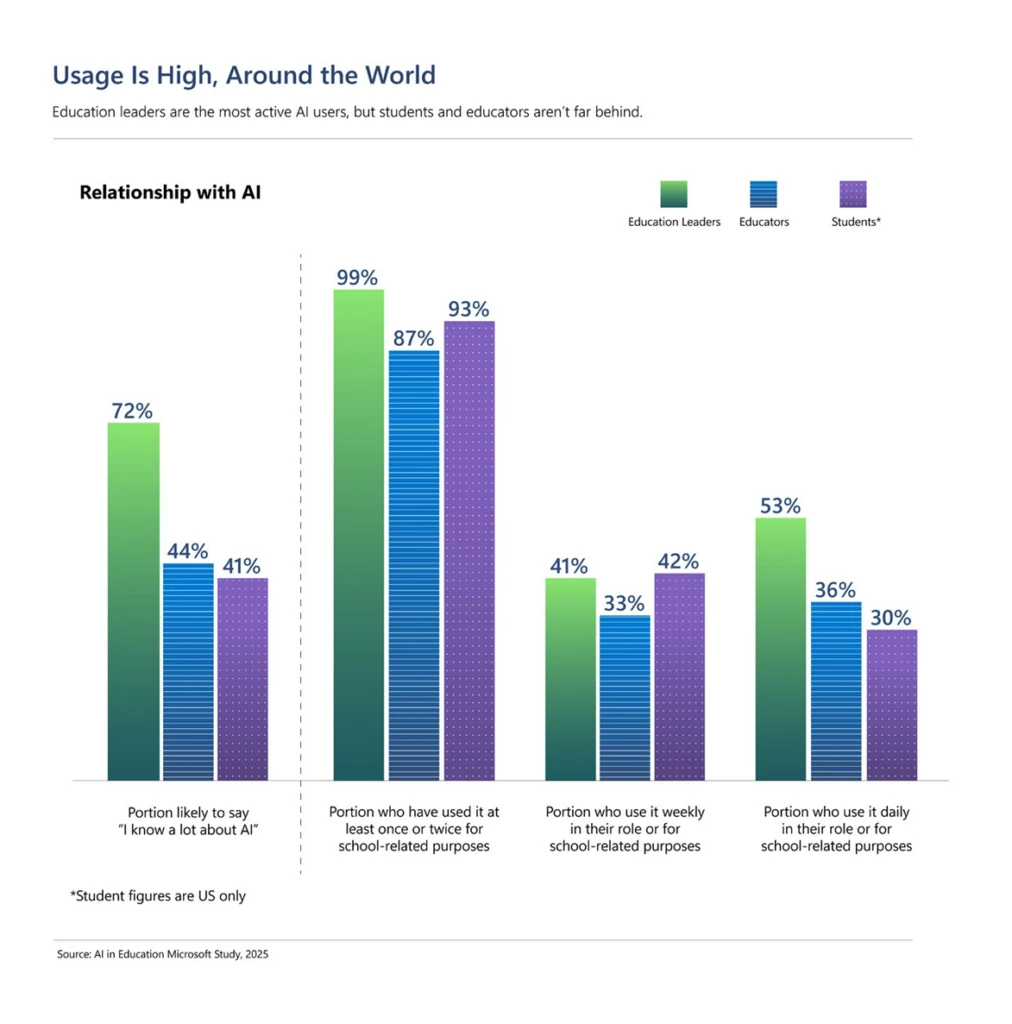
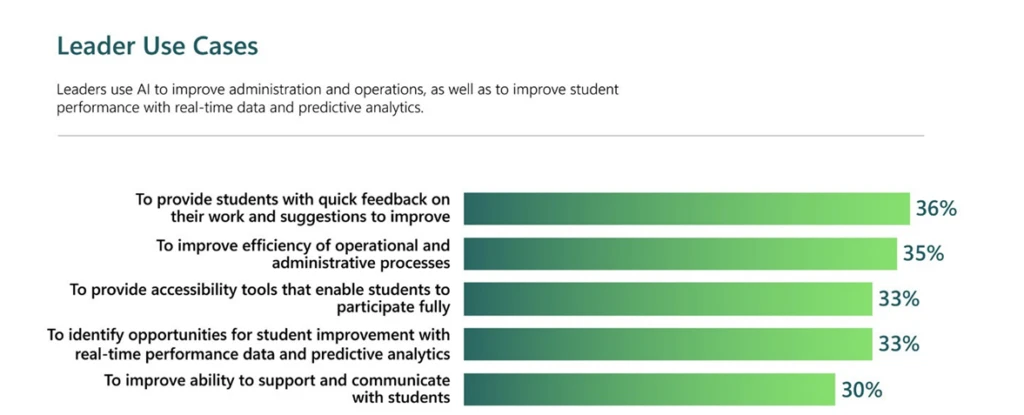
- Education Leaders: This group represents the most active users, utilizing AI primarily for operational efficiency, data analysis, and institutional planning.
- Educators: Teachers are increasingly using AI to generate lesson plans, automate grading for formative assessments, and create diverse instructional materials.
- Students: Learners are employing AI as a "brainstorming partner," using it to clarify complex concepts and overcome creative blocks during the writing process.
However, the surge in usage has exposed a significant "perception gap" regarding support and training. While 82% of institutional leaders believe they have provided sufficient AI training and resources, only 29% of students and 33% of educators feel they have received the necessary guidance to use these tools effectively. This mismatch suggests that while the tools are being provided, the pedagogical support required to integrate them meaningfully into the curriculum is still lagging.
Reimagining Pedagogy: The Synergy of AI and Traditional Learning
One of the most critical findings of the 2025 report is that AI is most effective when used to complement, rather than replace, traditional learning methods. A collaborative study conducted by Microsoft Research and Cambridge University Press & Assessment examined student outcomes when using AI tools for complex tasks. The research found that students who combined AI-generated insights with traditional note-taking and active recall methods demonstrated a deeper understanding of the subject matter than those who relied solely on AI for answers.
This "human-in-the-loop" approach is being championed by educational experts as the gold standard for AI integration. Pragya Modgil, a student at Johns Creek High School, noted that her peers use tools like Copilot Chat as an ideation partner. "It helps us collaborate and expand our creativity to think of more ambitious ideas," she stated, emphasizing that the technology serves as a springboard for human thought rather than a substitute for it.
Workforce Readiness and the Evolution of Human Skills
As AI becomes a standard fixture in the professional world, AI fluency is emerging as a non-negotiable skill for the next generation of workers. The report indicates that 76% of global education leaders now view AI literacy as an essential component of basic education, equivalent in importance to traditional literacy and numeracy.
However, the report also stresses that technical proficiency is only one side of the coin. As machines take over routine cognitive tasks, "fundamentally human" skills—such as conflict mitigation, ethical judgment, adaptability, and emotional intelligence—are becoming more valuable. Employers are looking for graduates who can navigate the interface between human intuition and machine intelligence. Consequently, curricula are being redesigned to emphasize these durable skills, ensuring that students can lead and innovate in an AI-augmented economy.
Addressing Systemic Challenges: Integrity, Privacy, and Access
Despite the optimism surrounding AI’s potential, the 2025 report does not shy away from the significant challenges facing the sector. Plagiarism remains the primary concern for educators, with many calling for new "authentic assessment" models that evaluate the process of learning rather than just the final product.
Beyond academic integrity, the report identifies three other major hurdles:
- Data Privacy and Security: Institutions are struggling to ensure that student data remains protected when interacting with third-party AI models.
- The Digital Divide: There is a growing risk that students in well-funded institutions will gain an "AI advantage," while those in under-resourced schools fall further behind due to lack of access to high-quality tools and high-speed internet.
- Cost of Implementation: The financial burden of licensing advanced AI software and maintaining the necessary hardware infrastructure is a significant barrier for many public school systems.
To address these concerns, the report recommends that institutions foster open communication with their communities and lean into "always-on" training opportunities. By creating spaces for students and educators to share their experiences and ethical dilemmas, schools can build a more inclusive and confident culture around technology.

Official Responses and Strategic Recommendations
The call for high-quality, job-embedded professional development is echoed by leaders in the field. Pat Yongpradit, Chief Academic Officer of Code.org and Lead of TeachAI, emphasized that the era of banning AI is over, but the era of guided instruction has just begun. "Teachers are saying, ‘I need training, it needs to be high quality, relevant, and job-embedded,’" Yongpradit noted. He argues that the success of AI in education depends entirely on the ability of administrators to provide continuous support for their staff.
Microsoft Education has responded to these needs by offering a suite of resources, including the AI Skills Navigator and specific accessibility tools designed for neurodivergent learners. The report concludes that the most successful institutions will be those that commit to "responsible AI" frameworks—policies that prioritize transparency, fairness, and student well-being.
Conclusion: Strategic Imperatives for the Future of Learning
The 2025 AI in Education Report serves as a roadmap for the future of global learning. It illustrates a world where AI acts as a "thought partner" and "force multiplier," amplifying human ideas and streamlining the administrative burdens that have long hindered educational innovation. However, the report also serves as a cautionary tale: without addressing the perception gap in training and the looming threat of a new digital divide, the benefits of AI may not be equitably distributed.
As institutions move forward, the focus must remain on the human element. The goal of AI in education is not to automate the teacher out of the classroom, but to empower the teacher to focus on what they do best: mentoring, inspiring, and challenging the next generation. By working together to adapt in real-time and committing to the ethical use of technology, the educational community can ensure that AI becomes a tool for empowerment rather than just another source of disruption. The journey of AI in education is still in its early stages, but the data from 2025 suggests that the foundation for a more innovative and inclusive future is currently being laid.