

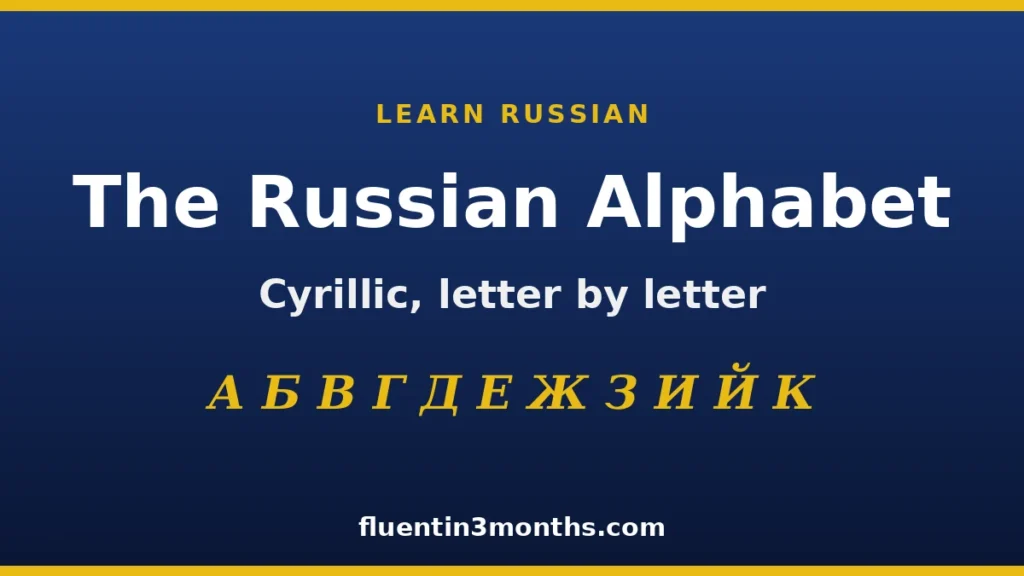
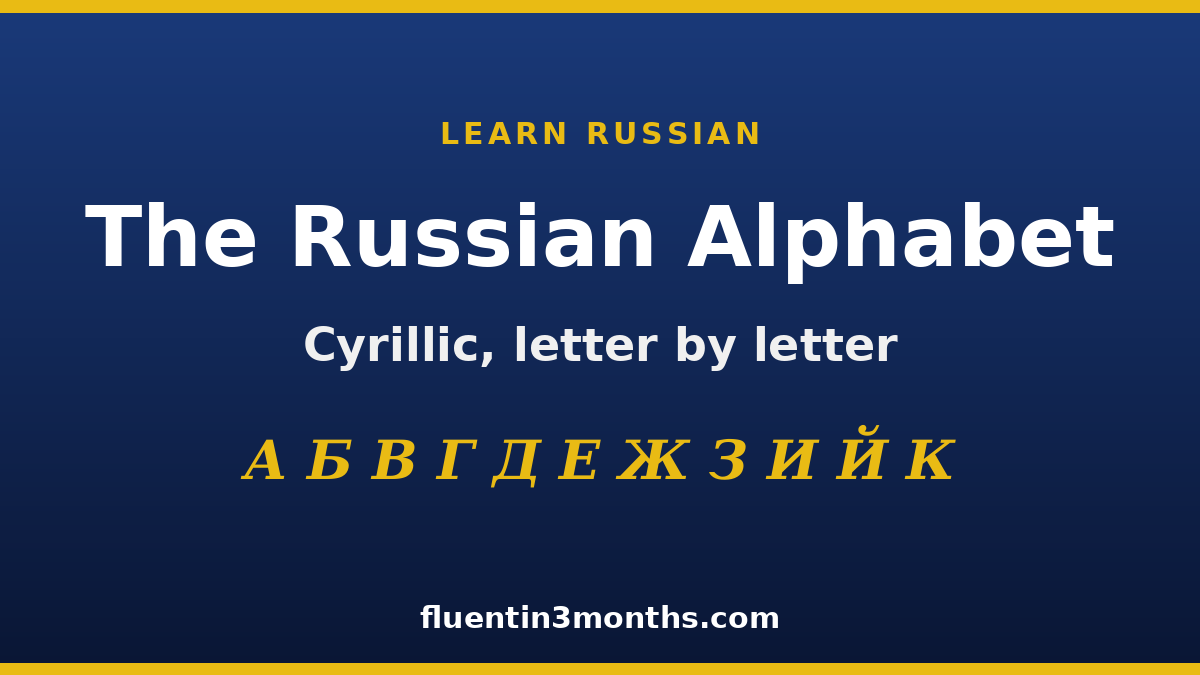
The Russian alphabet, a 33-letter system known as Cyrillic, serves as the primary script for the Russian language and several other Slavic and non-Slavic tongues across Eurasia. While often perceived by Western learners as a significant barrier to entry due to its distinctive characters—such as the "reversed R" (Я) or the "numerical 3" (З)—linguists and educators argue that the system is highly logical, phonetic, and accessible. Unlike logographic systems such as Mandarin Chinese, where characters represent concepts or morphemes, Cyrillic is a purely alphabetic script. This structural characteristic ensures that once the 33 symbols are mastered, a learner can phonetically decode any Russian word, regardless of whether they understand its meaning. This report examines the historical origins of the script, its structural categorization, the linguistic mechanics of its phonetic system, and the modern pedagogical approaches used to facilitate rapid acquisition.
Historical Evolution of the Cyrillic Script
The development of the Cyrillic alphabet is a pivotal event in the history of Eastern European literacy and religion. The script is named after Saint Cyril, a ninth-century Byzantine missionary who, along with his brother Methodius, was tasked with translating liturgical texts into Old Church Slavonic to facilitate the conversion of Slavic peoples to Christianity. However, historical records indicate that the brothers did not directly invent the Cyrillic script used today. Instead, they developed Glagolitic, a complex and highly original script that bore little resemblance to the Greek or Latin alphabets.
The transition from Glagolitic to Cyrillic occurred in the late ninth and early tenth centuries, primarily at the Preslav Literary School in the First Bulgarian Empire. Students of Cyril and Methodius, most notably Saint Clement of Ohrid, are credited with refining the script by basing many of its characters on Greek uncial script. This Greek foundation explains why many Russian letters—such as А, Е, К, М, О, and Т—remain identical to their Latin and Greek counterparts.
Throughout the centuries, the alphabet underwent several significant reforms to align it with the evolving spoken language. The most transformative of these was the Civil Script reform of 1708, initiated by Peter the Great. This reform modernized the appearance of the letters, making them more consistent with Western European typography and removing several archaic Greek-based characters that had become redundant. The final major modification occurred in 1918, shortly after the Russian Revolution, when the Soviet government eliminated four additional letters (Ѣ, І, Ѳ, and Ѵ) to simplify spelling and increase literacy rates among the general population.
Structural Categorization of the 33 Letters
To facilitate efficient learning, modern linguistic frameworks often categorize the Russian alphabet into four distinct groups based on their visual and phonetic relationship to the Latin alphabet. This systematic approach allows learners to leverage existing knowledge while identifying potential cognitive traps.
Group 1: The True Cognates
The first group consists of five letters that are visually identical and phonetically similar to English letters: А, К, М, О, and Т. For an English speaker, these require virtually no effort to memorize. They provide an immediate "win" for the student, allowing for the reading of basic words such as "Атом" (atom) or "Мама" (mama) within minutes of beginning study.
Group 2: The False Friends
Linguists identify this category as the most challenging for Western learners. These seven letters use shapes familiar to the Latin alphabet but assign them entirely different phonetic values. This group includes:
- В (V): Not a "B," but a "V" sound.
- Е (Ye): Often pronounced with a preceding "y" sound.
- Н (N): Not an "H," but an "N" sound.
- Р (R): Not a "P," but a rolled "R" sound.
- С (S): Not a "C," but an "S" sound.
- У (U): Not a "Y," but an "oo" sound.
- Х (Kh): Not an "X," but a guttural "h" sound similar to the "ch" in "loch."
Failure to distinguish these "False Friends" leads to the most common reading errors, such as misinterpreting the abbreviation "СССР" (SSSR) as "CCCP."
Group 3: Unique Cyrillic Shapes
This category encompasses characters that do not exist in the Latin alphabet, many of which are derived from Greek or represent sounds specific to Slavic phonology. This includes letters like Б (B), Г (G), Д (D), Ж (Zh), З (Z), И (I), Л (L), П (P), Ф (F), Ц (Ts), Ч (Ch), Ш (Sh), Щ (Shch), Э (E), Ю (Yu), and Я (Ya). While these require more rote memorization, they do not present the same cognitive interference as the "False Friends" because they do not have a pre-existing English sound attached to their shape.
Group 4: The Orthographic Signs
The final group contains two characters that produce no sound of their own: the Hard Sign (Ъ) and the Soft Sign (Ь). These serve as phonetic instructions, telling the reader how to pronounce the preceding consonant or indicating a slight pause between a consonant and a vowel. Additionally, the vowel Ы (Yeri) belongs to this group as a unique sound with no direct English equivalent, often described as a "hit to the stomach" vocalization.
Phonetic Mechanics: Hard and Soft Vowel Pairs
A defining feature of the Russian language is its system of palatalization, which is governed by the 10 vowel letters. These vowels are organized into "hard" and "soft" pairs:
- А / Я (A / Ya)
- Э / Е (E / Ye)
- Ы / И (Y / I)
- О / Ё (O / Yo)
- У / Ю (U / Yu)
When a consonant is followed by a "soft" vowel (the second letter in each pair), the consonant undergoes palatalization. This means the speaker raises the middle of the tongue toward the hard palate while pronouncing the consonant, giving it a distinct "soft" quality. This phonetic rule is one of the most consistent aspects of Russian grammar and is essential for achieving an authentic accent and distinguishing between words that are otherwise identical in spelling.
Global Impact and Modern Relevance
The Cyrillic alphabet is far from a localized Russian phenomenon. It is currently the official script for over 250 million people worldwide. In 2007, with the accession of Bulgaria to the European Union, Cyrillic became the third official script of the EU, alongside Latin and Greek.
The script is utilized by several sovereign nations, including Belarus, Ukraine, Serbia, Bulgaria, North Macedonia, Kyrgyzstan, Tajikistan, and Mongolia. Each nation has adapted the script to fit its specific phonological needs; for instance, the Serbian version of Cyrillic is uniquely optimized so that each letter corresponds to exactly one sound, a principle known as "Write as you speak and read as it is written."
From a strategic and geopolitical perspective, proficiency in the Cyrillic script remains highly valued. Russian is one of the six official languages of the United Nations and is the primary language of international space travel; all astronauts aboard the International Space Station (ISS) are required to have a working knowledge of Russian and the Cyrillic alphabet.
Pedagogical Analysis of Acquisition Timelines
Educational data suggests that the Cyrillic alphabet is one of the fastest scripts for English speakers to acquire. While the Foreign Service Institute (FSI) categorizes Russian as a "Category IV" language—meaning it is significantly more difficult for English speakers than Spanish or French—this difficulty lies primarily in its complex grammar (cases and verb aspects) rather than its alphabet.
Most intensive language programs, including the "Fluent in 3 Months" methodology championed by polyglot Benny Lewis, suggest that the alphabet can be learned in as little as two to five days. This rapid acquisition is possible because the system is entirely phonetic. Once a student overcomes the initial hurdle of the "False Friends," the consistency of the script allows for immediate transition into vocabulary building and conversational practice.
Linguistic experts recommend a "no-transliteration" policy early in the learning process. Transliteration—the practice of writing Russian words using Latin letters (e.g., writing "Spasibo" instead of "Спасибо")—is often viewed as a "crutch" that inhibits the brain’s ability to internalize the new script. By immersing directly in Cyrillic, learners develop the necessary neural pathways for reading fluency much faster than those who rely on phonetic approximations in their native script.
Implications for Future Literacy
As digital communication continues to bridge international borders, the standardization of Cyrillic in computing (via Unicode) has ensured its survival and growth in the 21st century. The script’s ability to represent a wide array of sounds with precision makes it a robust tool for linguistic expression. For the modern learner, mastering these 33 letters is not merely an academic exercise; it is the key to unlocking a vast cultural, historical, and scientific landscape that spans two continents. The perceived "wall" of Cyrillic is, upon closer inspection, a gateway that is far easier to pass through than initial appearances suggest.