

The largest behavior change program running in most organizations today is not owned by learning and development teams, but rather by HR and facility management departments under the guise of return-to-office (RTO) policies. This shift represents a fundamental realignment of how modern enterprises attempt to influence workforce habits. According to the JLL Global Occupancy Planning Benchmark Report 2026, 62 percent of organizations now enforce a fixed number of office days, marking a significant increase from the 49 percent reported just one year prior. With global office utilization currently stagnating at 56 percent, the disconnect between management mandates and employee behavior has become a primary case study in the limitations of top-down organizational control.
The Evolution of the RTO Mandate: A Chronology
The trajectory of corporate mobility and RTO policies can be traced back to the post-pandemic recovery phase of 2021 and 2022. Initially, many firms adopted "wait-and-see" approaches, offering hybrid flexibility to retain talent during the "Great Resignation." However, by late 2023, a shift occurred as leadership teams—facing economic headwinds and a desire to reclaim pre-pandemic levels of collaboration—began transitioning from voluntary hybrid models to rigid, policy-driven mandates.
By 2024, the "mandate-first" strategy reached a fever pitch. Major financial institutions, technology giants, and consultancy firms began utilizing badge-swipe data to track attendance, tying office presence to performance reviews and promotion eligibility. This period solidified the trend: when leadership perceives a decline in culture or productivity, the reflexive response is to codify a requirement rather than investigate the underlying friction points within the operational environment.
Data-Driven Reality vs. Policy Ambition
The reliance on mandates has produced measurable, often detrimental, outcomes. Research from Unispace, which surveyed 9,500 employees and 6,650 employers across 17 countries, provides a sobering look at the cost of these initiatives. While 62 percent of organizations have formal policies, 42 percent of those firms reported higher-than-anticipated attrition rates, and 29 percent cited increased difficulty in talent acquisition.
These statistics suggest that while mandates may successfully shift metrics on paper—such as badge swipes or desk occupancy—they often fail to achieve true behavior adoption. The data implies a "compliance trap": employees perform the minimum required action to avoid sanctions, but their internal commitment to the organization’s cultural goals remains detached. This phenomenon mirrors the limitations of traditional compliance training, where completion rates are high, but long-term behavioral change is negligible.
Friction as the Primary Barrier to Change
The most successful organizational shifts are rarely the result of superior communication or more persuasive messaging; they are the result of removing friction. In the context of corporate mobility, the transition from mandatory policies to voluntary adoption relies on the ease of the desired behavior.
For instance, consider an organization attempting to reduce its carbon footprint. A traditional campaign might involve town halls, posters, and email blasts regarding climate change. Historical data shows that such awareness campaigns rarely move the needle. Conversely, when the organization implements a seamless carpool application that matches routes, calculates real-time ETAs, and facilitates user feedback, the friction associated with the behavior drops. The messaging remains the same, but the behavior shifts because the operating environment has been redesigned to support it.
L&D departments and HR leaders must apply this principle to all cultural initiatives. If a company wants managers to provide more frequent feedback, the intervention should not be a workshop on the importance of feedback. Instead, the focus must shift to why providing feedback is currently difficult. Is the performance management software cumbersome? Is the process laden with bureaucratic approval steps? Is there a lack of incentive? If the system makes the desired behavior difficult, no amount of training will yield a sustainable change.
The Audit of Contradictions: Operational Integrity
A critical lesson for modern leadership is that employees read operations, not mission statements. A corporation may declare "Collaboration" as a core value, but if its physical and digital infrastructure—such as inadequate parking, lack of bookable meeting rooms, or unoptimized transit shuttles—makes arriving at the office an exercise in frustration, employees perceive a clear message: the organization does not actually value their time or their collaboration.
This leads to the concept of the "Contradiction Audit." Before any learning or cultural intervention is launched, leadership must map the proposed behavior against the current operational reality. If the reality contradicts the goal, the intervention will fail. In such instances, the most responsible action for an L&D or HR team is to highlight the systemic contradiction to senior leadership rather than launching a program that is destined to be perceived as disingenuous by the workforce.
Accessibility and the Minority Experience
A common pitfall in corporate program design is the assumption of a monolithic workforce. Whether it is a new hybrid work policy or a leadership development curriculum, designers often build for the "average" user, neglecting the needs of those with different access requirements, roles, or personal circumstances.
Leesman research into workplace design offers a stark warning: in unassigned, flexible offices without a variety of functional spaces, only 41 percent of employees report being able to work productively. When variety is introduced, that number jumps to 85 percent. However, even in the best-designed environments, roughly 25 percent of the workforce continues to struggle.
Learning and development initiatives often suffer from the same lack of inclusivity. A program that relies on a single delivery mode—such as a mandatory, hour-long webinar—inevitably isolates employees who learn, retain, and react differently to information. To build a resilient culture, designers must pivot from asking, "How do we reach the majority?" to "Who will this design fail, and what accommodations are necessary for them?"
Defining the Framework for Success
To move beyond the cycle of ineffective mandates, organizations must adopt a framework that prioritizes design over delivery. This involves answering four fundamental questions before a program is approved:
- Observed Behavior: What is the concrete, observable action that defines the goal? General terms like "accountability" or "innovation" are too vague. The goal must be a specific, measurable behavior.
- Friction Analysis: What makes the current, undesired behavior easier than the new one? This requires an honest audit of systems, incentives, and time costs.
- Contradiction Mapping: What operational realities currently block the desired outcome? These may include legacy policies, antiquated tools, or physical workspace constraints.
- Inclusive Design: Who is the program failing to reach? By identifying the 25 percent who are likely to struggle, organizations can provide alternative paths to success.
Measuring Intent vs. Impact
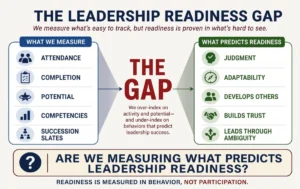
Finally, the distinction between intent, participation, and behavior is paramount. Many organizations mistake attendance (participation) for culture change. Attendance is merely a metric of compliance. True behavior change is measured by observing shifts in the underlying patterns of work—such as the quality of peer-to-peer interactions, the frequency of cross-departmental collaboration, or the speed of decision-making.
The L&D function is evolving into a "culture catalyst." By treating culture change as a design and measurement challenge rather than a content delivery mandate, organizations can create environments where the desired behavior is not just requested, but facilitated. In the long term, initiatives that are built on the foundations of operational support and reduced friction will consistently outlast the initial launch phase, driving sustainable growth in an increasingly complex work environment.