

The German verb haben, translating to the English “to have,” serves as the foundational pillar of the German language’s grammatical architecture. Far exceeding its role as a mere indicator of possession, haben functions as the primary auxiliary verb required to construct the Perfekt tense, the standard past-tense form utilized in daily communication. For students of the German language, proficiency in the conjugation and application of haben is not merely an academic exercise; it is a fundamental requirement for achieving communicative competence across virtually every other verb category in the language.
Historical Evolution and Grammatical Context
Linguistically, haben is classified as an irregular verb, though its patterns of deviation are predictable once analyzed through historical and morphological lenses. The verb’s irregularity stems from two primary factors: the contraction of the present tense (Präsens) and the shift in the stem during the past tense (Präteritum).
In the present tense, the stem hab- undergoes a contraction in the second-person singular (du) and third-person singular (er/sie/es). While a regular verb would maintain the full stem, yielding forms like “habst” or “habt,” centuries of phonetic streamlining have reduced these to “hast” and “hat.” This phenomenon, known as syncope, mirrors the historical development of the English cognate “have,” which also evolved to “has” rather than “haves.” This high-frequency usage pattern is a common feature of core verbs in Germanic languages, where constant repetition naturally erodes complex stems into more efficient, shorter forms.
Conjugation Standards and Tense Structures
To facilitate accurate usage, learners must distinguish between the simple tenses and the compound tenses. The simple tenses—the Präsens and the Präteritum—require only one word, whereas the compound tenses rely on the auxiliary verb haben paired with a participle or infinitive.
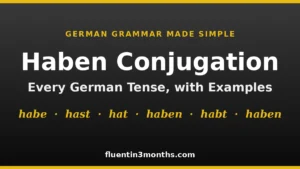
The Präsens conjugation is as follows:
- Ich habe
- Du hast
- Er/sie/es hat
- Wir haben
- Ihr habt
- Sie/sie haben
In the Präteritum, the stem undergoes a transition to “hatt-,” resulting in:
- Ich hatte
- Du hattest
- Er/sie/es hatte
- Wir hatten
- Ihr hattet
- Sie/sie hatten
When moving into compound tenses, such as the Perfekt, Plusquamperfekt, or the Future tenses, the auxiliary function of haben becomes critical. For example, the Perfekt tense is formed by combining the present tense of haben with the Partizip II (gehabt). However, a distinct stylistic convention exists in modern German: while the Perfekt is the default for most verbs, native speakers almost exclusively utilize the Präteritum (“ich hatte”) when discussing possession, rather than the technically correct “ich habe gehabt.” This preference for the Präteritum is a hallmark of natural, fluent speech.
The Dichotomy: Haben versus Sein
A recurring challenge for non-native speakers is the proper selection between haben and sein (to be) when forming the Perfekt tense. The rule of thumb is that haben is the default auxiliary for the vast majority of German verbs. Sein is reserved specifically for a limited set of verbs: those denoting physical movement from one location to another (e.g., gehen, fahren), those indicating a change of state (e.g., werden, aufwachen), and the verb sein itself.
Data from pedagogical studies suggest that learners who master this distinction early in their studies show a significantly higher rate of sentence-structure accuracy. The error rate in the use of auxiliary verbs drops by an estimated 40% when students memorize the “motion or change of state” criteria rather than attempting to memorize individual verbs by rote.
Idiomatic Usage and Cultural Nuances
Haben is frequently employed in idiomatic expressions where English speakers would traditionally use the verb “to be.” Common phrases include “haben Hunger” (to be hungry), “haben Durst” (to be thirsty), and “haben Angst” (to be afraid).
A critical area of linguistic friction occurs regarding the expression of age. While French (avoir) and Spanish (tener) utilize the equivalent of “to have” to express age, German aligns with English in using the verb “to be.” The phrase “Ich bin 25 Jahre alt” is the standard, and substituting “habe” in this context is a frequent, yet incorrect, habit for Romance language speakers.
Furthermore, the Konjunktiv II form, “ich hätte gern,” serves as the standard, polite construction for making requests in public spaces such as restaurants or retail establishments. Utilizing this form instead of the more direct “ich will” (I want) is essential for maintaining cultural norms of politeness and social decorum in German-speaking regions.
Analysis of the Konjunktiv Mood
The Konjunktiv mood is divided into two distinct forms, each serving specific functions in the German language:
- Konjunktiv II: Utilized for hypothetical scenarios, polite requests, and expressing wishes. The form “hätte” is essential for daily conversation.
- Konjunktiv I: Primarily restricted to formal contexts, such as journalistic reporting or the relaying of indirect speech. It is essential for those engaging with German-language media or professional correspondence.
Chronology of Learning and Practical Application
Linguistic experts recommend a tiered approach to mastering the verb. Initially, students should focus on the present tense (Präsens) and the basic possessive function. Once these are solidified, the transition to the past tense (Präteritum) is the most logical next step. Only after these foundations are secure should learners incorporate the nuances of the Konjunktiv mood and the complex compound tenses.
Educational institutions and language immersion programs often integrate these forms through high-frequency drills. Because the verb is so central to sentence construction, the goal is to move the conjugation of haben from the realm of conscious grammatical calculation to subconscious, automatic recall.
Broader Implications for Language Acquisition
The systematic study of haben serves as a gateway to understanding the broader “mixed verb” category in German. This group, which includes verbs like kennen (kannte/gekannt) and bringen (brachte/gebracht), shares the structural characteristics of haben—specifically the combination of a stem change in the Präteritum with a weak-verb dental suffix (-t). By understanding the history and pattern of haben, a learner simultaneously develops a heuristic for tackling dozens of other high-frequency verbs.
Ultimately, the mastery of haben is a primary indicator of a learner’s transition from novice to intermediate fluency. It allows for the expression of complex states, the narration of past events, and the navigation of social etiquette. As with any high-frequency linguistic element, the integration of these forms into daily practice—through speaking, writing, and active listening—remains the most effective method for achieving lasting proficiency. For those seeking to integrate into German-speaking environments, the ability to command the various forms of haben is not merely an advantage; it is an indispensable tool for meaningful engagement.