

The acquisition of temporal vocabulary represents a foundational milestone in the study of the Spanish language, serving as a critical bridge between basic comprehension and functional fluency. For the estimated 591 million Spanish speakers worldwide, the days of the week—los días de la semana—are not merely labels for time but are deeply embedded in the grammatical, historical, and cultural fabric of Hispanophone societies. Understanding these seven terms requires more than rote memorization; it demands an appreciation of specific orthographic rules, etymological origins, and the standardized calendar systems that differ significantly from those used in English-speaking North America.
Fundamental Vocabulary and Phonetic Accuracy
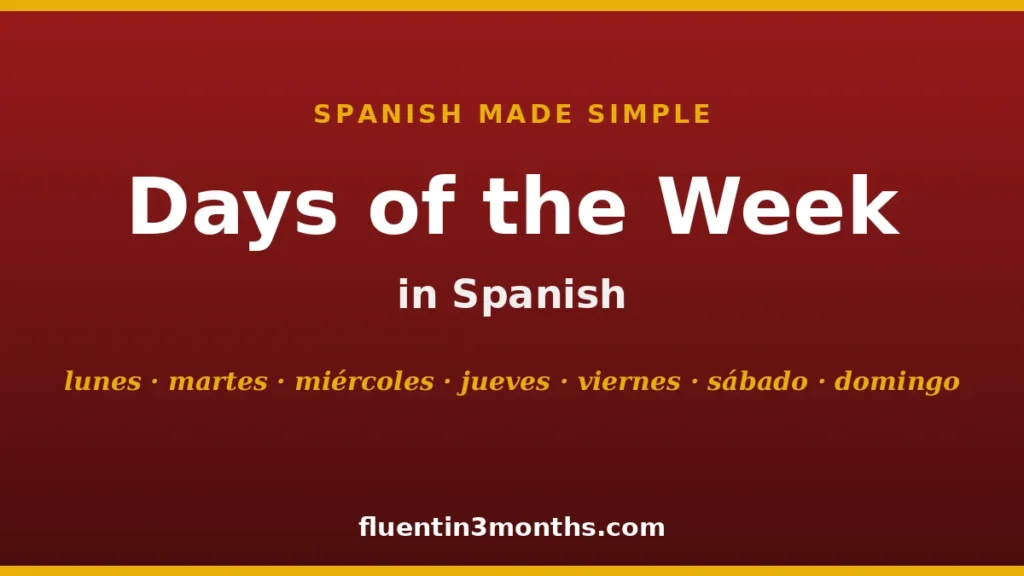
In the Spanish language, the seven days of the week are categorized as masculine nouns. Achieving native-like proficiency begins with accurate pronunciation and the correct application of diacritical marks. The following table outlines the standard terminology used across the Spanish-speaking world:
| Spanish Day | IPA / Phonetic Guide | English Equivalent |
|---|---|---|
| lunes | /ˈlunes/ (LOO-nes) | Monday |
| martes | /ˈmaɾtes/ (MAR-tes) | Tuesday |
| miércoles | /ˈmjeɾkoles/ (MYAIR-koh-les) | Wednesday |
| jueves | /ˈxweβes/ (HWEH-ves) | Thursday |
| viernes | /ˈbjeɾnes/ (VYAIR-nes) | Friday |
| sábado | /ˈsaβaðo/ (SAH-bah-doh) | Saturday |
| domingo | /doˈmiŋɡo/ (doh-MEEN-goh) | Sunday |
A critical technical detail often overlooked by novice learners is the use of the written accent (tilde). In Spanish, "miércoles" and "sábado" are "esdrújula" words, meaning the stress falls on the third-to-last syllable. According to the rules established by the Real Academia Española (RAE), these words must always carry a written accent to indicate proper vocal emphasis. Omitting these marks is considered a formal orthographic error. Furthermore, the pronunciation of the letter "j" in "jueves" requires a voiceless velar fricative sound, similar to the English "h" but produced deeper in the throat, distinguishing it from the English "j" sound.
Orthographic Standards and Capitalization Rules
One of the most frequent errors committed by English-speaking learners is the capitalization of days and months. In English, these terms are treated as proper nouns; however, Spanish orthography dictates that days of the week, months of the year, and seasons are common nouns.
Unless a day begins a sentence or forms part of a formal proper title (such as a specific holiday or a street name), it must remain in lowercase. For example, a professional email would state, "La reunión es el lunes" (The meeting is on Monday), rather than "el Lunes." This distinction is vital for maintaining a professional tone in written correspondence. Failure to adhere to this rule is a primary indicator of non-native writing and can detract from the perceived authority of a document in business or academic settings.
Chronological Standardization: The Monday-Start Convention
The organization of the Spanish calendar follows the international standard ISO 8601. This protocol, established by the International Organization for Standardization, designates Monday as the first day of the week. Consequently, in Spain and the vast majority of Latin American countries, calendars are printed with "lunes" in the leftmost column.
This chronological structure reflects the cultural perception of the "fin de semana" (weekend) as a cohesive unit comprising Saturday and Sunday at the end of the cycle. While some regions in the Americas influenced by U.S. commercial standards may occasionally utilize a Sunday-start calendar, the Monday-start remains the official and most prevalent format in professional, educational, and legal contexts across the Spanish-speaking world. For international travelers and business professionals, this shift is significant when interpreting schedules, booking transportation, or managing deadlines.
Syntactic Application and Grammatical Integration
The use of days of the week in Spanish sentences involves specific grammatical structures that differ from English syntax. Most notably, Spanish does not use a preposition equivalent to "on" when referring to days. Instead, the definite article (el/los) performs this function.
Singular vs. Plural Usage
All seven days are masculine, but their pluralization follows two distinct patterns based on their ending:
- Invariable Days (Monday through Friday): Because these days already end in "-es" or "-s," the word itself does not change when pluralized. The plurality is indicated solely by the article.
- El lunes (Monday/On Monday)
- Los lunes (Mondays/On Mondays)
- Variable Days (Saturday and Sunday): These days follow standard noun pluralization by adding an "-s."
- El sábado (Saturday/On Saturday)
- Los sábados (Saturdays/On Saturdays)
Sentence Examples and Context
- Habitual Action: "Los martes estudio español" (On Tuesdays, I study Spanish).
- Specific Event: "La conferencia es el miércoles" (The conference is on Wednesday).
- Omission of Article: The article is typically omitted after the verb "ser" (to be) when simply identifying the current day: "Hoy es jueves" (Today is Thursday).
Etymological Evolution: A History of Celestial and Religious Influence
The names of the Spanish days offer a historical timeline of the linguistic evolution from Latin to the modern Romance languages. Five of the seven days are derived from the "Planetary Week" of the Roman Empire, which named the days after celestial bodies that were, in turn, associated with Roman deities.
- Lunes: Derived from dies Lunae (Day of the Moon).
- Martes: Derived from dies Martis (Day of Mars, the god of war).
- Miércoles: Derived from dies Mercurii (Day of Mercury, the messenger of the gods).
- Jueves: Derived from dies Iovis (Day of Jupiter, the king of the gods).
- Viernes: Derived from dies Veneris (Day of Venus, the goddess of love).
The weekend days diverged from this planetary path due to significant cultural and religious shifts in the Mediterranean region. Sábado stems from the Hebrew Shabbat (Sabbath) via the Latin sabbatum, reflecting the Jewish and later Christian influence on the Roman calendar. Domingo replaced the original dies Solis (Day of the Sun) with the Latin dies Dominicus, meaning "the Lord’s Day," marking the Christianization of the Roman timekeeping system. This etymological "scaffolding" is shared with French, Italian, and Romanian, highlighting the deep-rooted Latin heritage of the Spanish language.
Supporting Data: The Role of Temporal Vocabulary in Language Acquisition
Data from the American Council on the Teaching of Foreign Languages (ACTFL) and the Common European Framework of Reference for Languages (CEFR) categorize the ability to use days of the week as a "Novice-Mid" to "Novice-High" competency. Mastery of these terms is essential for achieving functional literacy.
According to a 2023 analysis of high-frequency Spanish vocabulary, "día" (day) consistently ranks within the top 100 most used words in the language. Furthermore, in professional environments, approximately 35% of introductory business dialogue involves the coordination of time, making the days of the week indispensable for logistical operations.
Essential Temporal Phrases for Natural Communication
To effectively integrate days of the week into conversation, learners must also master a bank of related temporal expressions. These phrases provide the necessary context for past, present, and future planning.
- Hoy: Today
- Mañana: Tomorrow
- Ayer: Yesterday
- Pasado mañana: The day after tomorrow
- Antes de ayer / Anteayer: The day before yesterday
- La semana que viene: Next week
- La semana pasada: Last week
- El fin de semana: The weekend
- Entre semana: During the week (weekdays)
- Cada lunes: Every Monday
The phrase "el fin de semana" is particularly vital in social contexts. In many Spanish-speaking cultures, the weekend is prioritized for family gatherings and communal events, and correctly referencing these days is key to social integration.
Broader Impact and Practical Implications
The accurate use of Spanish days of the week carries significant implications for global trade and international relations. As the United States and the European Union continue to strengthen economic ties with Latin American markets, linguistic precision becomes a tool for efficiency. Misinterpreting a deadline due to a misunderstanding of the "Monday-start" calendar or failing to pluralize "los viernes" in a contract can lead to logistical errors and financial discrepancies.
Furthermore, for the growing number of heritage learners and students of Spanish, understanding the etymology and grammar of the days provides a deeper connection to the history of Western civilization. It illustrates how language acts as a living record of human transition—from pagan planetary worship to monotheistic traditions, and finally to the standardized, secularized international systems of the modern era.
In conclusion, the days of the week in Spanish are a microcosm of the language’s broader complexities. By adhering to the rules of lowercase writing, mastering the unique pluralization of the weekdays versus the weekend, and understanding the celestial and religious history behind the names, speakers can navigate the Spanish-speaking world with greater confidence and cultural competence. These seven words, though simple in concept, are the essential gears that drive the daily machinery of communication, commerce, and culture across the Hispanic world.