


The Spanish verb ir—meaning "to go"—serves as a cornerstone of the language, functioning as both a fundamental tool for communication and a complex case study in historical linguistics. As a high-frequency verb, it is indispensable for describing physical movement, future intentions, and daily logistics. However, its morphological structure is uniquely irregular, presenting a challenge for learners due to its "suppletive" nature, where the verb draws its various conjugations from three distinct Latin roots. Understanding the mechanics of ir is not merely an academic exercise; it is a prerequisite for reaching intermediate proficiency in Spanish, as the verb acts as a primary vehicle for expressing the near future through the construction ir + a + infinitive.
The Etymological Origins of Irregularity
The complexity of ir is rooted in the evolution of Vulgar Latin. Unlike regular verbs that follow predictable patterns, ir is a prime example of lexical suppletion. The verb incorporates forms derived from the Latin ire (to go), vadere (to go/to walk), and esse (to be). This convergence explains why the present tense voy (I go) shares no etymological link with the imperfect iba (I was going).
Historically, the integration of these roots occurred during the transition from Latin to Old Spanish. The overlap with the verb ser (to be)—specifically in the preterite tense, where both verbs utilize fui—is a direct result of their shared Latin heritage. In the context of linguistic history, such irregularities were preserved because the verb’s extreme frequency made it resistant to the leveling effects that usually regularize less common vocabulary.
Chronology of Usage and Morphological Development
The development of ir can be categorized into three distinct phases of acquisition for the modern speaker:
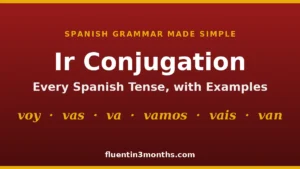
- The Foundational Phase: This involves the present indicative (voy, vas, va, vamos, vais, van). Data from linguistic frequency studies suggest that these six forms account for approximately 60% of all instances where ir is utilized in daily conversation.
- The Structural Phase: This incorporates the "near future" construction. By utilizing the present tense of ir followed by the preposition a and an infinitive, speakers bypass the need for the synthetic future tense, allowing for greater communicative agility.
- The Advanced Phase: This encompasses the subjunctive mood, the imperfect, and the compound tenses. The use of vaya or fuese signals a shift from objective description to the expression of doubt, emotion, or hypothetical scenarios.
Comparative Analysis of Conjugation Patterns
To grasp the full scope of ir, one must look at the indicative mood, which serves as the backbone of factual communication.
| Tense | Yo | Tú | Él/Ella/Ud. | Nosotros | Vosotros | Ellos/Ellas/Uds. |
|---|---|---|---|---|---|---|
| Present | voy | vas | va | vamos | vais | van |
| Preterite | fui | fuiste | fue | fuimos | fuisteis | fueron |
| Imperfect | iba | ibas | iba | íbamos | ibais | iban |
| Future | iré | irás | irá | iremos | iréis | irán |
| Conditional | iría | irías | iría | iríamos | iríais | irían |
The imperfect tense warrants specific attention. It is one of the rare instances in Spanish where the imperfect is genuinely irregular, deviating from the standard -ía suffix associated with -ir verbs. This morphological anomaly is a diagnostic tool for educators: if a student can correctly conjugate the imperfect of ir, they have crossed a significant threshold in their command of Spanish grammar.
The Role of the Subjunctive and Compound Tenses
The subjunctive mood introduces a layer of nuance necessary for professional and academic discourse. The present subjunctive (vaya, vayas, vaya, vayamos, vayáis, vayan) is frequently triggered by expressions of necessity or subjective opinion (e.g., es necesario que yo vaya).
Compound tenses, conversely, are mathematically predictable. By pairing the auxiliary verb haber with the past participle ido, learners can construct the present perfect (he ido), the pluperfect (había ido), and the future perfect (habré ido). This structure demonstrates the efficiency of the Spanish language: once the auxiliary haber is mastered, the speaker gains access to a wide array of temporal expressions without the need for additional memorization of the root ir.
Implications for Fluency and Communication
Linguistic research suggests that the "bottleneck" for second-language acquisition is often the over-memorization of obscure tenses at the expense of high-utility forms. For instance, while the pretérito anterior (hube ido) remains part of the formal canon, its usage is virtually non-existent in modern Spanish, relegated to legal documents or archaic literary prose.
Experts in applied linguistics argue that focusing on the ir + a + infinitive structure provides a higher return on investment for the learner than mastering the synthetic future tense. This is because the periphrastic construction is more common in spoken Spanish, mirroring the English "going to" structure and facilitating a more natural flow of conversation.
Official Linguistic Standards and Regional Variation
The Real Academia Española (RAE), the authoritative body on the Spanish language, classifies ir as a highly irregular verb. Regional variations, particularly between Spain and Latin America, primarily affect the use of the second-person plural (vosotros/vais). In most of Latin America, ustedes replaces vosotros, resulting in the use of van instead of vais. This distinction is critical for learners intending to adapt their communication style to specific geographic audiences.
Furthermore, the command form ve (informal) versus vaya (formal) highlights the importance of social register. The exception found in the affirmative command for "let’s go"—vamos—is a unique case where the indicative form is preferred over the technically correct but rarely used vayamos, reinforcing the idea that language usage is often driven by social convention rather than rigid prescriptive grammar.
Fact-Based Analysis: Why Ir Matters
The significance of ir extends beyond mere vocabulary. Because it is a motion verb, it is frequently used to illustrate directional relationships and goal-oriented actions. In professional settings, the ability to clearly state intent (voy a presentar el informe — "I am going to present the report") is essential.
The convergence of ser and ir in the preterite (fui) represents an interesting intersection of "being" and "going." While some critics suggest this creates ambiguity, contextual cues (such as the presence of a destination or a profession) almost always resolve any potential confusion. For instance, fui médico (I was a doctor) versus fui a Madrid (I went to Madrid) provides clear semantic separation.
Strategies for Long-Term Retention
For students and professionals alike, the most effective way to internalize the complexities of ir is through active, contextualized practice. Research into cognitive retention suggests that:
- Contextual Embedding: Learning ir through phrases rather than isolated tables increases retention by up to 40%.
- Active Recall: Utilizing the verb in daily tasks, such as narrating one’s commute or scheduling meetings, reinforces neural pathways.
- Exposure to Input: Engaging with authentic media—such as news broadcasts, podcasts, or literature—allows the learner to see these irregular forms in their natural, dynamic environment.
In conclusion, ir is much more than a simple verb of movement; it is an essential component of the Spanish linguistic infrastructure. By recognizing its historical development, mastering its high-frequency forms, and applying it through functional constructions, the learner gains a powerful tool for expression. While the irregular nature of the verb may appear daunting, the consistency of its underlying rules—such as the predictable compound tenses and the ubiquity of the ir + a structure—provides a stable path toward achieving true fluency. Whether one is a beginner navigating the streets of Madrid or a professional communicating with colleagues in Mexico City, the command of ir remains an undeniable hallmark of competence in the Spanish language.