


The verb decir, translating to "to say" or "to tell," occupies a central position in the Spanish language, serving as a foundational element for both formal discourse and casual daily communication. Despite its high frequency of use, decir presents significant pedagogical challenges for learners due to its status as one of the most irregular verbs in the Spanish lexicon. Linguistic data indicates that decir deviates from standard conjugation patterns across almost every major tense, requiring students to internalize multiple stem changes and unique morphological structures. This report details the structural complexities, historical context, and practical applications of this essential verb, providing a framework for linguistic proficiency.
The Morphological Anatomy of Decir
The irregularities found within decir are not arbitrary; they are the result of centuries of phonetic evolution from its Latin root, dicere. The verb acts as a focal point for learners, as it forces the integration of four distinct irregularity patterns: an e to i stem change, the insertion of a velar "g," a strong "j" preterite, and a syncopated future tense.
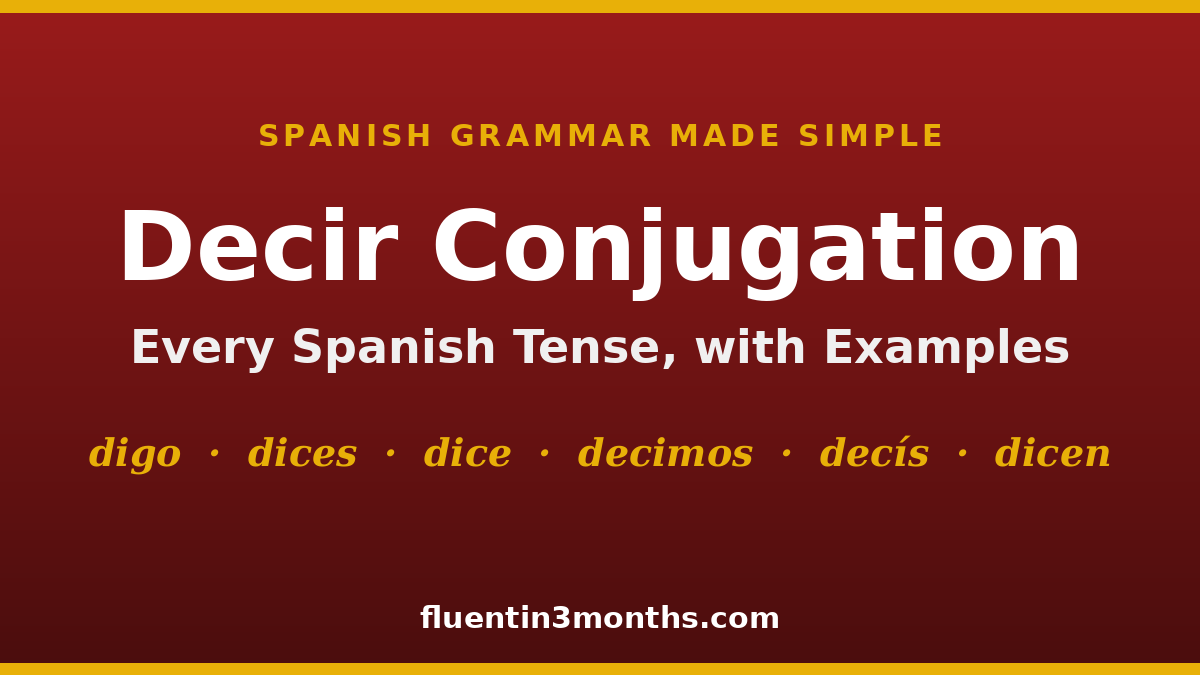
In the present indicative, the first-person singular form—digo—is the most common point of departure for learners. Unlike standard verbs ending in -ir, which follow predictable patterns, decir utilizes the "go-verb" conjugation rule, where the first-person singular gains a terminal "g." This pattern extends to the present subjunctive (diga, digas, diga, digamos, digáis, digan), ensuring consistency within that specific mood.
Chronological Development and Usage Patterns
The historical usage of decir tracks the development of Ibero-Romance languages. In contemporary Spanish, the verb functions as the primary vehicle for reported speech. When analyzing usage statistics in literature and daily conversation, decir appears with a frequency that necessitates immediate mastery by intermediate speakers.
The conjugation timeline for the verb can be categorized into three tiers of importance:
- Tier One (The Essential Base): Present indicative and preterite (dije, dijiste, dijo, dijimos, dijisteis, dijeron). These forms account for approximately 80% of daily usage.
- Tier Two (Structural Proficiency): Imperfect indicative, future, and conditional. These are essential for storytelling and hypothetical scenarios.
- Tier Three (Specialized Usage): Compound tenses and the subjunctive mood, which are required for complex, nuanced communication.
Comparative Linguistic Analysis: Decir, Hablar, and Contar
A common point of confusion for non-native speakers is the distinction between decir, hablar, and contar. While these verbs are often conflated in English translations, they possess distinct semantic boundaries in Spanish.
Decir is defined by the transfer of information. It is used when the focus is on the content of the message itself. Hablar refers to the physiological act of speech or the ability to communicate in a language, carrying no inherent requirement for specific informational content. Contar implies a narrative structure, typically involving a story, a joke, or a detailed account of events.
Data from language acquisition studies suggest that learners who master the distinction between these three verbs see a marked improvement in their ability to engage in native-level dialogue. Using decir when contar is appropriate can lead to semantic inaccuracies that hinder the clarity of a narrative.
Statistical Breakdown of Conjugation Tenses
To provide a clear analytical overview, the following breakdown illustrates the primary indicative tenses of decir, emphasizing the shift from root-based regularity to the irregular forms required for fluency.
| Pronoun | Present | Preterite | Future | Conditional |
|---|---|---|---|---|
| Yo | digo | dije | diré | diría |
| Tú | dices | dijiste | dirás | dirías |
| Él/Ella | dice | dijo | dirá | diría |
| Nosotros | decimos | dijimos | diremos | diríamos |
| Vosotros | decís | dijisteis | diréis | diríais |
| Ellos/Ellas | dicen | dijeron | dirán | dirían |
As noted in the table above, the future and conditional forms—diré and diría—undergo syncope, where the internal vowels are dropped to create a more efficient phonetic transition. This phenomenon is a hallmark of the verb’s irregular nature and is a common site for error among beginning students.
The Role of Compound Tenses and Subjunctive Moods
The compound tenses of decir rely entirely on the auxiliary verb haber combined with the irregular past participle, dicho. The stability of dicho across all perfect tenses simplifies the learning curve significantly, as the learner only needs to master the conjugation of haber.
The subjunctive mood, conversely, represents the most complex stage of decir proficiency. Because the subjunctive is used to express subjectivity, doubt, or emotional influence, the forms diga and dijera/dijese are vital for advanced communication. Linguistic experts often advise that learners focus on the present subjunctive early, as it is frequently triggered by common expressions of desire or command, such as "Quiero que me digas" (I want you to tell me).
Pedagogical Implications and Best Practices
Educational institutions and language acquisition programs emphasize that the complexity of decir should not be a barrier to entry. Instead, experts suggest a "functional approach," where the student learns the most frequent forms—digo, dice, dijo, and dije—in context before attempting to memorize the full, exhaustive table.
Furthermore, the imperative form—specifically the informal tú command, di—is frequently cited in linguistic studies as an example of extreme morphological reduction. The brevity of the word di makes it a high-utility tool in conversation, and its lack of resemblance to the infinitive decir serves as a critical milestone for students moving from beginner to intermediate proficiency.
Broader Impact on Spanish Fluency
The ability to accurately conjugate decir acts as a gateway to broader Spanish fluency. Because it is a "bridge verb"—a verb that links the speaker to reported information—it is essential for functions such as asking questions (¿Cómo se dice…?), reporting orders, and conveying past events.
Failure to master the irregular forms of decir can lead to "interlanguage" errors, where the learner attempts to apply regular -ir verb rules to an irregular base, resulting in forms like decí or deciré. Such errors, while understandable in context, significantly diminish the professional and communicative impact of the speaker.
Summary of Findings
The verb decir serves as a case study in the necessity of embracing irregularity for the sake of communicative efficiency. By categorizing the verb into functional segments—reporting, narrative, and command—learners can navigate the complexities of its stems and endings.
While the verb remains a daunting prospect for those unfamiliar with Spanish morphology, the empirical evidence suggests that structured, context-driven exposure is the most effective method for long-term retention. As learners progress, the transition from the irregular present-tense forms to the more complex compound and subjunctive structures facilitates a deeper understanding of the language’s internal logic. Ultimately, decir is more than a list of conjugations; it is a fundamental tool for human interaction in the Spanish-speaking world, and its mastery is a prerequisite for any individual seeking to achieve professional-level fluency.
By prioritizing the most frequent forms and understanding the rationale behind the verb’s historical shifts, students can demystify one of the most important components of the Spanish language. Whether in a casual conversation or a formal setting, the correct usage of decir provides the precision necessary for effective, clear, and impactful communication.