

The Spanish verb querer occupies a central position in the Romance language lexicon, serving as the primary vehicle for expressing desire, intent, and emotional attachment. Derived from the Latin quaerere—meaning to seek or to ask—its evolution into modern Spanish has rendered it one of the most frequently utilized, yet morphologically complex, verbs in the language. For learners, understanding the nuances of querer is not merely an exercise in memorization; it is a fundamental requirement for navigating the social, professional, and romantic landscapes of the Spanish-speaking world.
Etymological Evolution and Structural Irregularity
Linguists trace the trajectory of querer from its Latin roots to the medieval Spanish querer, noting that while it retained its semantic breadth, it underwent significant phonetic shifts. The verb is categorized as a "stem-changing" verb, specifically exhibiting an e-to-ie vowel shift in the present indicative tense. This irregularity is a common feature in high-frequency verbs, reflecting the linguistic tendency for words used most often in daily speech to resist regularization over centuries of usage.
The irregularity of querer is primarily categorized by two distinct patterns: the present tense stem change and the "strong" preterite stem, quis-. This second stem, quis-, is the foundational block for the preterite indicative, the imperfect subjunctive, and the future subjunctive. Unlike regular verbs that follow predictable patterns of inflection, querer demands that students of the language recognize these irregular roots as distinct units.
Chronology of Usage and Conjugation Paradigms
The complexity of querer is best understood through its functional division into moods: the indicative, which addresses objective reality; the subjunctive, which conveys subjectivity, desire, or hypothetical scenarios; and the imperative, used for commands.
The Indicative Mood: The Foundation of Communication
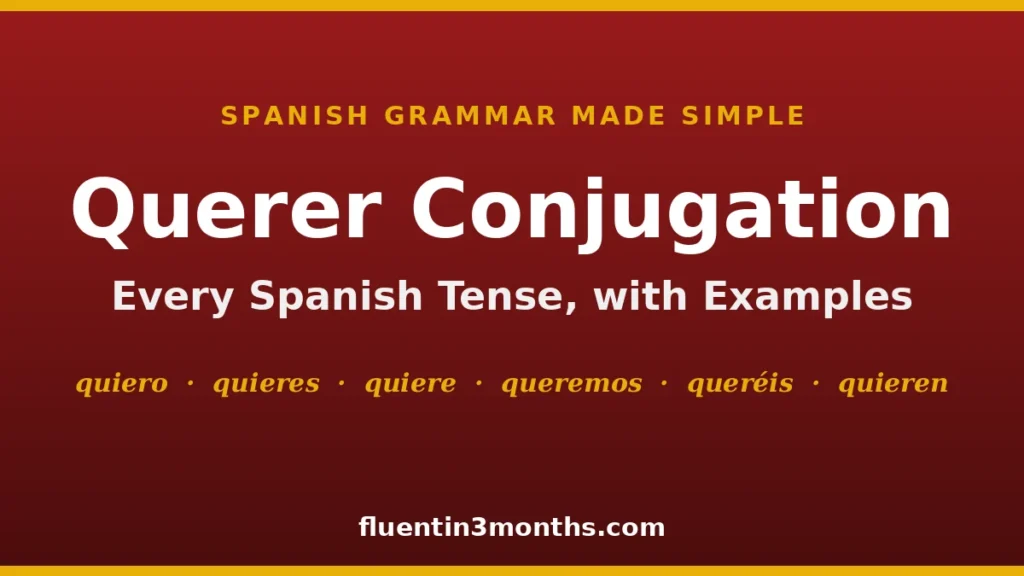
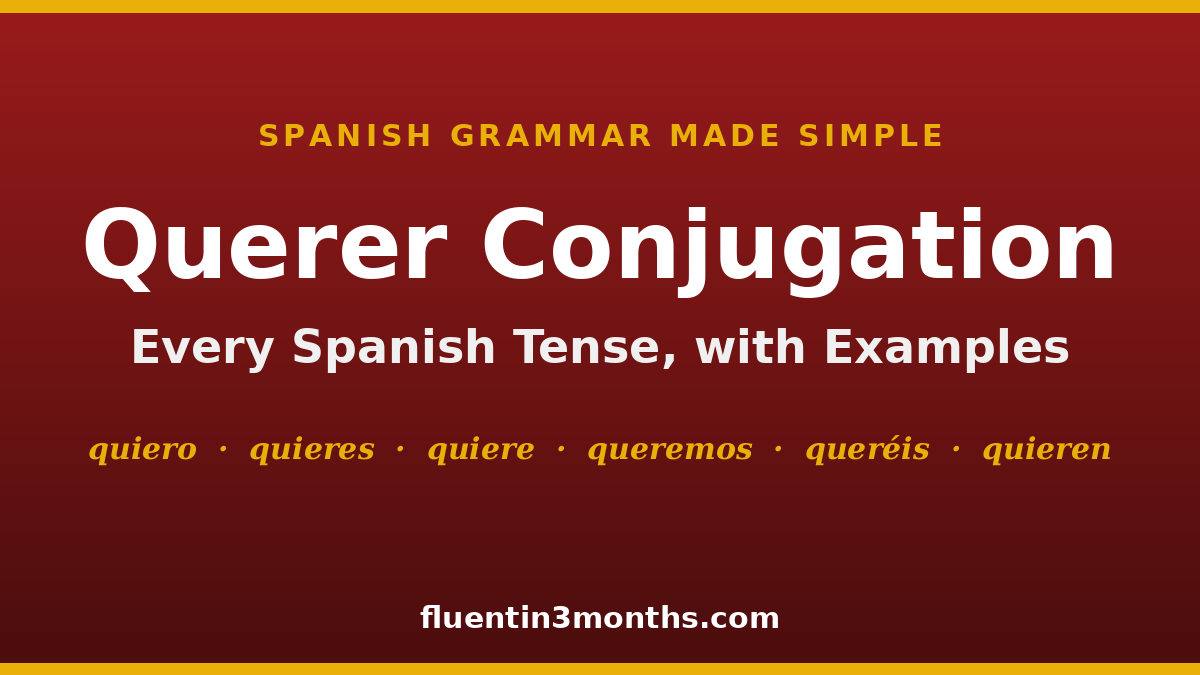
The indicative mood provides the bedrock for daily interaction. In the present tense, the forms quiero, quieres, quiere, queremos, queréis, and quieren are essential for basic transactions, such as ordering in a restaurant or stating preferences.
The historical timeline of the verb’s usage shows that while the simple tenses remain the most frequent, the compound tenses—constructed using the auxiliary verb haber—are increasingly utilized in modern academic and professional writing to denote completed actions or complex conditional states. For instance, the transition from quería (imperfect, denoting a continuous past desire) to había querido (pluperfect, denoting a desire that existed prior to another past action) allows for greater temporal precision.
The Subjunctive Mood: Expressing Nuance
The subjunctive mood is the hallmark of advanced Spanish proficiency. When a speaker uses querer to express a desire for someone else to perform an action—for example, quiero que vengas (I want you to come)—the verb must shift into the subjunctive. The use of quisiera as a polite, softened alternative to quiero is a critical social marker. Sociolinguistic studies indicate that in formal settings, particularly in Latin America, the use of the imperfect subjunctive quisiera is perceived as significantly more respectful than the direct, blunt indicative quiero.
Statistical Frequency and Lexical Utility
Quantitative analysis of Spanish corpora, such as those maintained by the Real Academia Española (RAE), consistently ranks querer among the top 100 most frequent verbs. This ubiquity is attributed to its dual meaning: the expression of material desire ("I want a book") and the expression of emotional affection ("I love you").
The distinction between te quiero and te amo has been the subject of extensive cultural analysis. While both translate to "I love you," the usage patterns are geographically and socially bounded. In Spain and parts of the Southern Cone, te quiero is the standard expression for family, friends, and early-stage romantic partners. Te amo, conversely, carries a heavier, more profound weight, often reserved for long-term romantic commitments. This semantic duality necessitates that learners understand not just the grammar, but the cultural weight of the words they employ.
Comparative Analysis: The Imperative and Formal Requests
While the imperative mood (command form) exists for querer, it is statistically rare in common parlance. Instructing someone to "want" something is pragmatically illogical in most contexts. However, its presence in literature and motivational rhetoric—such as quered lo mejor (desire the best)—demonstrates its potential for expressive, albeit niche, usage.
When comparing querer to its synonyms, such as desear (to desire) or amar (to love), linguists point out that querer remains the most versatile. While desear may sound overly formal or intense, and amar is strictly restricted to profound affection, querer acts as a linguistic bridge, allowing for a spectrum of intensity that few other verbs can match.
Strategic Learning for Proficiency
For the modern language learner, the strategy for mastering querer should prioritize functional utility over rote memorization of every possible permutation. The following hierarchy is recommended:
- The Present Indicative: Essential for daily interaction.
- The Polite Subjunctive (Quisiera): Crucial for navigating service-oriented social interactions.
- The Preterite (Quise/Quiso): Necessary for recounting historical events or past decisions.
- Compound Tenses: Necessary for professional or literary proficiency.
The "strong stem" irregularity in the preterite (quise) is a point of frequent error for learners who attempt to apply regular patterns. Recognizing that the past tense shifts from the quer- stem to the quis- stem is a milestone that separates intermediate learners from those with advanced comprehension.
Broader Linguistic Implications
The persistence of the irregular nature of querer highlights the resilience of archaic linguistic features. Despite the language’s evolution toward simplification in many areas, the irregular conjugations of querer have remained steadfast, preserved by their high frequency of use. This suggests that the verb is not only a functional tool but a core component of the Spanish identity.
Furthermore, the influence of regional variants cannot be ignored. The "voseo" (the use of vos instead of tú in countries like Argentina and Uruguay) affects the conjugation of querer in the present tense, resulting in querés. Understanding these regional variations is vital for any learner planning to interact with Spanish speakers across diverse territories.
Expert Perspectives and Educational Frameworks
Language pedagogy experts emphasize that the most effective way to internalize these irregularities is through contextual usage rather than isolated table study. Incorporating querer into personalized sentences—such as discussing personal goals or expressing care for relatives—creates neural associations that facilitate faster recall.
The integration of querer with other grammatical structures, such as ser vs. estar or the use of direct object pronouns, further elevates a learner’s fluency. For instance, the sentence te quiero is not merely a verb; it is a construction involving the object pronoun te. Mastering the placement of these pronouns in relation to the conjugated forms of querer is a final, essential step in reaching near-native fluency.
Conclusion
Querer is more than a verb; it is a fundamental element of the Spanish language that bridges the gap between basic needs and complex emotional expression. By understanding its irregular morphology, its nuanced application in the subjunctive mood, and its cultural significance in personal relationships, learners can navigate the complexities of Spanish with greater confidence and accuracy. While the verb presents challenges due to its irregularities, its high utility and versatility make it one of the most rewarding components of the Spanish language to master. As with all aspects of language acquisition, consistent application and a focus on context-driven learning remain the most effective paths to fluency. Through careful study of the patterns outlined in this guide, learners can transition from simple translation to the nuanced, expressive use of one of Spanish’s most vital verbs.