

The German verb haben, translating to the English "to have," serves as the foundational pillar of the German language, functioning as both a primary verb of possession and a critical auxiliary component for constructing complex tenses. While learners often categorize it as a simple irregular verb, its structural influence extends across nearly every grammatical dimension of the language, from the everyday Perfekt tense to the hypothetical constructs of the Konjunktiv mood. Understanding the nuances of haben is not merely an exercise in vocabulary acquisition; it is a prerequisite for achieving fluency and syntactical accuracy in both spoken and written German.
Historical Development and Morphological Irregularity
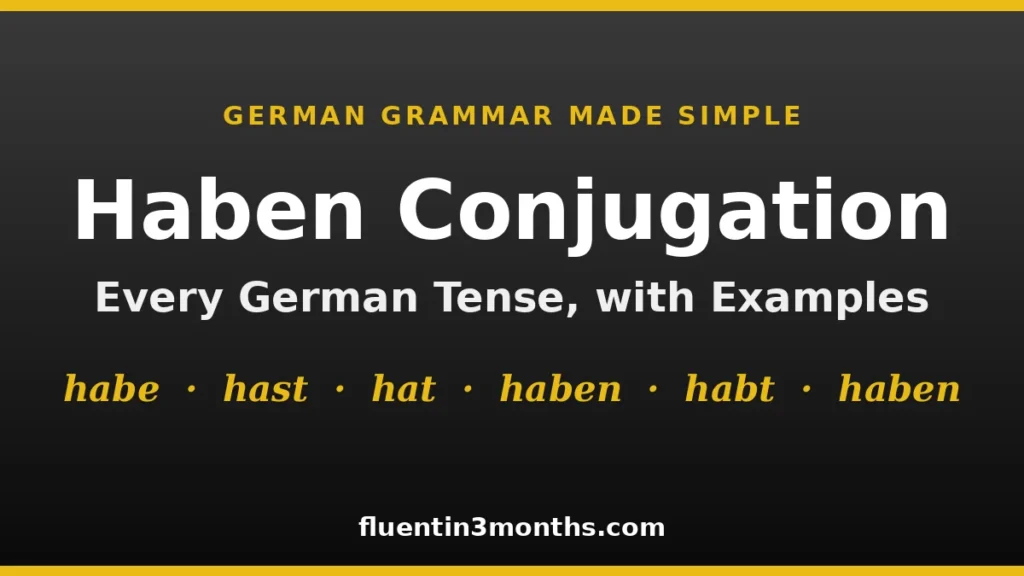
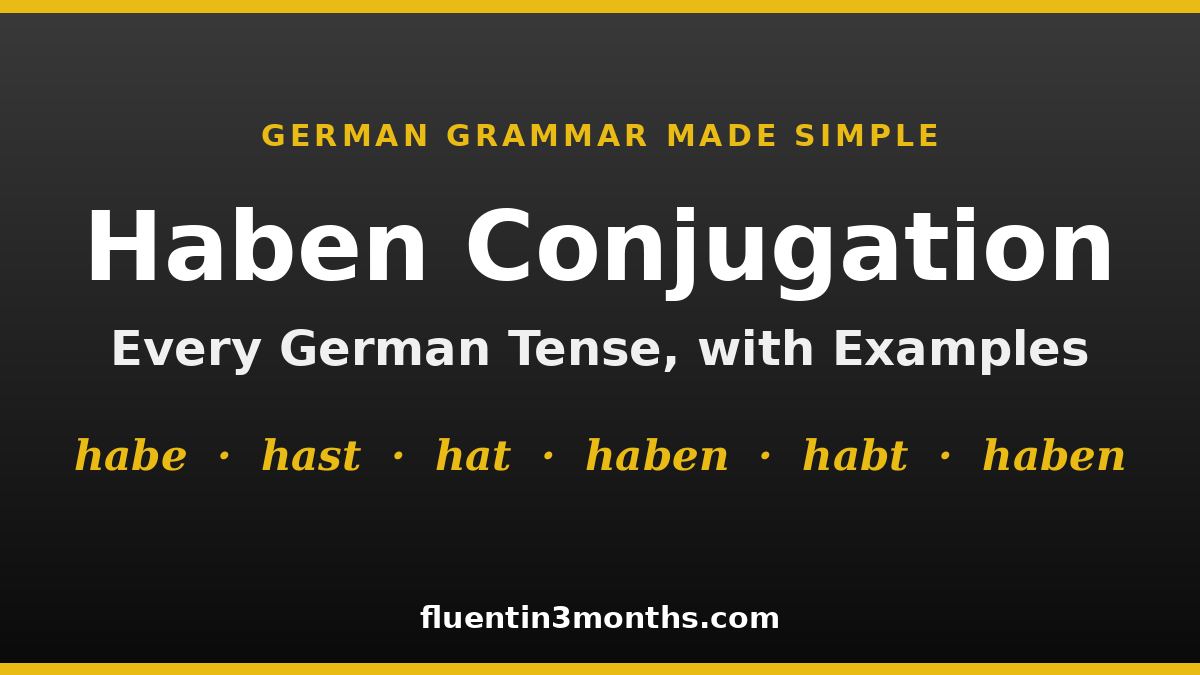
The irregularity of haben stems from its status as a high-frequency verb. In linguistic evolution, verbs that are used with extreme regularity in daily discourse tend to experience "morphological erosion," where the structure of the word simplifies over time to facilitate faster articulation. This process explains why the stem "hab-" undergoes a contraction in the present tense (Präsens). Specifically, the second-person singular (du) and third-person singular (er/sie/es) forms drop the medial "b," resulting in "hast" and "hat" rather than the expected "habst" and "habt."
This phenomenon is not unique to German; English speakers observe a similar pattern with the verb "to have," which conjugates to "has" rather than the etymologically regular "haves." This historical pressure has cemented haben as a "mixed" verb. While it adopts the weak-verb dental suffix "-t" for its past tense (Präteritum) and participle (Partizip II), it concurrently exhibits a vowel-stem shift in the past tense (hatte), distinguishing it from fully regular weak verbs like "machen" (machte, gemacht).
Chronology of Tense Construction and Usage
For the learner or the professional communicator, mastering the sequence of haben usage is essential. The verb operates across four primary temporal dimensions: the present, the past (divided between the spoken Präteritum and the compound Perfekt), the future, and the hypothetical.
In contemporary German, the Präteritum (simple past) is the preferred form for haben, even in casual conversation. While most German verbs rely on the Perfekt (auxiliary + participle) for past-tense narration, haben and its counterpart, sein, are the notable exceptions that retain the Präteritum for everyday speech. The conjugation table for the Präteritum—ich hatte, du hattest, er/sie/es hatte, wir hatten, ihr hattet, sie/Sie hatten—serves as the bedrock of narrative capability in German.
Supporting Data: The Auxiliary Dichotomy
A central challenge for students of the language is distinguishing between the two primary auxiliary verbs: haben and sein. Data from linguistic corpora indicate that the vast majority of German verbs (estimated at over 85%) utilize haben to construct compound tenses. The criteria for selection are relatively consistent:
- Haben is the default auxiliary for transitive verbs and verbs that do not involve a change of location or state.
- Sein is exclusively reserved for verbs of motion (e.g., gehen, fahren), change of state (e.g., aufwachen, werden), and specific stative verbs such as bleiben.
Failure to observe this distinction is cited by educators as the most frequent error in intermediate German composition. For instance, stating "ich habe gegangen" (I have walked) is grammatically incorrect, as the motion inherent in the verb requires the auxiliary "bin."
Syntactical Implications and Idiomatic Usage
The utility of haben extends into the realm of idiomatic expression, where it often replaces the "to be" construction used in English. This creates a significant "interference zone" for speakers of Germanic and Romance languages. For example, expressions of hunger (Hunger haben), thirst (Durst haben), or fear (Angst haben) require the verb haben, whereas English uses the verb "to be" (I am hungry).
Furthermore, the Konjunktiv II mood—a form frequently utilized for polite requests and hypothetical scenarios—relies heavily on the subjunctive form of haben, specifically "hätte." The phrase "Ich hätte gern…" (I would like…) represents a vital social tool in professional and retail environments. It allows the speaker to articulate desires with a level of formality and social grace that the direct verb "wollen" (to want) lacks.
Analysis of Professional and Academic Impact
In professional journalism and academic writing, the distinction between Konjunktiv I and Konjunktiv II is of paramount importance. Konjunktiv I, which retains the root "habe/habest," is the standard for reported speech. When a publication reports on a statement made by a third party, the use of Konjunktiv I indicates that the information is being attributed to another source, thereby maintaining the journalistic integrity of the report. This ensures that the writer does not endorse the statement as objective fact, but rather as reported information.
Conversely, the use of Konjunktiv II ("hätte") in formal reports often denotes counterfactuals or hypothetical projections, such as economic forecasts or policy simulations. For example, an analyst might state, "Die Firma hätte mehr Gewinn erzielt, wenn…" (The company would have achieved more profit if…), illustrating how the verb acts as a vehicle for complex logical argumentation.
Comparative Linguistic Context
The divergence between German and other languages regarding age expression remains a critical point of analysis. While Spanish ("tener… años") and French ("avoir… ans") utilize the equivalent of "to have" to express age, German aligns with English in using "sein" (to be). This specific point of divergence often leads to "negative transfer," where speakers of Romance languages habitually default to haben, resulting in errors that are immediately identifiable by native speakers.
Strategic Recommendations for Mastery
To achieve professional-level competence, learners should prioritize the following developmental stages:
- Immediate Memorization: The present tense (Präsens) must be internalized as a reflexive action, as it forms the basis for nearly all auxiliary constructions.
- Contextual Application: Moving beyond rote memorization, learners should utilize the Konjunktiv II form "hätte" in controlled scenarios, such as mock business meetings or restaurant ordering simulations.
- Diagnostic Drills: Practicing the conversion of English "to be" phrases into German "haben" idioms (e.g., "I am cold" to "Ich habe kalt") mitigates the interference from native language patterns.
Broader Implications for Language Acquisition
The systematic study of haben provides a microcosm of the German language’s broader architecture. Its development from ancient linguistic roots to its current status as a highly irregular, essential verb demonstrates the tension between historical preservation and the modern drive for communicative efficiency. By treating haben not just as a word, but as a structural gateway, learners can bridge the gap between basic functional communication and the ability to engage in complex, nuanced discourse.
Ultimately, the mastery of this verb is not defined by the ability to recite a table, but by the ability to instinctively select the correct form within the rapid-fire context of a native-level conversation. As the language continues to evolve in the digital age, the role of haben remains unchanged: it is the primary instrument by which speakers define possession, narrate the past, and project the hypothetical future. Those who command its irregularities gain a distinct advantage in navigating the complexities of German communication, ensuring that they can express intent with precision and clarity.