

The linguistic nuances of celebrating a birthday in the Francophone world extend far beyond a simple translation of common English greetings. While the phrase "Joyeux anniversaire" is widely recognized as the standard salutation for marking another year of life in France, the cultural framework surrounding these expressions involves regional variations, social etiquette, and historical context. Understanding these intricacies is essential for effective cross-cultural communication, particularly as linguistic habits diverge significantly between European French and the Canadian French spoken in Québec.
Linguistic Foundations and Standard Greetings
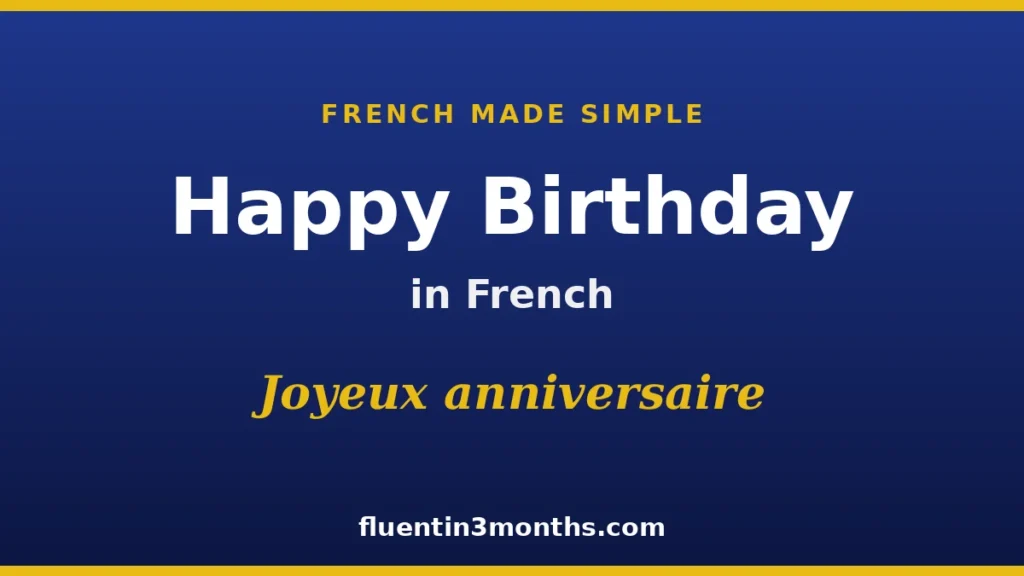
At the core of French birthday celebrations are two primary expressions: "Joyeux anniversaire" and "Bon anniversaire." Both are grammatically sound and universally accepted in both formal and informal contexts. Linguistically, "Joyeux" functions as an adjective meaning "joyful," while "anniversaire" denotes the anniversary or the day of birth. Together, they represent a direct equivalent to the English "Happy Birthday."
The phrase "Bon anniversaire" is equally common. The use of "Bon," meaning "good," serves a similar function to the English "Happy." Contrary to popular belief among non-native speakers, neither phrase dictates a specific level of social formality. The choice between the two is largely a matter of personal preference or regional habit. In more casual settings, particularly among younger generations or close social circles, the term is frequently truncated to "anniv." This abbreviation mirrors the English "b-day" and is generally reserved for text messaging, social media interactions, or casual verbal exchanges.
The Québecois Distinction: A Case of Regional Variance
A critical point of divergence exists in the Canadian province of Québec. In this region, the phrase "Bonne fête" is the standard, primary way to wish someone a happy birthday. This creates a notable opportunity for misunderstanding; in France, "Bonne fête" traditionally refers to a "name day"—a custom rooted in the Catholic calendar where an individual celebrates the feast day of the saint for whom they are named.
Data from the Office québécois de la langue française confirms that in the North American context, "fête" has evolved to become synonymous with a birthday. For a visitor from France, receiving a "Bonne fête" wish in Paris might lead to confusion regarding whether they are being congratulated on their name day rather than their birth anniversary. Conversely, using "Joyeux anniversaire" in Montreal is understood, but it may strike local residents as a distinctly European linguistic import. Recognizing this regional split is essential for individuals navigating professional or social relationships across the Atlantic.
Chronology and Evolution of Birthday Customs
The history of birthday celebrations in France is a fusion of secular tradition and historical religious observance. Historically, the emphasis in France was placed on the name day, as the Catholic Church prioritized the veneration of saints. It was only during the 20th century, particularly following the post-war period, that the birthday—the actual anniversary of one’s birth—began to eclipse the name day in terms of social prominence.
This shift was mirrored in the development of musical traditions. While the globalized melody of "Happy Birthday to You" is ubiquitous in France, it is often supplemented or replaced by a dedicated French song titled "Bon anniversaire." Composed by Louiguy with lyrics by Jacques Larue, the song was famously popularized by André Claveau in the 1950s. Unlike the generic English tune, this song holds its own copyright and remains a staple of French celebrations. Historians note that the adoption of this specific song helped solidify the "anniversaire" as a distinct, culturally specific event rather than a mere translation of Anglo-American practices.
Social Etiquette and Workplace Dynamics
The execution of a birthday event in a French context often follows a specific set of unwritten social protocols. One of the most significant differences from North American workplace culture is the expectation regarding refreshments. In many French professional environments, the onus is on the person celebrating to provide the cake or treats for their colleagues. This is viewed as an act of collegiality rather than a burden.
Furthermore, the "la bise" custom—the practice of kissing on the cheek—often dictates the level of physical intimacy in a greeting. The frequency and number of kisses vary significantly by department and region. Experts in French sociology emphasize that in a professional setting, one should defer to the host’s lead. If a colleague offers a handshake, mirroring that action is the appropriate response. Assuming physical contact is standard can occasionally lead to awkward social interactions, particularly in formal or hierarchical environments.
The Role of Phonetics and Liaison
For non-native speakers, the challenge of delivering these greetings lies in the phonetic phenomenon known as "liaison." The French language requires the final, normally silent consonants of words to be pronounced when the following word begins with a vowel.
In "Joyeux anniversaire," the ‘x’ at the end of "Joyeux" is not pronounced in isolation, but when spoken in the full phrase, it creates a /z/ sound, flowing into the "a" of "anniversaire." Similarly, in "Bon anniversaire," the final ‘n’ of "Bon" links with the following vowel, transforming the nasal sound into a smooth, connected transition. Mastering these liaisons is the primary indicator of a speaker’s fluency. Linguists suggest that learners practice these phrases as a single, rhythmic unit rather than as two distinct words to avoid the "staccato" effect often heard in beginners.
Statistical Context and Social Implications
While empirical data on birthday etiquette is difficult to quantify due to the highly localized nature of the customs, sociologists point to a decline in the "superstition" surrounding early birthday wishes. Historically, many French families adhered to the belief that wishing someone a happy birthday before the actual date was a harbinger of bad luck.
Recent trends, however, indicate that the digital age has largely dismantled this taboo. With the advent of social media notifications, the pressure to acknowledge birthdays on the exact day has diminished. Nevertheless, for those aiming to adhere to traditional social graces, sending a message on the day itself remains the safest and most respectful approach.
Broadening the Scope: Formal vs. Informal Communication
When crafting written messages for cards or emails, the distinction between "tu" (informal) and "vous" (formal) remains paramount. The decision to use one over the other is not merely a matter of age, but of the depth of the relationship.
- For Formal Relationships: Using "vous" is advised. Phrases such as "Je vous souhaite un très joyeux anniversaire" (I wish you a very happy birthday) demonstrate professional respect.
- For Close Friends and Family: The "tu" form allows for greater warmth, such as "Passe une excellente journée" (Have an excellent day) or "Je te souhaite beaucoup de bonheur" (I wish you much happiness).
The inclusion of these small linguistic markers significantly impacts how the message is received. An error in formality can sometimes be perceived as a lack of cultural awareness.
Conclusion: Navigating the Cultural Landscape
The act of wishing someone a happy birthday in French is a multifaceted exercise in social intelligence. It requires an awareness of regional differences, an understanding of historical context, and a grasp of the phonetic nuances that allow for natural speech. Whether navigating the office birthday ritual in Paris or participating in a family gathering in Montreal, the successful communicator is one who observes the local customs, respects the established level of formality, and recognizes that the sentiment behind the greeting is as important as the words themselves. By moving beyond simple rote memorization and engaging with the cultural expectations of the Francophone world, individuals can ensure their greetings are not only linguistically accurate but socially resonant.