



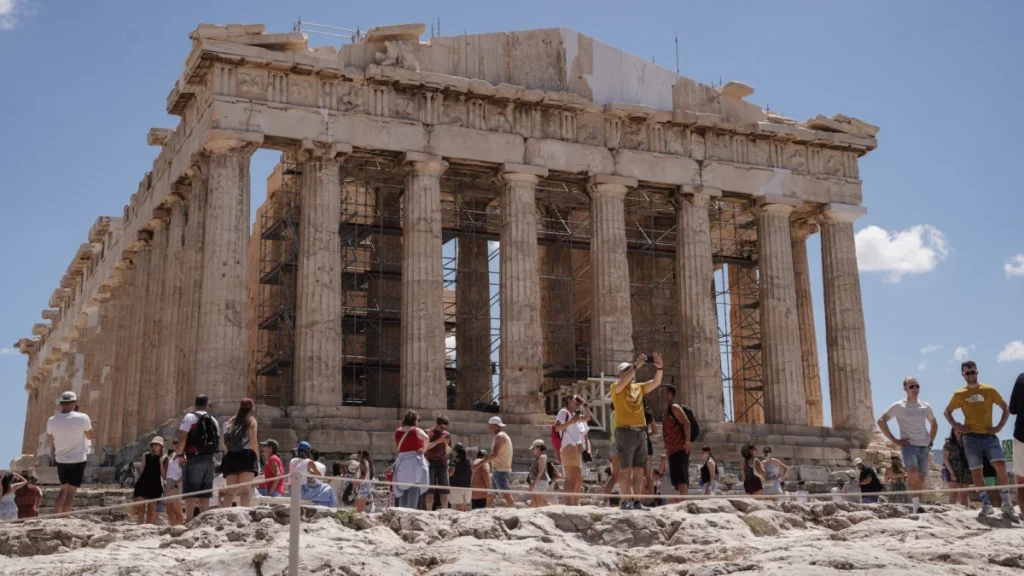
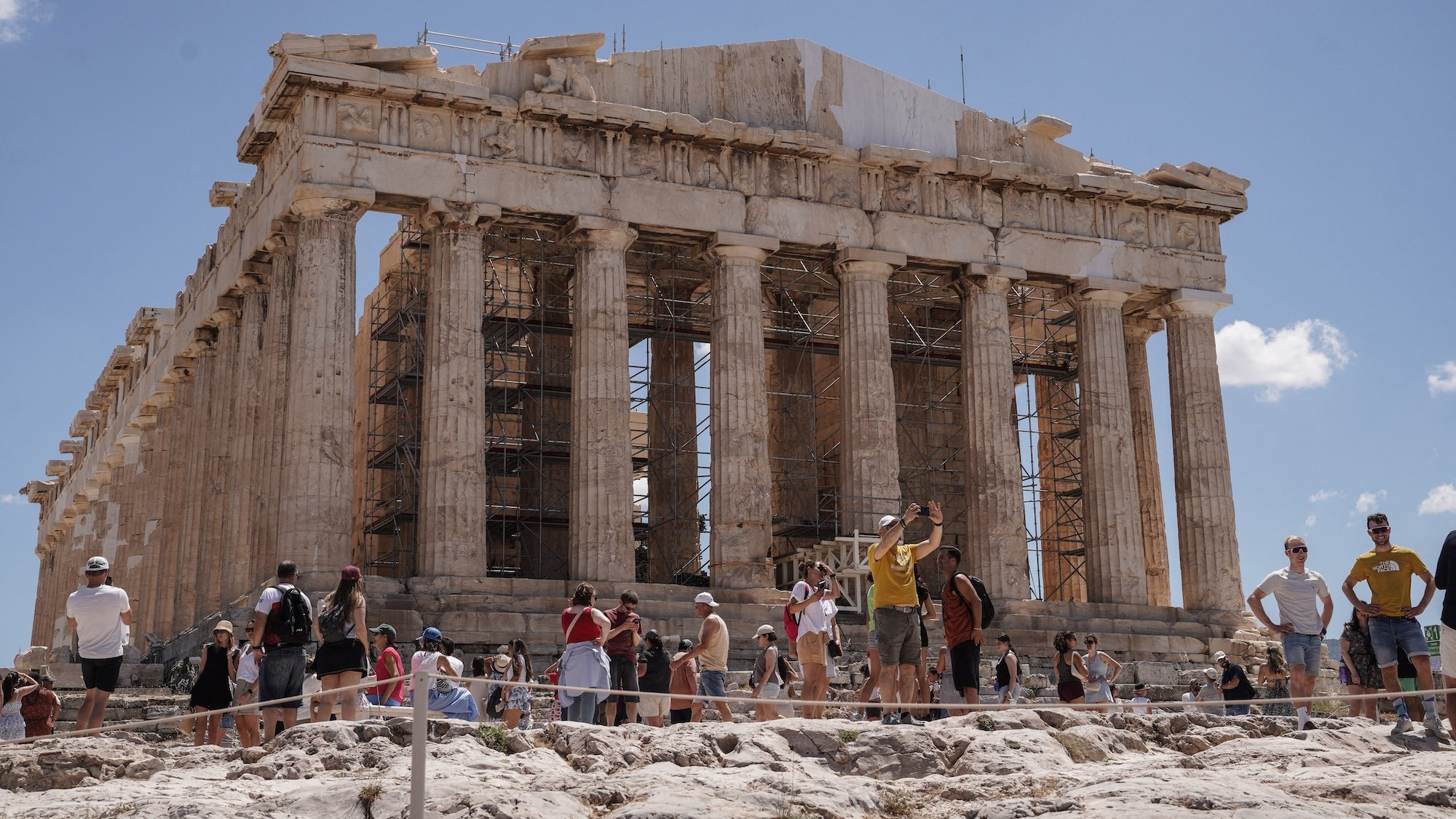
For more than two millennia, the Parthenon of Athens has stood not only as the pinnacle of classical Greek architecture, but also as a supreme triumph of applied mathematics and visual perception. Generations of art historians, architects, and classical scholars have taught that the temple’s iconic, imperceptible curves were deliberately engineered to correct human optical illusions. According to this long-standing scholarly consensus, if the ancient Greeks had built the temple with perfectly straight lines and right angles, human vision would have perceived it as sagging, warped, or structurally unstable.
However, a sweeping new computational study has shattered this foundational myth. Alain Goriely, a distinguished professor of mathematical modeling at the University of Oxford, has published research demonstrating that these famous optical corrections are largely non-existent. Utilizing advanced computer modeling and rigorous mathematical analysis, Goriely’s findings suggest that the subtle architectural variations found in the Parthenon were never designed to trick the human eye. Instead, the narrative of intentional optical wizardry is a romanticized fabrication born centuries after the temple’s completion—a projection of later generations seeking to elevate classical antiquity into an untouchable paradigm of absolute perfection.
The Parthenon is far more than a physical structure perched atop the Athenian Acropolis; it is the ultimate vessel into which successive eras have poured their highest ideals of proportion, harmony, and civilization. Yet, as Goriely notes in his study published in the journal Royal Society Open Science, this over-veneration has turned the monument into the "mother of all myths." By re-examining the physical evidence through modern computational tools, contemporary science is finally separating empirical engineering from centuries of cultural folklore.
Main Facts and the Core Revelation
The crux of Goriely’s investigation centers on four primary architectural anomalies traditionally cited as optical corrections: the curvature of the stylobate (the temple’s base), the entasis (the slight outward bulge in the columns), the inclination of the columns toward the center, and the corner adjustments designed to manage corner-column thickness and spacing.
For generations, textbooks have claimed that these minute adjustments—often measuring mere fractions of an inch—were masterstrokes of ancient visual engineering. The traditional narrative holds that the stylobate curves upward in the middle to counteract the illusion that a flat base sags in the center. Similarly, the columns were thought to bulge outward to prevent them from looking pinched or weak under the heavy weight of the entablature.
Goriely’s computational models, however, reveal a starkly different reality. While these micro-variations do physically exist within the structure, they are functionally invisible to the human eye from normal viewing distances. For instance, certain warps and adjustments measure a negligible 0.7 inches, falling well below the threshold of human visual perception. When subjected to rigorous mathematical testing to determine if they successfully counteract optical illusions, the calculations consistently fail. The adjustments are simply too small to correct the visual phenomena they were purportedly designed to fix.
Rather than marveling at invisible optical engineering, Goriely suggests a return to mundane pragmatism. The slight curvature of the temple’s base, for example, may have served the entirely practical, unromantic purpose of facilitating rainwater drainage, preventing pooling on the platform during torrential Mediterranean storms. Alternatively, these variations may simply reflect aesthetic preferences or masonry tolerances of the era, rather than a master plan orchestrated by omniscient mathematical wizards.
Historical Chronology of a Two-Millennium Myth
To understand how a structural quirk or practical building technique transformed into an elaborate optical conspiracy, one must trace the historical timeline of the Parthenon and its interpretation.
The genesis of the Parthenon dates back to the 5th century BCE, during the Golden Age of Athens under the statesman Pericles. Conceived as a grand temple dedicated to the city’s patron goddess, Athena, the construction project was spearheaded by the master sculptors and architects Ictinus and Callicrates, under the artistic direction of Phidias. Initiated in 447 BCE, the monumental Doric temple took roughly 15 years to complete, with construction largely finishing around 432 BCE.
For the first four centuries of its existence, the Parthenon stood as a functional religious sanctuary, untouched by the theories of optical physics. The building later underwent multiple transformations as the geopolitical landscape of Athens shifted. It served as a Christian church dedicated to the Virgin Mary in the Byzantine era, a Catholic church under Frankish rule, and a mosque following the Ottoman conquest of Greece in the 15th century. In 1687, tragedy struck when Venetian forces under commander Francesco Morosini bombarded the Acropolis during a war with the Ottoman Empire. A cache of gunpowder stored inside the temple ignited, triggering a catastrophic explosion that blew out the building’s center and reduced much of its pristine architectural integrity to ruins.
The myth of the Parthenon’s optical illusions did not emerge during its construction, nor even during its classical heyday. Claims regarding these illusion-defying adjustments first began circulating roughly 400 years after the temple was completed. The earliest recorded assertion is attributed to the 1st-century BCE Roman architect and engineer Vitruvius. In his monumental treatise De architectura, Vitruvius described subtle column curvatures and scale corrections allegedly crafted by Greek architects to counteract the appearance of concavity and optical distortion. Vitruvius focused heavily on the stylobate, claiming its arched sides were intentional manipulations of human perception.
For centuries, Vitruvius’s claims remained a minor architectural footnote. However, the myth experienced a massive resurgence during the European Enlightenment of the 18th and 19th centuries. As European scholars, architects, and romantic travelers—such as James Stuart and Nicholas Revett—rediscovered the ruins of Athens, they brought with them an idealized vision of classical Greece. Inspired by the scientific revolution and an emerging obsession with rationalism and geometry, Enlightenment thinkers projected their own sophisticated mathematical and scientific standards back onto the ancient builders. The Parthenon was retroactively transformed into a symbol of absolute, flawless perfection, where every millimeter of stone was believed to be calculated using advanced geometry and optics.
Supporting Data and Mathematical Methodology
Goriely’s journey into what he describes as a "mathematical rabbit hole" required a synthesis of historical architectural surveys and modern computational mechanics. Previous researchers had relied on manual measurements and qualitative visual assessments, which often fell victim to confirmation bias—researchers looking for perfection naturally found it embedded in the stones.
To break this cycle, Goriely applied advanced mathematical modeling to the physical dimensions of the Parthenon recorded by modern archaeological surveys, including laser-scanning data of the surviving ruins. His computer models simulated human visual perception under various lighting conditions, viewing angles, and distances.
The data yielded conclusive negative results. When modeling the impact of a 0.7-inch column bulge or a minor foundation arc on human optical processing, the computer simulations demonstrated that the human eye cannot discern the difference between a straight line and these minute deviations from a distance greater than a few meters, let alone from the ground looking up at the colonnade. Furthermore, the optical physics models showed that even if the curves were perceptible, they would not counteract the specific visual distortions—such as the illusion of sagging columns—that Vitruvius and later scholars claimed they were engineered to fix.
This quantitative disconnect proved that the traditional explanations were mathematically untenable. The architectural features exist, but their intended function was never the correction of optical illusions.
Academic Reactions and Scholarly Implications
The publication of Goriely’s study in Royal Society Open Science has sent ripples through the fields of classical archaeology, architectural history, and mathematics. While some traditionalists have expressed initial resistance—reluctant to abandon a charming narrative that has graced architectural textbooks for generations—many classical scholars have welcomed the rigorous empirical challenge to established dogma.
Reacting to the study, architectural historians note that the debunking of the optical illusion myth does not diminish the genuine brilliance of classical Greek builders. Instead, it strips away an overly romanticized, near-supernatural layer of myth, replacing it with an appreciation for the pragmatic, experimental, and evolving nature of ancient craftsmanship. The builders of the Parthenon were master stone-cutters and structural engineers, but they operated without the aid of modern calculus, optical physics, or computer-aided design. Assuming they possessed an infallible, encyclopedic knowledge of advanced optics is anachronistic.
Furthermore, the study highlights a broader philosophical issue within the humanities and sciences: the danger of retroactive idealization. When a culture or historical period is elevated to the status of perfection, subsequent generations tend to interpret every physical artifact through the lens of that perfection, turning mundane construction techniques into profound philosophical statements.
Broader Impact and Future Outlook
The demolition of the Parthenon optical illusion myth carries significant implications for how architectural history is taught and how historical monuments are interpreted by the public. Tour guides, museum exhibits, and academic textbooks will now be forced to correct a narrative that has persisted unchecked for two thousand years.
Beyond educational curricula, Goriely’s findings invite a broader epistemological shift in how humanity interacts with historical marvels. In his concluding remarks, the Oxford mathematician offers a simple yet radical prescription for visitors to ancient sites: "Trust your own eyes, question what you see and decide for yourself whether the theory of optical corrections holds up."
As modern technology continues to shed new light on antiquity—through laser mapping, artificial intelligence, and advanced computational modeling—our relationship with the ancient world is undergoing a profound transformation. The Parthenon remains an awe-inspiring testament to human creativity and endurance, having recently emerged from extensive restoration work on its western pediment. But as science strips away the romantic myths accumulated over millennia, the true genius of its builders is revealed not as superhuman perfection, but as the pragmatic, brilliant ingenuity of mortal hands shaping stone against the passage of time.