


The modern workplace has undergone a silent, data-driven transformation. In the past decade, corporate learning management systems (LMS) have evolved from simple repositories for compliance training into sophisticated, AI-powered engines capable of tracking every click, search, and hesitation an employee makes. While this granularity offers unprecedented opportunities for personalized professional development, it has also created a significant ethical divide: when does the collection of learning data transition from a supportive tool for growth into an instrument for workplace judgment?
As organizations increasingly integrate these learning ecosystems with broader talent management suites, HR analytics, and performance appraisal software, the risk of data "drift"—where information collected in one context is used to influence employment decisions in another—has become a central concern for human resources leaders and data privacy advocates alike.
The Evolution of Workplace Learning Analytics
Historically, workplace learning was a binary affair. An employee either completed a course, or they did not. However, the rise of "Learning Experience Platforms" (LXPs) and AI-driven diagnostic tools has changed the scope of visibility. Current platforms can now record not just completion rates, but time-to-completion, search history, the number of attempts at an assessment, and even the nuances of an employee’s conversation with an AI-powered tutor.
According to a 2024 survey by the Association for Talent Development (ATD), nearly 68% of large organizations have increased their investment in AI-based learning analytics. This trend, while designed to close skills gaps, has created a massive, often invisible, trail of behavioral data. The issue, according to organizational psychologists, is that these data points are frequently misinterpreted. A stalled course completion may be a sign of disengagement, or it could simply reflect a shift in urgent business priorities. A repeated attempt at an assessment might signal a knowledge deficit, or it may demonstrate a high degree of conscientiousness and a drive for mastery.
Chronology of a Data Integration Shift
The current landscape of integrated HR technology is the result of a multi-year shift in vendor architecture:
- 2018–2020: The Rise of the LXP. Organizations began moving away from rigid LMS structures, adopting platforms that prioritized user engagement and content discovery. This period marked the beginning of intensive tracking of "interest signals," such as search queries and course browsing behavior.
- 2021–2022: The Integration Mandate. To address the "skills gap," vendors began building deep integrations between learning systems and internal talent marketplaces. The goal was to allow employees to showcase their progress automatically.
- 2023–Present: The AI Inference Era. With the widespread deployment of Large Language Models (LLMs) as tutors and coaches, platforms began not just recording behavior, but inferring character traits and career intent from that behavior, often syncing these inferences to employee profiles without explicit consent.
The Problem of "Data Drift" and Implicit Judgment
The primary friction point for many organizations is the "default-on" nature of modern software integrations. When an employee engages with an AI tutor to ask a question—perhaps expressing uncertainty about a leadership task—that conversation is often stored as a transcript. If that transcript is fed into a sentiment analysis engine, the system might flag the employee as "lacking confidence" or "not ready for promotion."
If this inference is synced to an HR system by default, a manager viewing a potential candidate for a stretch assignment six months later might be presented with a red flag that the employee never knew existed. This creates a "permanent record" of developmental struggles that were intended to be private, formative moments.
Legal experts warn that this practice poses significant risks. "When you take behavioral data out of a development context and move it into a performance management context, you change the nature of the employment contract," notes Sarah Jenkins, an employment privacy analyst. "Employees are not being judged on their output, but on their process—a process they assumed was protected for the sake of learning."
A Framework for Governance
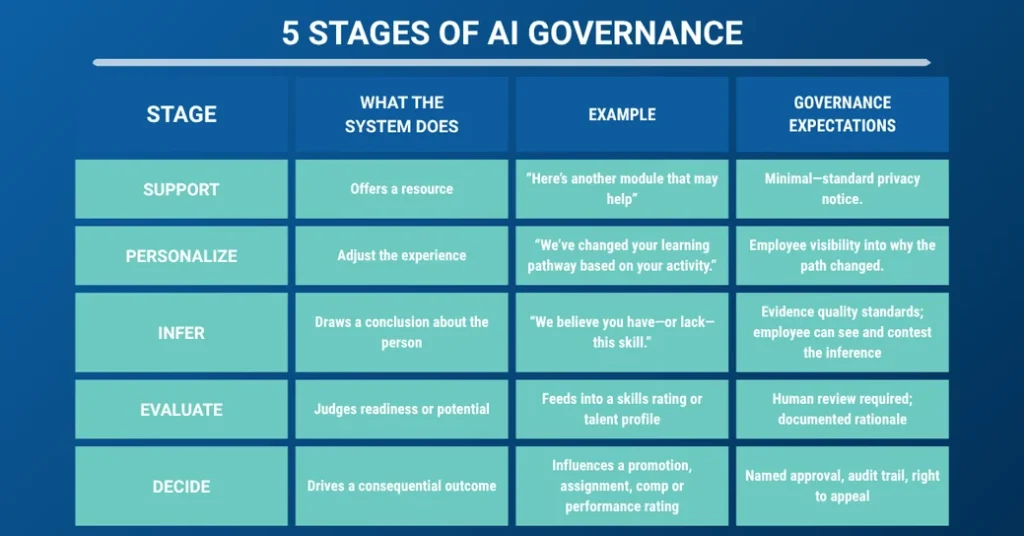
To mitigate these risks, industry leaders have begun proposing a structured approach to data governance. The goal is to distinguish between "supportive data" and "evaluative data." A Five-Stage Governance Framework is increasingly being adopted by forward-thinking firms:

- Support: Recommendations for content based on interests. (Low risk)
- Guide: Providing supplemental material to help an employee master a skill. (Low risk)
- Evaluate: Scoring performance for internal development feedback. (Medium risk)
- Decide: Using scores to impact promotions, raises, or terminations. (High risk)
- Predict: Using AI to forecast an employee’s future intent or potential. (Very high risk)
Under this framework, any system that crosses from "Support" into "Evaluate" or "Decide" requires a human-in-the-loop mechanism. Decisions impacting an employee’s career trajectory should not be based solely on automated inferences generated by a black-box algorithm.
Official Responses and Industry Standards
In response to growing scrutiny, several major HR software vendors have begun to adjust their architecture. Companies like Workday and Cornerstone OnDemand have introduced more granular permission settings, allowing learning administrators to toggle off specific data streams that sync to talent profiles.
"We recognize that the trust of the learner is paramount," says a spokesperson for a leading enterprise learning vendor. "If employees feel they are being ‘watched’ or ‘judged’ for their learning process, they will stop using the tools. We are moving toward a model where the employee has more control over what is shared with their manager."
However, industry adoption remains uneven. Many small-to-medium-sized enterprises (SMEs) lack the internal resources to configure these complex privacy settings, often relying on the default configurations provided by the vendor.
The Broader Implications for Workplace Culture
The most significant danger of over-collecting and over-analyzing learning data is the potential stifling of employee curiosity. If an employee believes that browsing a course on a different career path will be flagged by their current manager as "flight risk" behavior, they will cease to explore. If they fear that admitting they do not understand a topic to an AI tutor will be recorded as a competency gap, they will cease to ask questions.
The "unfinished" nature of learning is essential to personal growth. When organizations remove the safety of being unfinished, they replace a culture of development with a culture of surveillance.
Conclusion: The New Mandate for Learning Leaders
The responsibility now falls on learning and development (L&D) professionals to serve as the gatekeepers of this data. The task is no longer just to procure the most effective learning tools, but to audit them with the same rigor one would apply to an audit of financial systems.
Before implementing any new AI-enabled capability, leadership must ask three fundamental questions:
- What is the source? Are we recording an action, or an inference made by an algorithm?
- Where does it travel? Does this data remain in the learning ecosystem, or is it ported to performance systems?
- Is it transparent? Would the organization feel comfortable explaining the data flow and the resulting inferences directly to the employee in a performance review?
If the answer to the final question is "no," then the data, or at least the visibility of that data, should be restricted. As AI continues to refine its ability to map human potential, the role of the learning leader will be to ensure that the march toward efficiency does not come at the expense of employee agency and the freedom to learn, stumble, and grow in private.