



Artificial intelligence has officially crossed the threshold from experimental novelty to an indispensable foundational utility within the global academic ecosystem. According to the latest Microsoft AI in Education Special Report released in 2026, the integration of generative and analytical technology has reached near-ubiquity: 92 percent of students and education leaders, alongside 88 percent of educators, have already integrated artificial intelligence into their daily school-related workflows. Yet, this rapid technological adoption has simultaneously shifted the primary institutional focus away from mere administrative productivity and speed toward a more profound pedagogical challenge: ensuring that digital tools genuinely foster critical thinking, conceptual comprehension, and substantive learning outcomes.
The transition from early adoption to sophisticated, outcomes-driven integration requires a robust framework of institutional backing. The 2026 report emphasizes a growing demand for formalized guidance, revealing that 66 percent of educators and 52 percent of students are actively seeking monthly or quarterly professional training regarding safe, ethical, and effective utilization. In direct response to this feedback from the global educational community, Microsoft has introduced a sweeping suite of AI-powered teaching capabilities, secure student-centric experiences rooted in learning science, and expanded professional training initiatives designed for integration into Microsoft 365 Education.
Main Facts of the Microsoft Education Initiative
The newly announced suite of capabilities focuses heavily on transforming generative technology from a simple answer-generation mechanism into an interactive, scaffolded learning coach. Developed in direct collaboration with teachers through the Education Insiders Program, these features are embedded natively within existing Microsoft 365 applications, ensuring adherence to rigorous enterprise-grade privacy and data security standards.

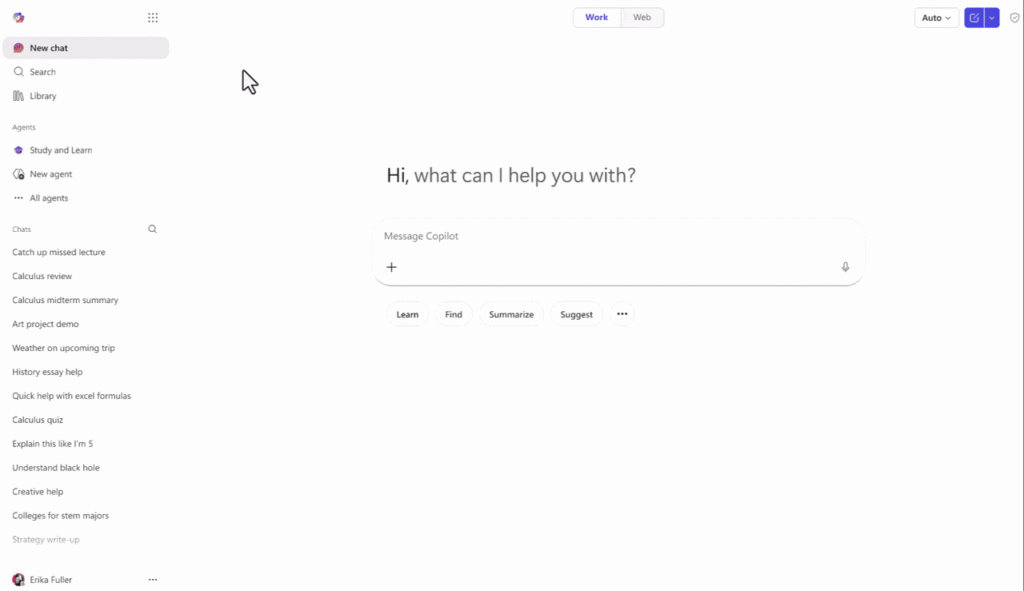
Among the primary technical deployments are the Study and Learn Agent within Copilot Chat, optimized for students aged 13 and older, and Copilot Notebooks, an intelligent workspace designed to anchor student inquiry strictly to verified course materials, lecture slides, and assigned readings. Furthermore, the introduction of Teach and Learn taskbar shortcuts on Windows devices provides immediate, frictionless access for both educators and students, while comprehensive administrative controls allow institutional IT departments to govern, deploy, and monitor these resources securely across entire school districts and higher education campuses.
Chronology and Development Timeline
The rapid evolution of educational technology over the past several years has necessitated a carefully paced deployment strategy by major technology providers and institutional regulators alike.
Phase one of this recent technological cycle spanned the initial post-pandemic years, characterized by widespread, unstructured experimentation with large language models. During this period, educational institutions grappled with widespread concerns regarding academic integrity, plagiarism, and a lack of standardized oversight.
Phase two, culminating in the early months of 2026, involved comprehensive global research. Between February 13 and March 9, 2026, research firm PSB Insights conducted a quantitative global survey spanning 3,345 respondents across K-12 and higher education sectors in the United States, the United Kingdom, Australia, Brazil, Japan, and Saudi Arabia. The findings of this landmark study highlighted an urgent, unmet demand for structured professional development and pedagogical alignment.

Phase three begins with the current rollout sequence. Initial iterations of the newly designed teaching workflows and collaborative dashboards are deploying to preview communities immediately, with general availability scheduled to expand across the global Microsoft 365 Education ecosystem in the coming months. Concurrently, academic policymakers and curriculum designers are aligning their instructional frameworks with international standards, such as the newly released AI Literacy Framework established by the European Commission and the OECD in collaboration with CodeAI.
Supporting Data and Demographic Insights
The statistical foundation underpinning Microsoft’s strategic pivot illustrates both the scale of current deployment and the distinct vulnerabilities felt by classroom practitioners. The 2026 Microsoft AI in Education Special Report provides critical quantitative metrics regarding global sentiment and behavioral trends across international educational markets:
- Market Penetration: 92 percent of students and institutional education leaders, as well as 88 percent of working educators, report active usage of artificial intelligence for academic purposes.
- Training Deficits and Demands: 66 percent of educators and 52 percent of students express a clear desire for structured, recurring professional development—specifically requesting monthly or quarterly training sessions.
- Future Preparedness: A substantial consensus exists regarding the economic and professional necessity of digital literacy; 87 percent of educators and education leaders, alongside 79 percent of students, agree that mastering effective and responsible AI utilization is vital for long-term career readiness.
These global data points were meticulously weighted based on World Bank education expenditure estimates to ensure accurate representation across diverse socioeconomic regions and institutional frameworks.
From Answer Engines to Interactive Learning Coaches

Historically, early generative models functioned primarily as answer engines—systems capable of producing immediate solutions to complex prompts, which frequently undermined the cognitive friction necessary for deep learning. To counteract this limitation, Microsoft’s newly introduced Study and Learn Agent reimagines Copilot Chat as an interactive pedagogical partner.
Operating within strict institutional privacy boundaries and requiring explicit K-12 administrative enablement, the Study and Learn Agent utilizes scaffolded questioning techniques. Rather than yielding direct answers to complex academic queries, the agent guides students through conceptual breakdowns, prompts critical self-reflection, and generates interactive study aids such as flashcards, customized quizzes, and matching exercises. This structural shift is designed to enhance knowledge retention and encourage independent problem-solving while keeping students firmly in control of their own academic progress.
Complementing this feature, Copilot Notebooks serves as a centralized, secure repository where learners can aggregate course materials, textbooks, lecture recordings, and teacher-provided handouts. By restricting the AI’s contextual scope strictly to these curated classroom sources, students can synthesize readings and generate reliable study guides without risking exposure to unverified external information or hallucinated data.
Official Responses and Institutional Perspectives
Education leaders and policy experts have offered measured, optimistic reactions to the introduction of structured, pedagogically sound AI integrations. Industry analysts note that by shifting the responsibility of administrative governance onto IT administrators while granting classroom autonomy to teachers, technology providers are successfully addressing longstanding institutional anxieties regarding data privacy and student safety.

Furthermore, the alignment of Microsoft’s professional development ecosystem with international governance models has drawn favorable reviews from curriculum standardizers. By integrating the Expert tier of Microsoft Elevate for Educators with the newly established "AI Literacy for Educators" credential pathway developed in partnership with ISTE and ASCD, the initiative provides a validated, verifiable standard for professional competency. This alignment ensures that educators are not merely taught how to operate software, but rather how to critically evaluate algorithmic outputs and cultivate digital discernment in their students.
Broader Impact and Policy Implications
The systematic integration of artificial intelligence into mainstream education carries profound implications for workforce development, institutional equity, and educational philosophy. As academic institutions increasingly recognize that digital literacy is a non-negotiable prerequisite for modern employment, the focus has shifted from prohibition to rigorous instruction in responsible use.
The collaboration between global technology entities, international regulatory bodies such as the OECD and the European Commission, and frontline educators signals a maturation of the ed-tech sector. By establishing transparent frameworks, verifiable credentials, and privacy-first architectures, the educational community is actively working to bridge the digital divide. Ensuring that every student, regardless of geographic or socioeconomic background, has equitable access to secure, high-quality learning tools remains the ultimate benchmark of success as schools prepare for the academic cycles of the future.