

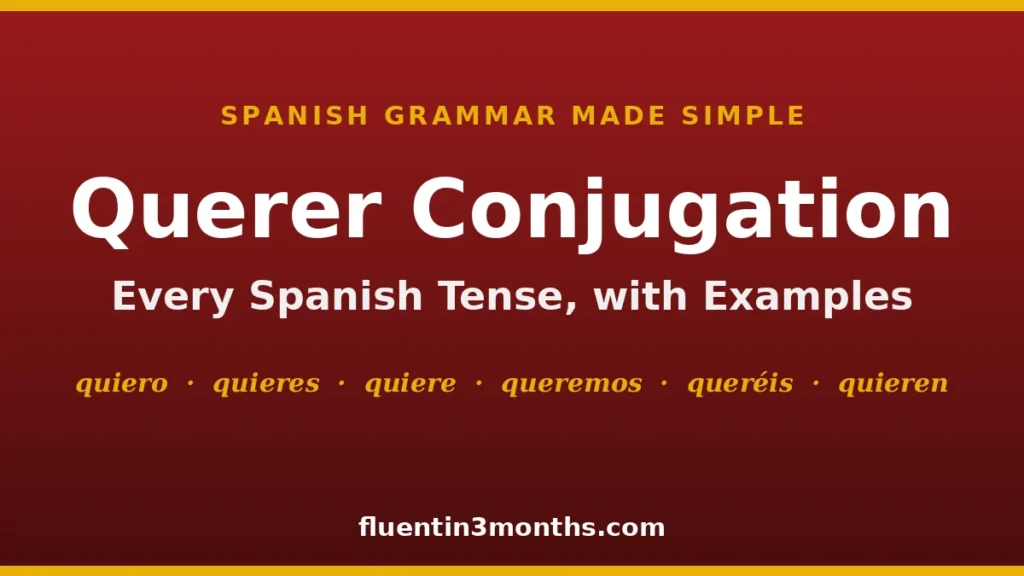
The Spanish verb querer serves as a foundational pillar in the Romance language lexicon, functioning simultaneously as a mechanism for expressing desire, intent, and deep emotional affection. Derived from the Latin quaerere—which translates to "to seek" or "to ask"—the verb has evolved into an irregular powerhouse that dominates everyday conversation. For learners and linguists alike, understanding querer is not merely an academic exercise but a practical necessity for navigating the social, professional, and romantic nuances of Spanish-speaking cultures.
Etymological Evolution and Structural Irregularity
The irregularity of querer is rooted in its historical transition from Latin to Old Spanish. The stem-changing nature of the verb—specifically the e to ie shift observed in the present indicative—reflects common phonetic patterns found in high-frequency verbs. Linguists categorize querer as a "boot verb" or "radical-changing verb," where the irregularity occurs in the root of the word across various forms.
The shift is most prominent in the present tense, where the e in the stem transforms into ie for all singular persons and the third-person plural. This linguistic quirk serves as a marker of the verb’s high utility; because it is used so frequently, the irregular forms have been preserved over centuries rather than being leveled out by regularizing linguistic pressures. Furthermore, the preterite stem quis- represents a distinct historical deviation, effectively creating a separate paradigm that governs the past tense and the imperfect subjunctive.
Chronology of Usage: From Intent to Expression
The application of querer follows a logical hierarchy of complexity. In early stages of language acquisition, the present indicative tense provides the necessary tools for basic needs. For instance, the transition from quiero (I want) to quisiera (I would like) represents a critical milestone in social competence. While quiero is direct and occasionally blunt, the use of the imperfect subjunctive quisiera—a "softening" technique—is essential in service industry interactions, such as ordering in a restaurant or requesting assistance.
Historical linguistic records suggest that the distinction between querer and amar (to love) has undergone subtle shifts. While te quiero remains the standard expression of affection among friends, family, and romantic partners in many regions, the inclusion of te amo creates a specific, more intense emotional register. In countries such as Mexico or Argentina, te amo is often reserved for profound, committed romantic relationships, whereas te quiero maintains a versatile status that spans multiple degrees of intimacy.
Comprehensive Conjugation Framework
The indicative mood acts as the bedrock of factual communication. The simple tenses—present, preterite, imperfect, future, and conditional—provide the temporal framework for any narrative.
- Present Indicative: Quiero, quieres, quiere, queremos, queréis, quieren. This is the primary tense for current states of mind or desire.
- Preterite: Quise, quisiste, quiso, quisimos, quisisteis, quisieron. Used for completed actions, often implying a specific, finalized desire or a failed attempt (e.g., "quise ir," meaning "I tried to go").
- Imperfect: Quería, querías, quería, queríamos, queríais, querían. Utilized for ongoing states or background conditions, such as "I used to want" or "I was wanting."
The compound tenses, constructed using the auxiliary verb haber combined with the past participle querido, allow speakers to navigate perfect aspects. The present perfect (he querido) and pluperfect (había querido) are essential for relaying experiences that have relevance to the present moment or occurred prior to another past action.
The Subjunctive: Expressing Subjectivity
The subjunctive mood introduces the dimension of doubt, desire, and emotional reaction. The use of querer in the subjunctive is triggered by clauses expressing a desire for someone else to perform an action (e.g., Quiero que vengas—I want you to come).
The imperfect subjunctive, specifically, features two competing forms: the -ra ending (quisiera) and the -se ending (quisiese). While both are grammatically correct, the -ra form has seen a rise in dominance within both oral and written communication across the Spanish-speaking world. In formal or legal contexts, the future subjunctive (quisiere) persists as a relic of older Spanish, though it is largely absent from daily discourse.
Analytical Overview: Common Pitfalls
For the non-native speaker, the most common error involves the misuse of the stem-change in the "we" (nosotros) and "you all" (vosotros) forms. In Spanish, the "boot" does not extend to these two forms; therefore, queremos and queréis retain the original e rather than shifting to ie. Misapplying this rule is a primary indicator of a learner who has not yet internalized the rhythmic patterns of the verb.
Another frequent oversight involves the confusion between the preterite and the imperfect. The preterite quise implies a specific moment of realization or an attempt to initiate action, whereas the imperfect quería describes a state of mind that persisted over an unspecified period. Understanding this distinction is vital for accurate storytelling and historical narration.
Broader Linguistic and Social Implications
The versatility of querer extends beyond simple translation. It is an instrument of social negotiation. When a speaker chooses quisiera over quiero, they are engaging in a sophisticated social contract that prioritizes politeness and hierarchy. Conversely, the use of the imperative (quiere/quieran) is rare, as commanding someone to "want" something is logically paradoxical. When it does appear, it is usually found in poetic or motivational literature, aimed at encouraging a specific mindset or emotional state.
Research into language acquisition suggests that the ability to correctly conjugate and contextually apply querer is a reliable proxy for overall fluency. Because the verb touches upon the foundational human experiences of desire and love, its mastery allows for deeper interpersonal connection. It is not merely a vocabulary item, but a lens through which Spanish speakers structure their reality.
Strategic Learning and Integration
For those seeking to integrate querer into their professional or daily repertoire, a modular approach is recommended. Rather than rote memorization of the full conjugation table, learners should prioritize the present indicative and the polite quisiera. These two forms cover approximately 80% of daily usage requirements.
Once these are secured, moving into the preterite and imperfect allows for the development of narrative skills. The final stage of mastery involves the subjunctive, which requires a deeper understanding of the relationship between clauses and the emotional framing of sentences.
Conclusion: The Enduring Utility of Querer
As an irregular verb with a complex Latin heritage, querer remains one of the most significant lexical items in the Spanish language. Its multifaceted nature—functioning as both a simple expression of need and a nuanced tool for emotional articulation—makes it an essential study for anyone engaged in serious linguistic pursuit. By moving beyond simple translation and into the structural mechanics of the verb, learners can achieve a higher level of proficiency, ensuring that their communication is both accurate and culturally resonant. Whether in the boardroom, the restaurant, or the intimate sphere of personal relationships, querer provides the necessary scaffolding for meaningful human interaction in the Spanish-speaking world.