


In the modern corporate landscape, the mandate for talent development has shifted from a focus on participation and engagement to a rigorous demand for quantifiable business outcomes. Recent research sponsored by the Association for Talent Development (ATD) underscores this transformation, revealing that 96 percent of CEOs within the Fortune 500 identify “business impact” as the primary metric for evaluating talent development programs. The second most critical measure, according to these executives, is the return on investment (ROI). This clear prioritization signals a fundamental evolution in how learning and development (L&D) functions are perceived by the C-suite, moving away from support-based cost centers toward becoming essential drivers of organizational performance.
The Shift Toward Business-Centric L&D
Historically, L&D departments were frequently evaluated on "vanity metrics," such as the number of hours spent in training, participant satisfaction surveys, or course completion rates. While these metrics remain relevant, they are increasingly insufficient for justifying multi-million-dollar budgets to CFOs and boards of directors. The current expectation is for L&D to demonstrate a direct, causal link between training initiatives and tangible business results—defined by output, quality, speed, and cost-efficiency.

The imperative for this alignment is not limited to for-profit corporations. Nonprofit organizations and government agencies are also under mounting pressure to demonstrate the efficacy of their internal programs. Regardless of the sector, every organization operates on fundamental business metrics. When a CEO asks whether talent development programs connect to the organization’s bottom line, the answer must be an unequivocal "yes." This connection defines the "why" of any professional development program, shifting the focus from the curriculum itself to the ultimate business problem it is intended to solve.
A Historical Perspective on Evaluation Models
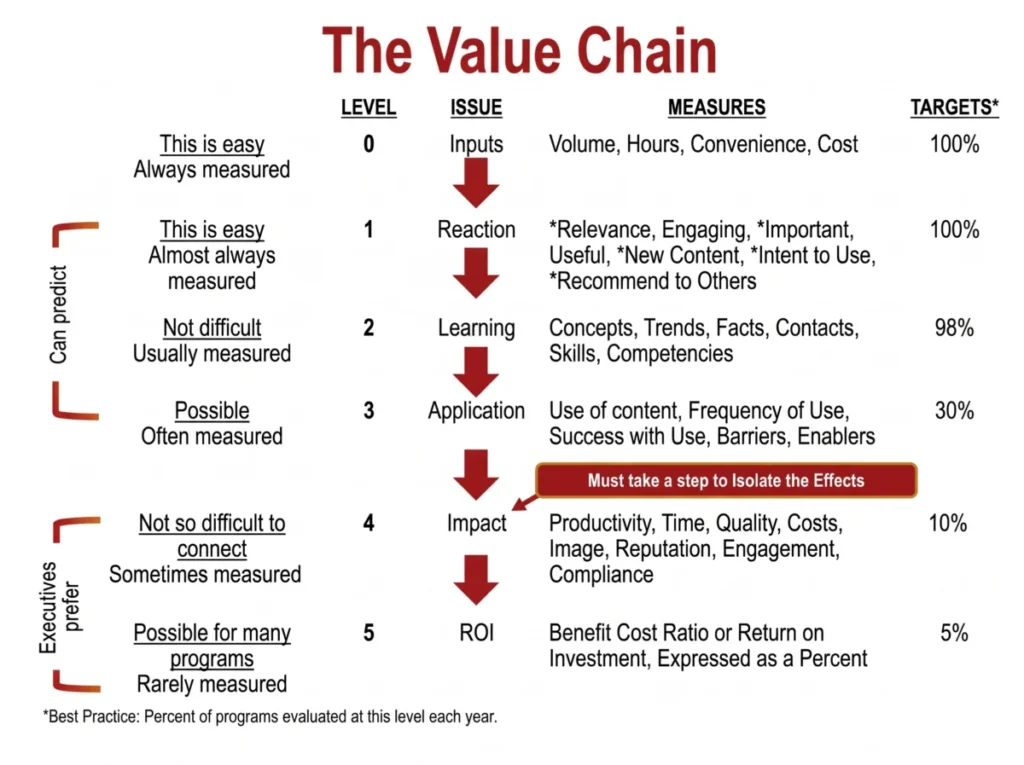
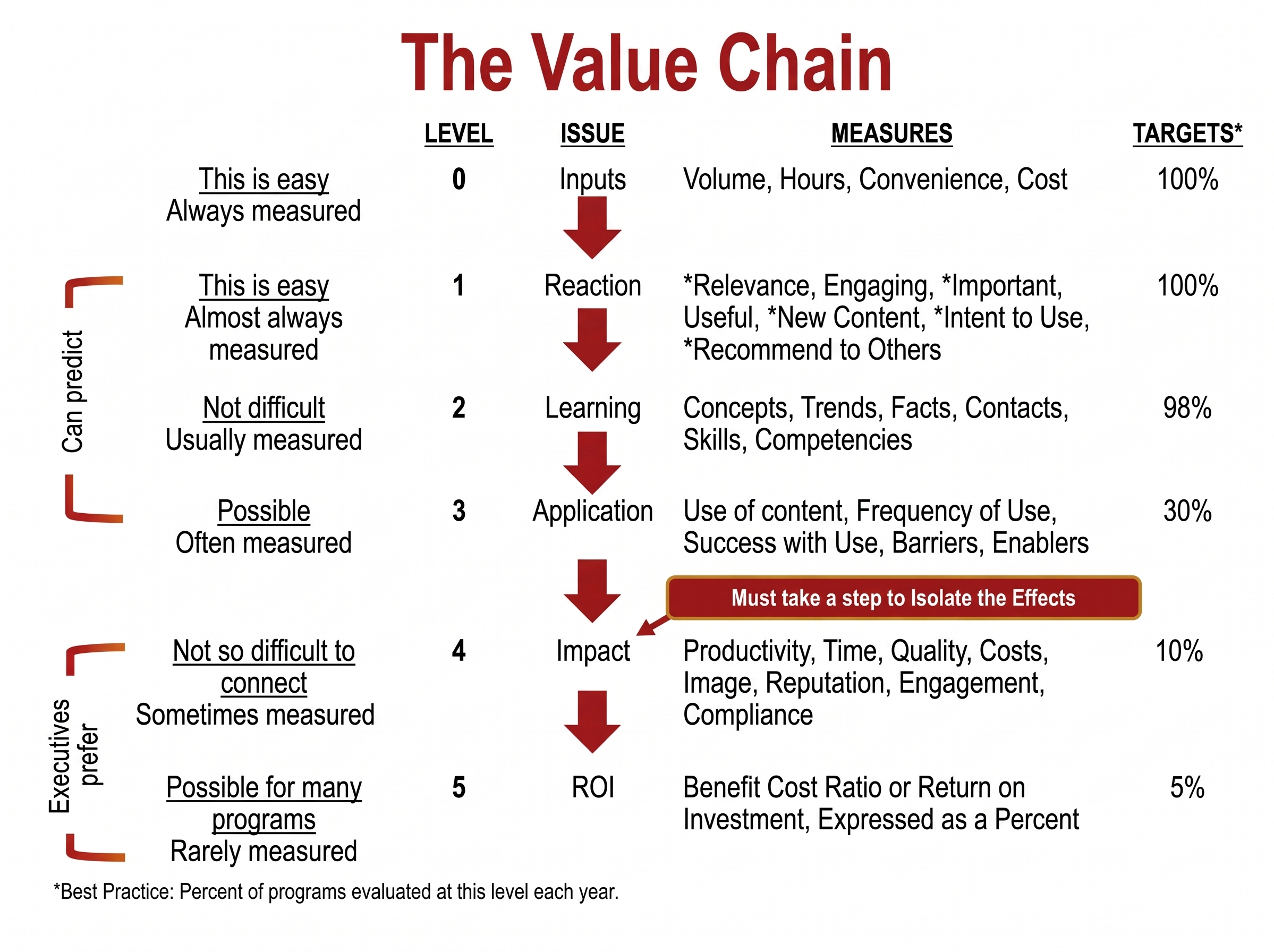
The foundation for modern evaluation methodologies can be traced back to the early 20th century, though the framework most commonly associated with these efforts was formalized in the mid-1900s. In 1952, Raymond Katzell published a foundational logic model that categorized data types into a sequential value chain. This model proposed that inputs lead to reactions, which in turn foster learning, facilitate application, and ultimately produce impact.
Don Kirkpatrick, a pioneer in the field, later popularized these steps, establishing a multi-level evaluation system that remains the standard in the industry. However, as the demand for financial accountability grew, the traditional Kirkpatrick model was expanded to include a fifth level: Return on Investment. This evolution was necessary to bridge the gap between human resources initiatives and the fiscal language spoken by financial leaders.

The Five-Level Value Chain
To understand the ROI Methodology, one must first grasp the hierarchical structure of the value chain. Each level of data represents a prerequisite for the next:
- Level 0 (Input): This captures the fundamental logistical data, including the number of participants, the duration of the program, and the total financial investment.
- Level 1 (Reaction): This measures the participant’s perception of the program’s relevance, importance, and quality. A negative reaction at this level can stall a program before it has the opportunity to influence behavior.
- Level 2 (Learning): This phase tracks the acquisition of new skills and knowledge. It assesses whether the participants have actually gained the capabilities required for the intended application.
- Level 3 (Application): This level evaluates whether the newly acquired knowledge is being applied in the workplace. It measures frequency and success of use, while identifying potential barriers or organizational enablers.
- Level 4 (Impact): This is the crucial stage where the consequences of application are measured. These are the "business" metrics—such as reduced cycle times, increased output, or improved product quality—that mirror the broader organizational goals.
- Level 5 (ROI): This level converts the impact data into monetary terms and compares it against the fully loaded costs of the program.
The Twelve-Step ROI Methodology
The ROI Methodology, now utilized by over 10,000 organizations globally, provides a systematic, twelve-step process that guides L&D professionals from the initial design phase through to the final reporting of results.
Designing and Planning for Success
The process begins with "designing for the delivery of results." In Step 1, practitioners must align the program with a specific business measure, effectively defining the "why." This requires identifying whether a proposed program is addressing a legitimate problem or pursuing a strategic opportunity. Step 2 focuses on verifying that the proposed solution is the most effective way to address that need. Finally, Step 3 involves "expecting success," which incorporates design-thinking principles to ensure the program is structured to influence the desired outcomes from the outset.

Credibility Through Rigorous Analysis
The core challenge in any ROI calculation is credibility. CFOs are often skeptical of L&D reports that claim excessive financial gains. The methodology mitigates this through three critical steps:
- Isolating the Effects (Step 6): This is perhaps the most vital component. The methodology requires practitioners to separate the effects of the L&D program from other influences—such as market changes, new technology, or management shifts. Techniques for this range from the use of control groups to participant estimation, ensuring that the results are defensible.
- Converting Data to Money (Step 7): Impact measures, such as customer satisfaction or error rates, are converted into monetary units using standard values. When uncertainty exists, the methodology follows the principle of "when in doubt, leave it out," ensuring the final figures remain conservative and trustworthy.
- Capturing All Costs (Step 9): To provide an accurate benefit-cost ratio, all direct and indirect costs—including staff time, materials, and overhead—are tallied. Here, the principle is reversed: "when in doubt, leave it in." This ensures that the final ROI is not inflated, thereby increasing its acceptance by financial leadership.
Implications for Organizational Strategy
The adoption of a standardized evaluation system has profound implications for the future of the talent development profession. By moving toward a model that speaks the language of finance, L&D professionals gain greater influence over budget allocations and strategic planning. When a program can demonstrate a high benefit-cost ratio, it ceases to be an expense to be cut and becomes an investment to be scaled.
Furthermore, the "optimizing results" phase (Step 11 and 12) demonstrates that evaluation is not merely a retrospective activity. By collecting data throughout the lifecycle of a project, organizations can make real-time adjustments, recognize high-performing contributors, and iterate on future programs.
Conclusion: The Path Forward
The demand for accountability in talent development is unlikely to wane. As organizations continue to navigate economic volatility and the rapid pace of technological change, the ability to demonstrate a tangible return on human capital investment will be the hallmark of a successful L&D function. By adhering to the twelve-step ROI methodology, practitioners ensure that their efforts are not just well-intended, but fundamentally linked to the long-term vitality of the organization. As noted in industry literature, such as The Business Case for Learning, the transition toward evidence-based L&D is the most effective path toward gaining the support and respect of the C-suite, ensuring that talent development remains a cornerstone of corporate strategy for years to come.