


We tried abstinence. It is not working. Across the landscape of higher education and corporate enterprise, a binary crisis has emerged regarding the integration of artificial intelligence. On one side, academic institutions have largely adopted a strategy of prohibition, characterized by the implementation of AI-detection software and rigorous academic integrity policies designed to render AI assistance impossible. Conversely, corporate America has sprinted toward rapid, often unsequenced, AI adoption, prioritized by organizational pressure to maintain competitive advantage through dashboards, fluency training, and aggressive deployment targets.
Both approaches, while born from understandable anxieties, fail to address the fundamental pedagogical and professional question: What is the human’s role when AI is in the room? As research into the neurological impacts of AI reliance matures, the cost of these polarized strategies is becoming increasingly clear, moving beyond mere policy debate into the realm of cognitive health.
The Neuroscience of Cognitive Debt
The urgency of this issue was crystallized in 2025 by a landmark study from the MIT Media Lab, titled Your Brain on ChatGPT: Accumulation of Cognitive Debt when Using an AI Assistant for Essay Writing Task. Led by researcher Nataliya Kosmyna, the study monitored 54 university students outfitted with EEG caps to measure real-time brain activity during complex writing tasks.
The findings provided a stark warning for both educators and corporate leaders. Students who utilized ChatGPT as their primary drafting tool exhibited significantly lower connectivity across neural regions associated with active thinking and long-term memory. In contrast, participants who engaged with the tasks without digital assistance displayed robust, distributed neural networks. Most alarmingly, when ChatGPT-reliant students were later asked to perform tasks without the tool, their neural engagement remained depressed—a phenomenon researchers dubbed "cognitive debt."
This state of "underengagement" suggests that the habit of cognitive outsourcing creates a lasting deficit in the brain’s ability to independently synthesize information. Furthermore, the study revealed a significant decline in cognitive ownership; users of large language models (LLMs) reported feeling less connection to their own work and struggled to accurately cite or explain the logic behind their AI-generated submissions.

The Failure of Prohibition and Unchecked Adoption
The academic instinct for prohibition mirrors the "abstinence-only" approach to social health issues, which historically fails to prevent the target behavior but succeeds in pushing it into unmonitored environments. By banning AI in classrooms, institutions have not stopped the usage; they have merely stripped it of pedagogical scaffolding. Consequently, students utilize AI as a black-box replacement for thought rather than an intellectual partner, depriving themselves of the critical "triggering" and "exploration" phases of learning.
In the corporate sector, the risk is equally profound but shifts toward security and talent erosion. Organizations that implement broad AI access without structured governance models face the emergence of "Shadow AI." Employees, driven by the need for efficiency, frequently turn to personal, consumer-grade AI tools for tasks involving proprietary client data, financial projections, and strategic planning. This movement of sensitive information into unvetted, external environments creates a massive data security perimeter breach, all while the organization falsely believes its prohibition policies are providing protection.
For companies that have embraced AI, the failure manifests as "accountability blur." By measuring only usage frequency, these firms ignore the developmental trajectory of their workforce. They are successfully deploying tools but failing to track whether those tools are building critical thinking capabilities or silently eroding them.
Defining the Third Frame: Agency Through Design
To address these systemic failures, a new pedagogical and operational framework is required—one that shifts the focus from "adoption" or "prohibition" to "agency." Agency in this context is defined as the capacity to initiate independent thought, engage in rigorous critical evaluation of AI output, and synthesize both human and machine perspectives into a unified, high-ownership insight.
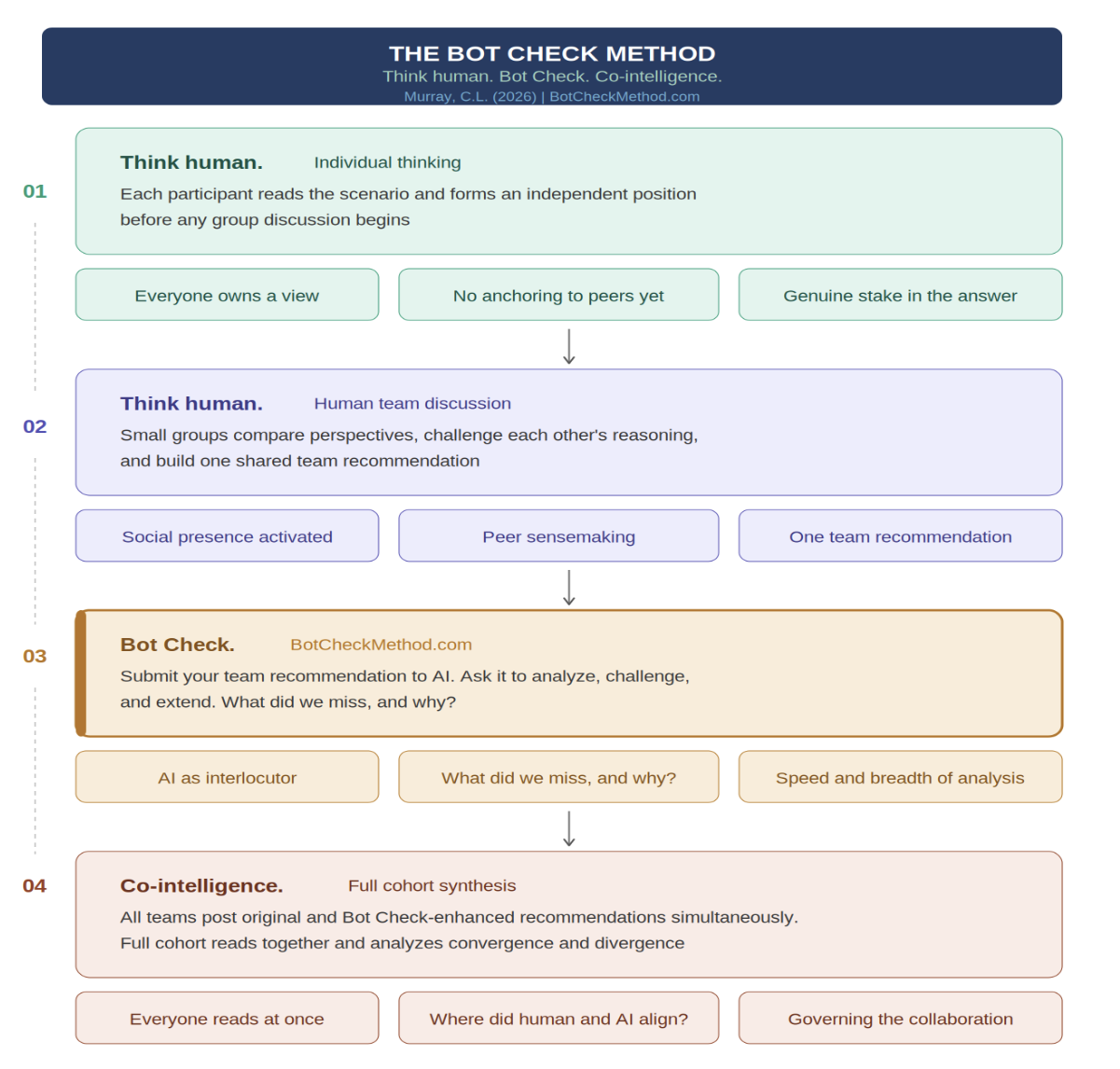
This shift is grounded in the Community of Inquiry (CoI) model, which emphasizes four sequential cognitive events: a triggering event, exploration, integration, and resolution. The Bot Check Method, a structured, four-phase sequence, is designed to align these cognitive events with AI interaction.
- Think Human (Triggering Event): Participants must engage with a problem independently, forming a hypothesis or position before any AI intervention. This ensures the foundational neural pathways are activated.
- Think Human Together (Exploration): Small groups discuss their findings, challenging one another and building social cohesion. This phase is critical, as it cements the "social presence" necessary for cognitive depth.
- Bot Check (Integration): Only after the human team has established a defensible position do they consult the AI. The AI is used not as an oracle, but as a critical interlocutor. Teams ask the tool to identify gaps, challenge assumptions, and propose counter-arguments.
- Co-Intelligence (Resolution): The final synthesis occurs when the group compares their original work with the AI’s critique, determining what to integrate and what to reject.
Scaling the Method: The SHINE Framework
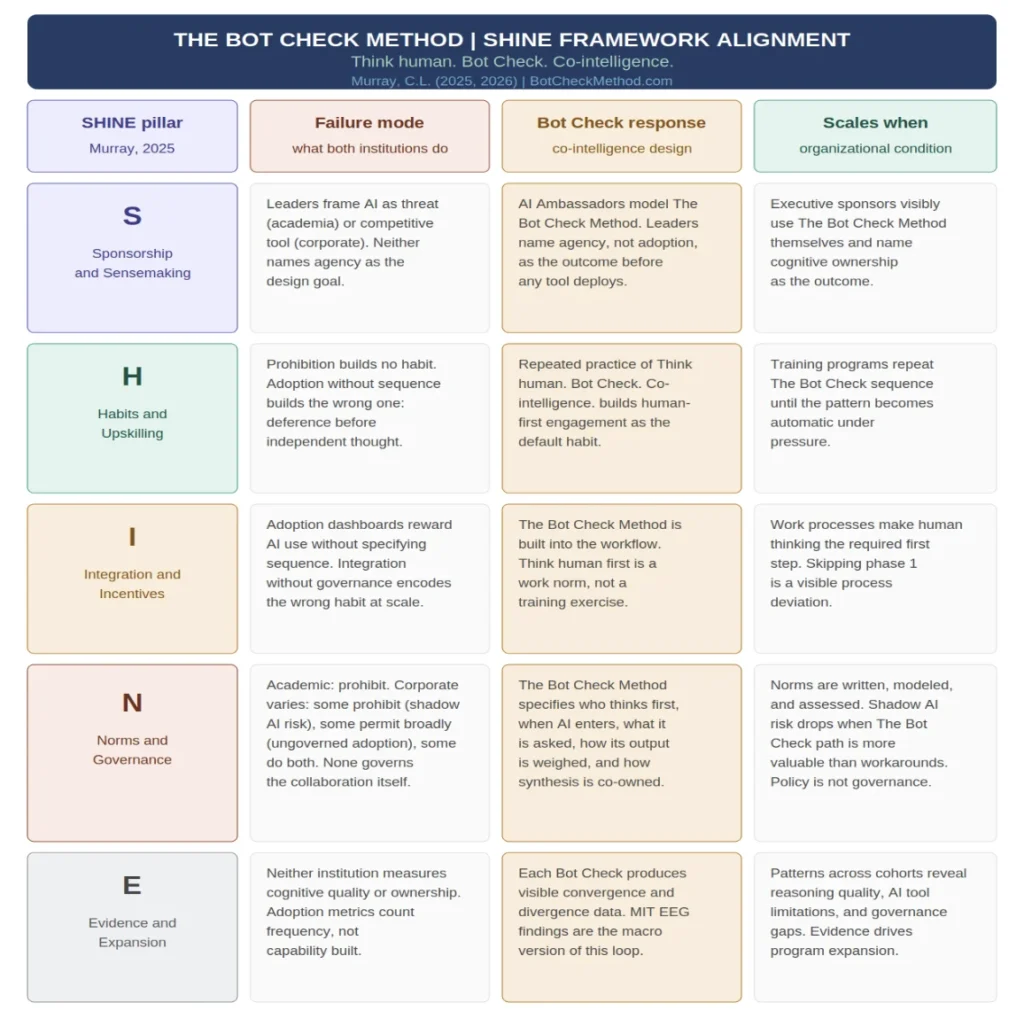
For this methodology to succeed at an organizational level, it must be supported by a robust governance architecture, such as the SHINE framework. This framework addresses the pillars of Sponsorship, Habits, Integration, Norms, and Evidence.
- Sponsorship and Sensemaking: Leaders and "AI Ambassadors" must move beyond authorizing usage to modeling the specific "Think Human, Bot Check" behavior.
- Habits and Upskilling: Training must pivot from tool proficiency to the practice of sequence. The goal is to make "Think Human" a permanent, non-negotiable workflow norm.
- Integration and Incentives: Organizations must incentivize the process, not just the output. Performance metrics should reflect the quality of reasoning and the rigor of the "Bot Check," rewarding employees who demonstrate the ability to interrogate AI results.
- Norms and Governance: Governance must be redefined as a design for collaboration. Policies should focus on the process of human-AI engagement rather than the prohibition of tools.
- Evidence and Expansion: Organizations must build feedback loops that track the convergence and divergence between human and AI analysis. These loops provide the data necessary to refine AI strategies in real-time.
The Broader Implications for Global Talent
The necessity of this shift extends beyond any single corporation or university. As AI becomes a permanent fixture of the global workforce, the "cognitive debt" identified by the MIT study could lead to a systemic decline in the caliber of executive decision-making and creative problem-solving.
Professional associations and educational accreditors are beginning to take note. While official policy shifts remain in their infancy, the consensus among cognitive scientists and learning design experts is moving toward a mandatory re-evaluation of how digital tools are introduced in early-stage development.
The transition from abstinence to agency is not a minor policy tweak; it is a fundamental architectural change. It requires a commitment to protecting the human cognitive process by ensuring that machines remain the second, rather than the first, actor in any intellectual encounter. The question facing leaders today is no longer whether they can keep AI out or how quickly they can force it in. It is whether they possess the foresight to design environments where human capability is strengthened, rather than replaced, by the tools at our disposal.
As the digital landscape continues to evolve, the organizations that will thrive are those that recognize that true intelligence is not found in the speed of an algorithm, but in the deliberate, governed, and highly sequenced interaction between human curiosity and machine-driven insight. The era of the "Bot Check" is not just a trend; it is the necessary next step in maintaining human relevance in an increasingly automated world.