
In the modern enterprise, the deployment of generative AI tools is frequently framed as a logistical challenge of adoption, certification, and completion rates. However, a growing body of evidence suggests that the primary obstacle to organizational transformation is not the technology itself, but the failure of institutional knowledge to circulate. When a Chief Learning Officer (CLO) mandates an AI rollout—spanning multiple business units, integrated curricula, and performance dashboards—the metrics often reflect success. Yet, 18 months into such initiatives, a common pattern emerges: a widening chasm between teams that have successfully integrated AI into their workflows and those that treat the technology as a bureaucratic mandate to be ignored.
This disconnect stems from a lack of psychological safety. Employees often view the admission of confusion or the development of unauthorized "workarounds" as a liability, fearing that exposing their struggles will be interpreted as professional incompetence. Consequently, the organization loses the most valuable data points: the innovative shortcuts discovered by early adopters and the specific systemic barriers encountered by those struggling to integrate the tools.
The Anatomy of the Adoption Gap
The lifecycle of these AI deployments typically follows a rigid, top-down chronology. In the initial phase, leadership defines the strategy, procures the software, and designs a standardized curriculum. By month six, internal dashboards report high completion rates for certification modules. However, by the 18-month mark, the discrepancy between compliance and competency becomes undeniable.
Research from Deloitte’s Global Human Capital Trends underscores that while seven in ten business leaders prioritize speed and organizational nimbleness through 2029, 59 percent of organizations persist in using a purely tech-focused implementation strategy. These organizations are 1.6 times more likely to fall short of their anticipated return on investment compared to those that prioritize human-centered design.
The issue is systemic. The traditional "cascade" model—where knowledge is generated at the executive level and pushed downward—is inherently unidirectional. It lacks the feedback loops necessary to adapt to the rapid, iterative nature of AI updates. By the time a formal refresher course is scheduled, the technology has often evolved, rendering the previous curriculum obsolete.
The Data Behind the Disconnect
The misalignment between leadership expectations and frontline reality is quantified in the Udemy 2026 Global Learning and Skills Trends Report. While 88 percent of employees recognize that effective leadership is the primary driver of AI success, only 48 percent believe their immediate managers possess the AI fluency required to guide them. This creates a vacuum of leadership at the point of implementation.
Furthermore, with 72 percent of CEOs now personally directing AI strategy, according to Boston Consulting Group (BCG), the pressure to demonstrate rapid results is intense. This pressure often exacerbates the "cascade" problem. When leaders emphasize the speed of implementation, they inadvertently discourage the "double-loop" learning—a concept where teams not only correct errors but question the underlying assumptions of the workflow itself.
From Single-Loop to Double-Loop Learning
To bridge this gap, organizations must transition from a cascade model to a circulation model. In a single-loop system, employees are instructed on how to use a tool to complete a task. In a double-loop system, employees are empowered to evaluate whether the tool is the right approach for the problem, or if the process itself requires fundamental restructuring.

For this shift to occur, leaders must treat "not-knowing" as a professional asset rather than a liability. When a senior leader openly admits to struggling with a prompt or failing to achieve a desired output from an AI agent, it signals to the rest of the organization that experimentation is encouraged. This psychological safety is the engine of knowledge circulation. Without it, the most critical insights—the "rogue" workarounds and the subtle technical hurdles—remain in the shadows.
Human-Centered Systems and Equitable Knowledge
A significant risk in the move toward a circulatory learning model is the potential for power concentration. In many organizations, the employees who receive the most support for AI experimentation are those already closest to the center of power. Those further from the institutional decision-making core, including contract staff and frontline service workers, often lack the resources to turn their experiments into organizational knowledge.
To mitigate this, humanizing the learning process requires a commitment to equity. This involves building sensing infrastructures—such as rapid-cycle inquiry sessions—that are intentionally inclusive. By including diverse voices from different tiers of the organization, companies can ensure that knowledge is not just circulating among the elite, but is being crowdsourced from the entire workforce.
AI as a Listening Partner
The very technology causing the disruption can also serve as the mechanism for its resolution. Agentic AI is increasingly capable of identifying patterns across disparate teams, flagging where employees are finding success or hitting roadblocks. If used as an "early-warning system" rather than a surveillance tool, AI can help L&D teams listen at scale.
However, the ethics of this approach are paramount. If employees perceive that their AI usage is being monitored to evaluate their individual performance or to identify who is "behind," the system will fail. Candor is fragile; it vanishes the moment a listening mechanism is perceived as a surveillance tool. Successful organizations introduce these AI-sensing tools as opt-in resources, explicitly stating that the data is used to improve the workflow, not to penalize the individual.
Redefining the Curriculum: Judgment as the Core Skill
As AI automates the "how" of technical tasks, the role of L&D is undergoing a fundamental shift. Teaching technical procedures is increasingly unnecessary when a copilot can provide the solution on demand. Instead, the new curriculum must focus on judgment: knowing when to trust an AI-generated output, when to interrogate it, and how to identify bias in the results.
This reinforces the importance of "power skills"—reflexivity, critical thinking, and the ability to operate in ambiguity. As noted by industry experts, these skills are not merely adjacent to technical competence; they are the load-bearing pillars of modern professional performance. The goal of L&D, therefore, is to transition from being an owner of training materials to being an architect of a system where human judgment and machine capability are continuously recombined.
The Path Forward: Two Quarters of Adaptive Intelligence
Organizations looking to implement these structural changes in the next two quarters should consider three specific actions:
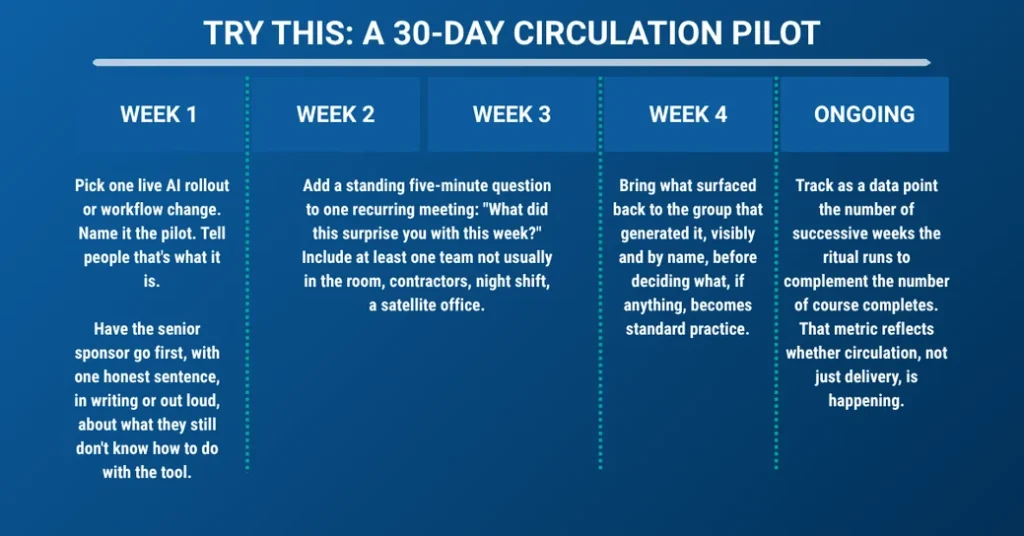
- Embed Listening Mechanisms: Build a standing five-minute inquiry slot into the pre-launch phase of any AI initiative. This is not for status updates, but for soliciting candid feedback on friction points.
- Model Uncertainty: Senior leadership must lead by example. A leader who discusses their own difficulties with a tool creates a cultural norm of openness, which is essential for honest reporting.
- Trait-Mapping Over Org Charts: Instead of relying on static job descriptions, organizations should map the specific strengths of their teams—such as idea generation, execution, or interpersonal sensitivity—to the demands of active projects. This allows for the reconfiguration of teams around the work, rather than forcing work into rigid, outdated structures.
Ultimately, the challenge of the AI era is the challenge of institutional trust. The most successful organizations will be those that view knowledge circulation as a form of core infrastructure. When an organization evolves from a cascade model—where information is pushed downward—to a circulation model, where learning moves fluidly across all levels, it gains the ability to learn at the speed of technological innovation. This is no longer just a training challenge; it is a prerequisite for survival in a volatile, competitive landscape. The CLO who facilitates this transition is no longer just managing a curriculum; they are designing the very capacity for the organization to think, adapt, and lead.