


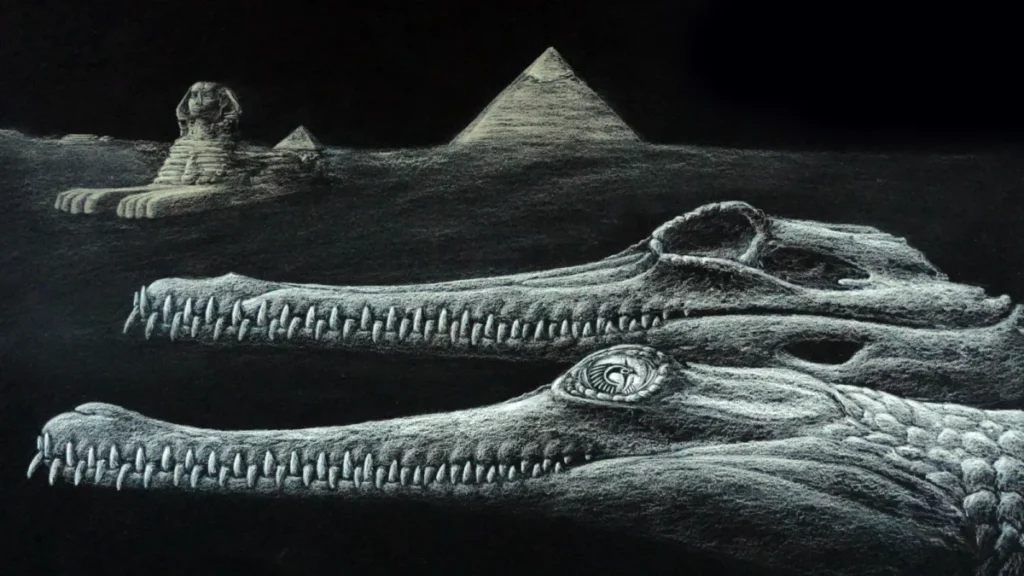
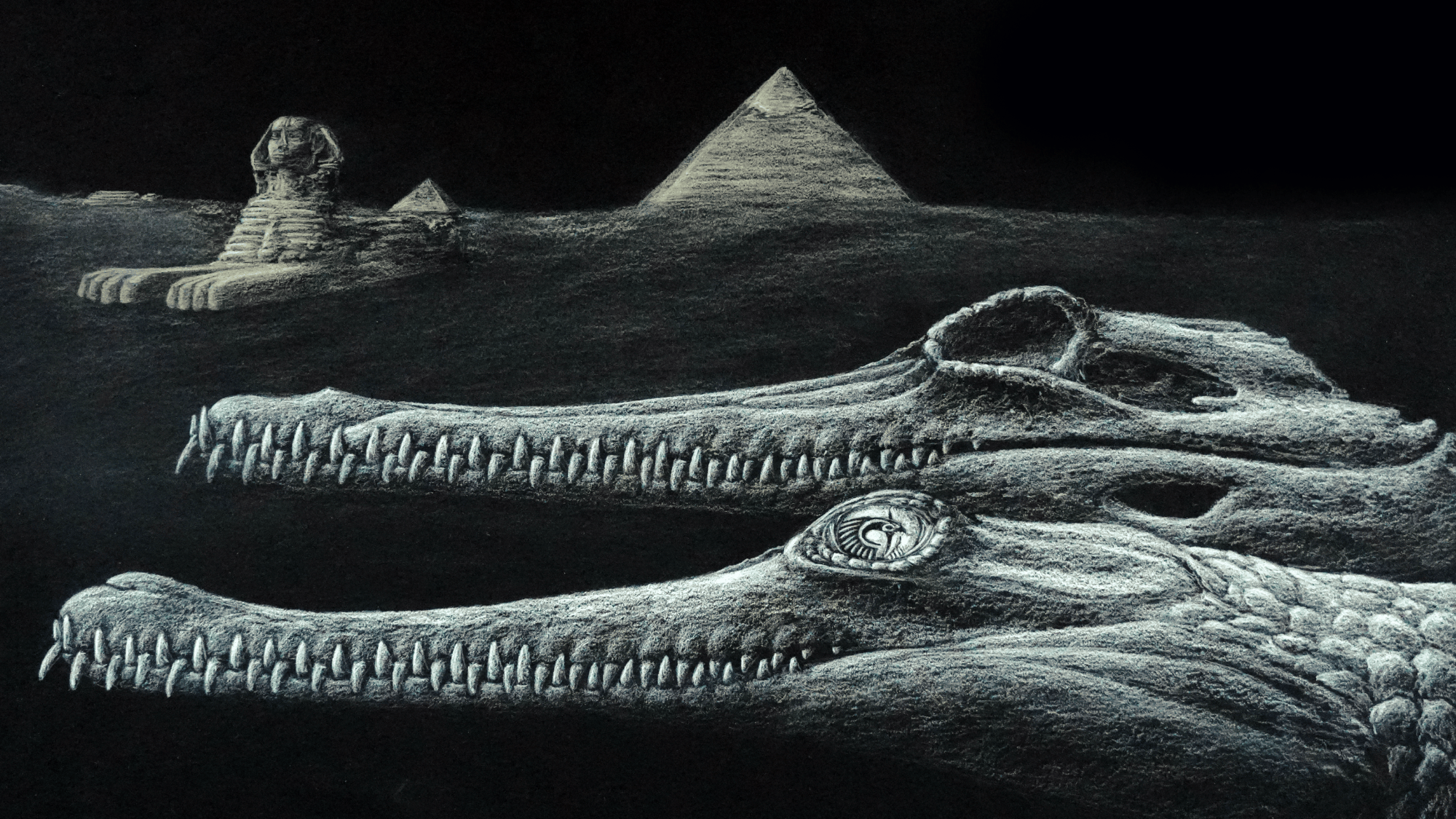
Buried deep within the geological strata of Egypt’s famous Giza plateau lies a historical and paleontological record that continues to surprise modern researchers. While the 4,500-year-old Great Sphinx remains one of the most thoroughly studied monuments on Earth, the surrounding bedrock and regional formations still hold secrets of a radically different prehistoric landscape. Among the most recent revelations is the formal identification of Herugavialis cairensis, a newly described species of extinct crocodile whose fossilized remains bear an uncanny, symmetrical resemblance to the most famous architectural flaw of the Great Sphinx itself: a missing tip of the snout.
The discovery, detailed in a study published in the peer-reviewed journal Royal Society Open Science, bridges millions of years of Egyptian natural and human history. Paleontologists and evolutionary biologists have meticulously re-examined historical fossil collections, utilizing modern imaging technology to unlock anatomical details that remained hidden for nearly a century.
The Anatomy and Classification of Herugavialis cairensis
The newly classified Herugavialis cairensis belongs to the gavial family, a lineage of crocodilians historically distinguished by their remarkably elongated and slender snouts. Today, gavials are primarily freshwater inhabitants restricted to specific river systems on the Indian subcontinent and Southeast Asia, represented by only two surviving species: the gharial (Gavialis gangeticus) and the false gharial (Tomistoma schlegelii).
However, the fossil record paints a vastly different global distribution. For more than 100 million years, gavial-like crocodiles were cosmopolitan predators, frequently inhabiting shallow marine and coastal environments across various continents. The specimen that would eventually become the type species for Herugavialis cairensis was originally recovered in the 1920s from Egypt’s rich Mokattam Formation—a geological treasure trove dating back approximately 45 million years to the Eocene epoch.
For nearly a century, the nearly complete fossilized crocodile skull sat in museum archives, largely categorized alongside known specimens of the genus Tomistoma due to superficial anatomical similarities. It was only through recent, high-resolution internal skull scans and comparative phylogenetic analyses that researchers realized this specimen represented an entirely distinct genus and species.
Yet, it was a striking physical anomaly that ultimately guided the researchers’ creative naming process. Much like the iconic Great Sphinx of Giza—which famously lacks the tip of its nose—the fossilized skull of the newly discovered crocodile features a distinctly missing snout tip.
"Given this coincidence with the famously missing nose of the Great Sphinx, we decided to name the new crocodile after the Egyptian god Heru, who was possibly the inspiration for this iconic monument," explained Philip Mannion, a study co-author and evolutionary biologist at University College London.
Chronology and Historical Context of the Giza Region
To understand the world of Herugavialis cairensis, scientists must look far beyond the dynastic history of Ancient Egypt and back into deep geological time. When the Great Sphinx was carved during the Fourth Dynasty—specifically under the reign of Pharaoh Khafre between 2613 and 2494 BCE—the surrounding North African landscape was predominantly arid, much like it is today.
However, the Eocene epoch, spanning from about 56 to 33.9 million years ago, presented a radically contrasting picture. During the period when Herugavialis thrived in the region, North Africa was submerged beneath or bordered by the Tethys Ocean, a vast prehistoric sea. Egypt was largely covered by shallow, warm marine environments that provided an ideal habitat for a diverse array of cold-blooded predators.
Historical excavations in the Mokattam Formation and surrounding Egyptian geological formations have consistently yielded marine fossils, signaling that ancient ecosystems supported thriving marine reptile populations. During the Eocene, at least three distinct species of gavial-like crocodiles coexisted in the shallow waters of what is now modern Egypt. These apex predators shared their marine habitats with early cetaceans (whales), sirenians, and a vast diversity of fish and invertebrates.
Paleontological Shifts and Global Climate Drivers
The discovery of Herugavialis cairensis sheds light on the broader evolutionary history and ecological dynamics of Mediterranean crocodilians. According to Paul Burke, a paleontologist at the Swedish Museum of Natural History and co-author of the study, the Mediterranean region historically served as a biodiversity hotspot for crocodiles.
"Throughout much of the last 50 million years, the Mediterranean region hosted a high diversity of crocodiles, including gavials," Burke noted. "However, this diversity fluctuated over time, seemingly corresponding to changes in global temperature and sea level, before the loss of all crocodiles in this region as a result of the drying of the Mediterranean approximately 6 million years ago."
This timeline highlights the profound sensitivity of crocodilian populations to global climatic shifts. As global temperatures cooled and tectonic movements altered ocean currents and sea levels toward the end of the Miocene epoch, the shallow marine ecosystems of North Africa underwent drastic transformations. The eventual desiccation of the Mediterranean basin—known scientifically as the Messinian salinity crisis, which occurred roughly 6 million years ago—effectively eradicated crocodilian lineages across the region, long before human civilization ever arose to build monuments along the Nile.
Implications for Modern Biodiversity and Future Research
The formal description of Herugavialis cairensis is more than a taxonomic update; it serves as a critical data point for understanding how ancient ecosystems responded to climate fluctuations. By integrating historical fossil collections with advanced computed tomography (CT) scanning and phylogenetic modeling, modern paleontologists can extract new data from specimens collected nearly a century ago.
Furthermore, the study underscores the deep historical entanglement between human cultural heritage sites, such as the Giza pyramids and the Great Sphinx, and the prehistoric fossil record embedded directly in their building materials. The limestone blocks used to construct many of Egypt’s ancient wonders are themselves composed of ancient marine sediments teeming with microfossils and larger vertebrate remains, linking the monumental achievements of the Old Kingdom directly to the ancient marine life of the Eocene.
As researchers continue to analyze museum archives and conduct field studies across North Africa, discoveries like Herugavialis cairensis demonstrate that the sands of Egypt still hold countless chapters of an evolutionary history that predates human civilization by tens of millions of years.