

The global integration of artificial intelligence within academic institutions has reached a critical juncture, transitioning rapidly from casual student experimentation to an entrenched component of daily curriculum delivery. Recent data released by Microsoft in its comprehensive AI in Education Report reveals that adoption rates among academic communities have surged to unprecedented levels. Specifically, 92 percent of students and education leaders, alongside 88 percent of educators, report utilizing artificial intelligence for school-related applications. However, this widespread utilization has brought institutional focus squarely onto a more demanding inquiry: whether these powerful digital systems actively foster genuine learning and critical thinking, or merely function as mechanisms for accelerating clerical productivity.
To address these evolving pedagogical demands, Microsoft has announced a sweeping rollout of new artificial intelligence capabilities embedded directly within the Microsoft 365 Education ecosystem. Developed in close collaboration with academic professionals through the Education Insiders Program, these features are explicitly engineered to transition artificial intelligence from a simple answer-generating utility into an interactive instructional coach grounded firmly in learning science. Concurrently, the tech conglomerate is expanding institutional access to professional development platforms, aiming to close a persistent training gap identified by educators and administrators worldwide.
Background Context and the Evolution of Classroom AI
The rapid influx of generative artificial intelligence into educational environments over recent years caught many school districts and universities unprepared. Initially treated as a novelty or an academic integrity threat—leading to widespread, reactionary bans on generative models—the technology quickly proved impossible to restrict entirely. Students and teachers organically adopted these tools to draft lesson plans, summarize dense academic texts, and brainstorm research topics.

Recognizing that prohibition was ineffective, educational technology providers and institutional leaders began pivoting toward integration and governance. The primary challenge shifted from blocking access to ensuring equitable, secure, and pedagogically sound deployment. Schools required systems that respected strict student privacy regulations, avoided data-harvesting practices, and actively resisted the temptation to complete assignments on behalf of students. Microsoft’s latest product release represents a direct institutional response to this background context, attempting to embed guardrails natively into the software layers that schools already license and trust.
Chronology of Modern Educational Technology Integration
The journey toward systematic artificial intelligence integration in formal schooling follows a distinct timeline over the past several years.
During the initial phase of discovery, marked by the public availability of advanced large language models, schools operated in a reactive posture. Administrators scrambled to draft interim usage policies, while educators experimented informally with automated grading and text-generation prompts.
In the subsequent phase of assessment and data gathering, typified by global research initiatives such as the Microsoft special report fielded between February and March, institutions began quantifying the exact scope of adoption. This period highlighted a profound disconnect: while usage soared past 80 to 90 percent across demographic lines, educators articulated an urgent demand for structured guidance. More than half of surveyed students and two-thirds of teachers requested monthly or quarterly professional development sessions to keep pace with algorithmic updates.

The current phase, marked by today’s announcements, represents an institutional pivot toward formalized, learning-science-backed ecosystems. By transitioning preview features into general availability over the coming months, developers and school leaders are attempting to synchronize software deployment with mandatory educator training pathways and standardized literacy frameworks.
Detailed Breakdown of Supporting Data and Research Findings
The empirical foundation for Microsoft’s strategic pivot is drawn from extensive international research. The Microsoft AI in Education Report reflects quantitative data gathered by PSB Insights from 3,345 respondents. The survey sample encompassed K-12 and higher education sectors across six major global markets: the United States, the United Kingdom, Australia, Brazil, Japan, and Saudi Arabia. Participants included classroom educators, academic and IT leadership, and students aged 13 and older, with global datasets appropriately weighted against World Bank education expenditure estimates.
The data exposes a profound consensus regarding the necessity of digital literacy. An overwhelming 87 percent of educators and education leaders, accompanied by 79 percent of students, agree that mastering effective and responsible artificial intelligence usage is vital for future career readiness. Furthermore, the data underscores a severe structural deficit in institutional support: 66 percent of educators and 52 percent of students explicitly demand recurring monthly or quarterly training regimens to navigate the technology safely. Without such intervention, institutions risk widening digital divides and fostering superficial comprehension rather than deep analytical skills.
From Answer Engine to Learning Coach: Core Technological Features

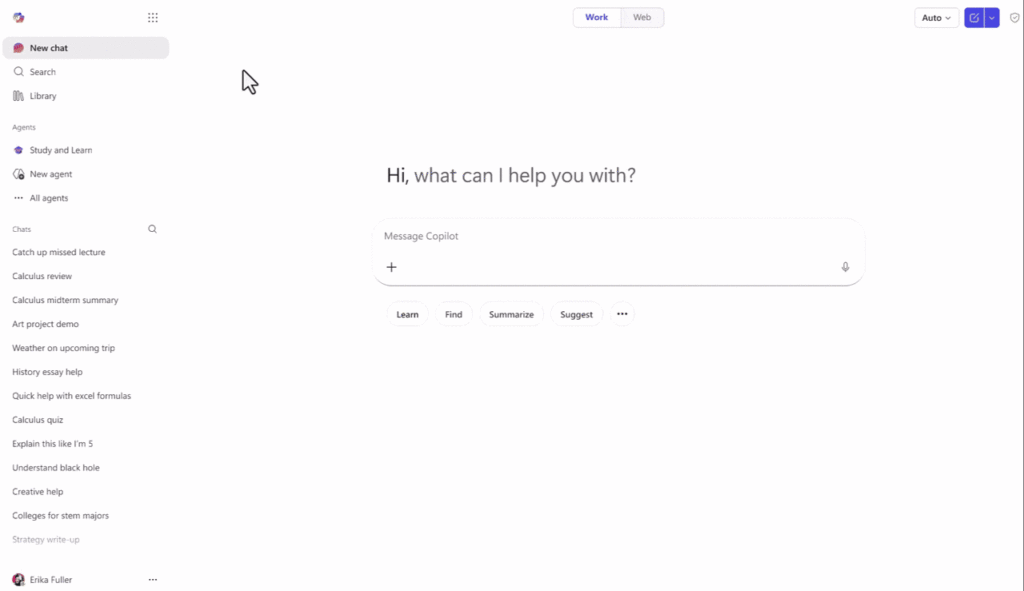
At the center of the newly announced capabilities is the Study and Learn Agent, an experience integrated into Copilot Chat tailored specifically for students aged 13 and older at no additional cost within Microsoft 365 Education. Rather than functioning as a traditional answer engine that bypasses cognitive effort, the tool is structured around pedagogical scaffolding. It utilizes interactive practice modules, including automated flashcards, quizzes, and matching exercises, alongside immediate feedback loops designed to reinforce long-term memory retention and independent problem-solving.
To ensure compliance with local educational policies and parental controls, deployment requires deliberate administrative action. IT departments must explicitly enable Copilot Chat for K-12 cohorts before the Study and Learn functionality becomes accessible by default. Furthermore, upcoming software iterations will empower educators to assign specific Study and Learn workflows directly through standard learning management assignments.
Complementing this agent is the expansion of Copilot Notebooks within the core Microsoft 365 Copilot application. This secure digital workspace allows students to aggregate heterogeneous source materials—including lecture recordings, PDF handouts, assigned readings, and handwritten notes—and query them exclusively within those parameters. The system transforms static source libraries into interactive study guides, enabling self-testing without exposing students to unvetted external web data. Additionally, the introduction of Teach and Learn taskbar shortcuts on compatible Windows hardware provides immediate, frictionless access to these resources directly from the operating system interface.
Official Responses and Industry Reactions
Education sector analysts and institutional leaders have responded cautiously yet optimistically to the announcements, emphasizing the balance between innovation and oversight. Representatives from administrative bodies note that shifting the technological paradigm away from direct output generation and toward guided inquiry addresses the core ethical dilemma of academic dishonesty.

Pedagogical experts have similarly praised the alignment of software engineering with established cognitive frameworks. By embedding interactive hints and structured questioning rather than providing raw solutions, the tools respect the foundational tenets of constructivist learning theory. However, labor representatives and teacher unions continue to emphasize that software deployment must be matched by dedicated time and compensation for professional development, warning that unfunded mandates for digital upskilling risk exacerbating educator burnout.
Broader Impact, Policy Implications, and Literacy Frameworks
Addressing the training deficit requires more than software updates; it demands standardized international definitions of digital competency. To this end, Microsoft has actively supported the AI Literacy Framework developed collaboratively by the European Commission, the OECD, and CodeAI. This comprehensive policy playbook outlines essential competencies that students should master regarding artificial intelligence before completing their formal schooling.
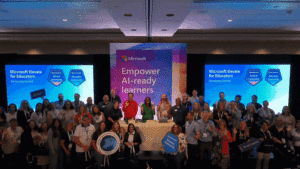
To operationalize these standards for instructional staff, Microsoft has partnered with the International Society for Technology in Education (ISTE) and the Association for Supervision and Curriculum Development (ASCD). Together, they have formulated the AI Literacy for Educators credential pathway. This professional development program connects directly to the Expert tier of Microsoft Elevate for Educators, an initiative currently accepting applications that provides certified community networks, credentialing, and capacity-building resources.
The economic and societal implications of these developments are profound. As artificial intelligence reshapes the global labor market, educational institutions face mounting pressure to produce graduates who can critically evaluate algorithmic outputs, detect systemic biases, and deploy computational tools ethically. By coupling institutional-grade privacy protections and robust IT governance with structured teacher training and student-centric coaching tools, the education sector is moving steadily from an era of chaotic experimentation toward a mature, sustainable paradigm of digital literacy.