


The rapid and widespread integration of artificial intelligence into daily student life has shifted the primary debate in modern education. For academic institutions worldwide, the central question is no longer whether students will utilize artificial intelligence for their coursework, but rather whether these digital tools are intentionally designed to cultivate critical thinking or merely function as shortcut answer keys. Across classrooms from primary schools to higher education facilities, learners are independently adopting generative technologies to manage heavy reading loads, brainstorm essay topics, and troubleshoot difficult homework problems. Recognizing this paradigm shift, technology providers and educational leaders are racing to implement frameworks that prioritize active learning over passive consumption. A primary development in this ongoing evolution is the introduction of Study and Learn, a specialized educational agent integrated within Microsoft 365 Copilot. Engineered specifically to support active learning methodologies while keeping the cognitive workload firmly on the student, this tool represents a concerted effort to align artificial intelligence with established pedagogical science. As school administrators grapple with institutional policies, training deficits, and student safety, the broader educational community faces critical choices regarding how to manage, regulate, and leverage AI in a learning-first environment.
The exponential acceleration of artificial intelligence adoption within the academic sector has outpaced traditional policymaking and institutional adaptation. According to comprehensive global research compiled in Microsoft’s 2026 AI in Education report, an overwhelming 92 percent of students report utilizing artificial intelligence for school-related tasks. Furthermore, over half of all surveyed education leaders indicate that their respective institutions are actively implementing or scaling AI initiatives. Students routinely reach for these technologies to synthesize dense academic materials, overcome conceptual roadblocks during independent study, and formulate foundational ideas for projects. Approximately one-third of student respondents explicitly note that they rely on AI to customize their learning pathways to suit their individual cognitive styles. Consequently, students are already embedding generative AI into their daily academic routines, establishing ingrained habits independent of institutional oversight. This widespread usage presents a distinct institutional opportunity: to guide students toward utilizing these tools in ways that foster deep conceptual understanding rather than superficial task completion.
However, a stark dichotomy exists within the marketplace regarding how different AI applications operate. While certain software platforms are explicitly built to guide learners systematically through complex problem-solving workflows, others are optimized purely for rapid, frictionless information retrieval, delivering finished answers without requiring cognitive effort from the user. Faced with the proliferation of unguided tools, numerous school districts and universities initially responded by imposing restrictive bans or heavily limiting AI access across campus networks. Despite these administrative prohibitions, students continue to access generative models on personal smartphones, tablets, and home computers. Educational analysts point out that restrictive access policies do not successfully insulate learners from external technologies; instead, these bans strip institutions of their ability to model responsible usage, leaving students to navigate powerful tools without professional guidance, academic guardrails, or institutional support.
Compounding the challenges of tool selection is a significant structural disconnect between administrative policies and the lived classroom experiences of educators and students. According to the 2026 global study, approximately four out of five education leaders believe their institutions provide clear and actionable artificial intelligence guidance. In stark contrast, only about half of surveyed students and teachers report receiving any such guidance whatsoever. The institutional training gap remains even more pronounced across the educational landscape. The research indicates that 77 percent of students and 53 percent of educators operate without any formal AI training, despite a strong, unmet demand for instruction, with 66 percent of educators and 52 percent of students requesting structured training at least quarterly. These findings underscore a systemic lag where professional development and resource allocation have failed to keep pace with the organic, bottom-up adoption of digital learning technologies.
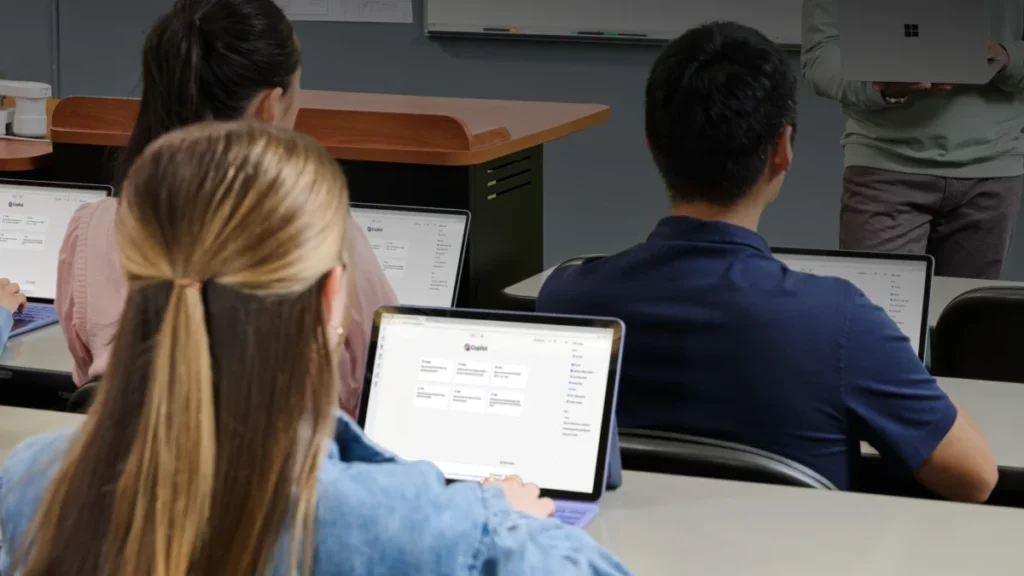
To address these systemic vulnerabilities, Microsoft designed Study and Learn as a first-party agent within the Microsoft 365 Copilot ecosystem, tailored exclusively for educational environments. Rather than outputting immediate, complete solutions to academic prompts, the agent is engineered to act as an interactive digital tutor that guides students through multi-step reasoning processes. For instance, a high school student preparing for an upcoming biology examination can dynamically generate a customized set of digital flashcards based on lecture notes. Similarly, an undergraduate student grappling with advanced calculus equations receives step-by-step scaffolding designed to stimulate analytical problem-solving rather than rote memorization. When applied to writing assignments, such as a history essay, the agent prompts students to defend their theses, asking targeted counter-questions that sharpen their argumentative structure. Critically, the tool operates directly within the framework of a student’s authorized documents, lecture slides, and assigned PDF textbooks, providing explicit citations back to the source material to ensure academic integrity.
The foundational architecture of Study and Learn relies heavily on established learning science principles rather than standard commercial AI algorithms. The user experience is purposefully structured around cognitive load theory, retrieval practice, and active engagement techniques designed to reinforce long-term memory retention and conceptual mastery. By requiring students to articulate their reasoning and interact with source citations, the technology discourages passive dependency and promotes metacognition. Furthermore, the agent operates entirely within the secure, enterprise-grade privacy boundaries of the Microsoft 365 infrastructure managed by the school district or university, ensuring compliance with student data privacy regulations and incorporating robust responsible AI safeguards.
International implementation provides early qualitative insights into how guided AI environments alter student behavior and classroom dynamics. Shane Tooley, Assistant Principal of Curriculum at St. Peter Claver College in Australia, observed a measurable transformation in student interactions with the technology. According to institutional observations, students are no longer simply prompting the system for direct answers; instead, they are formulating increasingly sophisticated and analytical queries within Copilot Chat, marking a major pedagogical shift toward higher-order inquiry.
From an administrative and technical perspective, enabling Study and Learn requires strategic coordination between educational leaders and IT departments. The agent is available through eligible Microsoft 365 Education licensing tiers, specifically including A1, A3, and A5 agreements. However, the system relies on a mandatory operational prerequisite: Copilot Chat must be explicitly activated by network administrators. For primary and secondary educational institutions, Copilot Chat is disabled by default, requiring IT administrators to configure age-gating controls specifically designed for learners aged 13 to 17. Without this precise administrative configuration, students cannot access the Study and Learn agent. Furthermore, the platform remains entirely inaccessible for children under the age of 13, adhering to strict child privacy standards. Consequently, enabling these capabilities necessitates a collaborative dialogue between curriculum directors who establish institutional learning priorities and technical leaders who manage network configurations.
The broader implications of these technological shifts extend far beyond immediate classroom performance, touching directly upon future workforce readiness and economic viability. According to labor market research published by LinkedIn, approximately 70 percent of the core skill sets utilized across standard occupations are projected to undergo substantial transformation between 2015 and 2030, with artificial intelligence serving as the primary catalyst. Concurrently, the proportion of job postings explicitly requiring demonstrated AI literacy experienced a sixfold increase within a single year. Students display a high degree of awareness regarding this economic evolution. Survey data reveals that 79 percent of students believe that possessing the ability to utilize artificial intelligence effectively and responsibly is critical to their future career prospects, a sentiment echoed by 87 percent of educators and institutional leaders. By integrating learning-first artificial intelligence environments into standard curricula, educational institutions can actively equip students with the digital competencies required to navigate an increasingly automated global economy with ethical awareness and technical proficiency.