

The German verb haben, translating to the English “to have,” serves as the foundational pillar of the German language’s grammatical architecture. Far beyond a simple indicator of possession, haben functions as the primary auxiliary verb required to construct the Perfekt tense—the most frequently utilized past tense in spoken German. For students of the language, achieving proficiency in the conjugation and application of haben is not merely a rote memorization task; it is an essential gateway to mastering the mechanics of German verbal communication. By understanding how this irregular verb interacts with other linguistic structures, learners can effectively navigate the transition from basic vocabulary to complex sentence construction.
Historical Context and Linguistic Evolution
The irregular nature of haben is a product of centuries of linguistic attrition. As a high-frequency verb, its form has been shaped by the tendency of natural language to favor efficiency. In the present tense (Präsens), the verb stem “hab-” undergoes a contraction in the second-person singular (du) and third-person singular (er/sie/es) forms. While a regular verb would logically follow a pattern resulting in “habst” and “habt,” centuries of colloquial usage have smoothed these into “hast” and “hat.” This phenomenon mirrors the evolution of the English cognate “have,” which similarly shortens to “has” rather than “haves.”
From a diachronic perspective, this reduction highlights the verb’s critical role in communication. Because speakers use it so frequently, the language system incentivizes shorter, more fluid pronunciations. This evolution is not limited to the present tense; the verb’s behavior in the past tense (Präteritum) and the participle (Partizip II) places it within the “mixed verb” category. While it adopts the standard weak-verb dental suffix (-te, -t), the stem shift from “hab-” to “hatt-” signifies its status as a foundational, irregular element of the Germanic lexicon.
Structural Analysis of Conjugation
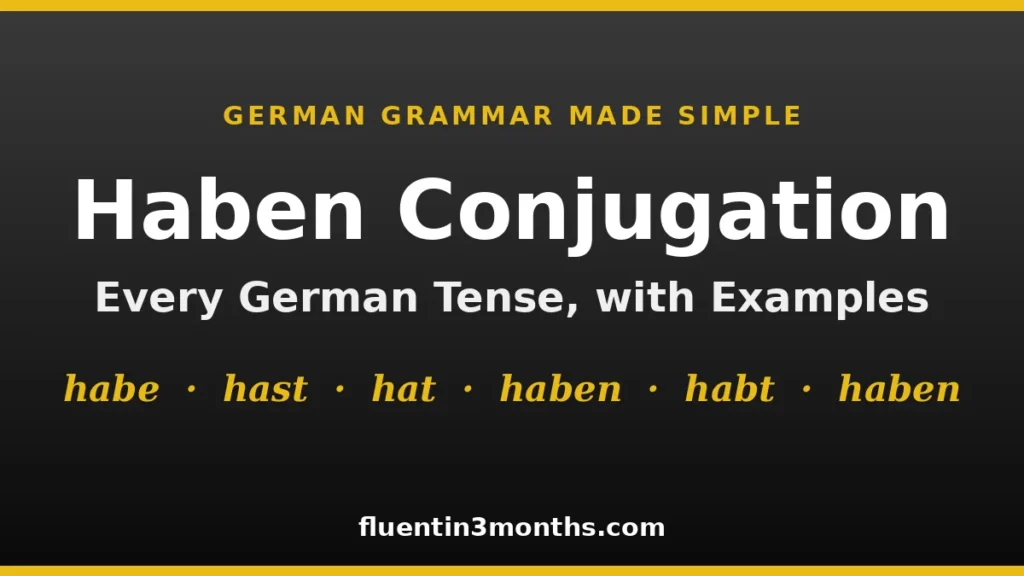
To achieve professional-level fluency, learners must categorize the conjugation of haben into simple and compound tenses. The German language utilizes two simple tenses: the Präsens and the Präteritum. In the Präsens, the conjugation follows a consistent pattern once the initial contractions are learned: ich habe, du hast, er/sie/es hat, wir haben, ihr habt, sie/Sie haben.
In the Präteritum, the verb shifts to a past-tense form that is uniquely preferred in spoken German, even when the Perfekt tense (constructed with an auxiliary) might be grammatically permissible. The Präteritum forms are: ich hatte, du hattest, er/sie/es hatte, wir hatten, ihr hattet, sie/Sie hatten.
The compound tenses, which include the Perfekt, Plusquamperfekt, Futur I, and Futur II, are built by pairing the auxiliary verb haben with a participle or infinitive. The Perfekt is formed by using the present tense of the auxiliary plus the Partizip II (gehabt). For example, “Ich habe ein Auto gehabt” (I have had a car). However, in standard German parlance, native speakers frequently prefer the simple “Ich hatte ein Auto” to describe past possession, a stylistic choice that underscores the efficiency of the language.
Strategic Usage: The Haben-Sein Dichotomy
One of the most significant challenges for non-native speakers is determining when to employ haben versus its counterpart, sein (to be), as a Perfekt auxiliary. Statistically, the vast majority of German verbs utilize haben. The usage of sein is strictly reserved for specific linguistic categories: verbs denoting motion (e.g., gehen, fahren), verbs indicating a change of state (e.g., werden, aufwachen), and a small set of stationary verbs such as sein itself and bleiben.
If a verb does not fall into these specific movement or state-change categories, the default auxiliary is haben. Misapplying this rule is a common indicator of non-native speech patterns. Furthermore, learners must navigate idioms where German relies on haben while English uses “to be.” For instance, expressions such as “Hunger haben” (to be hungry) or “Durst haben” (to be thirsty) require the verb of possession. A critical point of caution exists regarding the expression of age: unlike French or Spanish, which use their respective equivalents of “to have,” German adheres to the English structure, using sein (Ich bin 25 Jahre alt).
The Konjunktiv Mood and Polite Discourse
Beyond the indicative mood, the Konjunktiv II and I forms of haben are essential for high-level communication. The Konjunktiv II is the standard for expressing hypotheticals, wishes, and polite requests. The form “ich hätte” (I would have) is indispensable in social and commercial settings. Specifically, the phrase “Ich hätte gern…” (I would like…) serves as the gold standard for ordering in restaurants or making requests in shops. Using this construction is perceived as significantly more polite and sophisticated than the direct “Ich will” (I want), which can be interpreted as overly blunt.
The Konjunktiv I, conversely, serves a specialized function in formal reportage, particularly within journalism and official documentation. It is the primary vehicle for reported speech (indirekte Rede), allowing speakers to convey information attributed to third parties without necessarily verifying its veracity.
Data-Driven Learning and Pedagogical Implications
Language acquisition research suggests that the most effective way to internalize these patterns is through a combination of contextual usage and targeted repetition. In the field of applied linguistics, “spaced repetition” systems (SRS) are frequently cited as the optimal method for memorizing the irregular contractions of haben. By integrating these verb forms into daily active speech, rather than relying on static tables, learners accelerate their transition from the acquisition phase to the production phase.
Professional analysis of learner errors indicates that the primary obstacle is not the lack of understanding of the rules, but the interference from the learner’s native language. Speakers of Romance languages, in particular, must actively recalibrate their mental models to account for the German preference for “to be” in age-related statements and the specific idiomatic uses of haben for physical sensations.
Broader Linguistic Impact
The influence of haben extends into the very fabric of German sentence structure. Because it serves as an auxiliary for the majority of transitive and intransitive verbs, it acts as a primary scaffolding tool. When a learner successfully navigates the conjugation of haben, they have effectively learned the structural framework for a significant percentage of the German verbal system.
In contemporary academic and professional settings, the ability to use the Konjunktiv and the nuanced past tenses of haben is often viewed as a marker of intermediate-to-advanced proficiency. It allows for a level of precision in expression—such as distinguishing between a simple past event and a hypothetical scenario—that is vital for effective negotiation and clear communication.
Summary of Strategic Application
To summarize the operational hierarchy of the verb:
- Present Tense Mastery: Prioritize the Präsens. The contraction of the stem in the second and third person is non-negotiable for correct grammar.
- Auxiliary Selection: Recognize that haben is the “default” auxiliary. Use it unless the verb involves motion or state change.
- Idiomatic Awareness: Treat expressions of physical state (hunger, thirst) as instances requiring haben, while maintaining the English-style use of sein for age.
- Politeness Markers: Internalize “Ich hätte gern” as a foundational tool for daily social interaction.
As learners progress, they will find that haben is not merely a vocabulary item to be checked off, but a recurring participant in the vast majority of German interactions. Whether in the formal tone of a news report or the casual speed of a street-side conversation, the verb remains the engine of the language. By focusing on the mechanics of its irregularities and the strategy of its usage, the learner moves closer to the goal of natural, fluid, and accurate German communication. Mastering this single verb effectively reduces the friction of language acquisition, providing a reliable foundation upon which the rest of the German verbal system can be built.