


The Spanish verb ir, meaning "to go," stands as a cornerstone of Romance language acquisition, serving as one of the most frequently utilized and morphologically complex verbs in the lexicon. For students and linguists alike, ir represents a primary case study in linguistic evolution, particularly due to its suppletive nature—a phenomenon where a single verb draws its conjugations from multiple distinct Latin roots. As learners navigate the complexities of travel plans, temporal navigation, and daily communication, understanding the historical and functional architecture of ir is essential for achieving professional fluency.
Historical Evolution and Linguistic Architecture
The irregularity of ir is not a result of haphazard development but rather a documented historical fusion of three separate Latin verbs: ire (to go), vadere (to walk/go), and esse (to be). This process, known as suppletion, explains why the conjugation paradigm appears fragmented across different tenses. For instance, the present tense forms, such as voy and vas, derive from the Latin vadere, whereas the preterite forms, including fui and fue, originate from the perfect tense of esse.
Linguists categorize ir as an athematic verb, meaning its stems do not follow the standard suffix-based patterns of regular -ir, -er, or -ar verbs. This historical blending creates a unique challenge for learners but also provides a fascinating window into the evolution of Ibero-Romance languages. The coexistence of fui as the past tense for both "to be" and "to go" remains one of the most noted linguistic coincidences in Spanish, requiring contextual clarity to distinguish between states of being and movement through space.
Chronology of Usage and Syntactic Framework
In standard Spanish, the verb ir functions as a primary vehicle for both physical displacement and temporal projection. The following breakdown illustrates the structural requirements for mastering its various moods:
The Indicative Mood: The Foundation of Fact
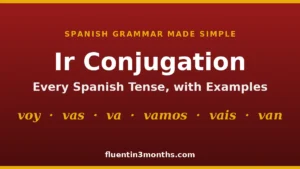
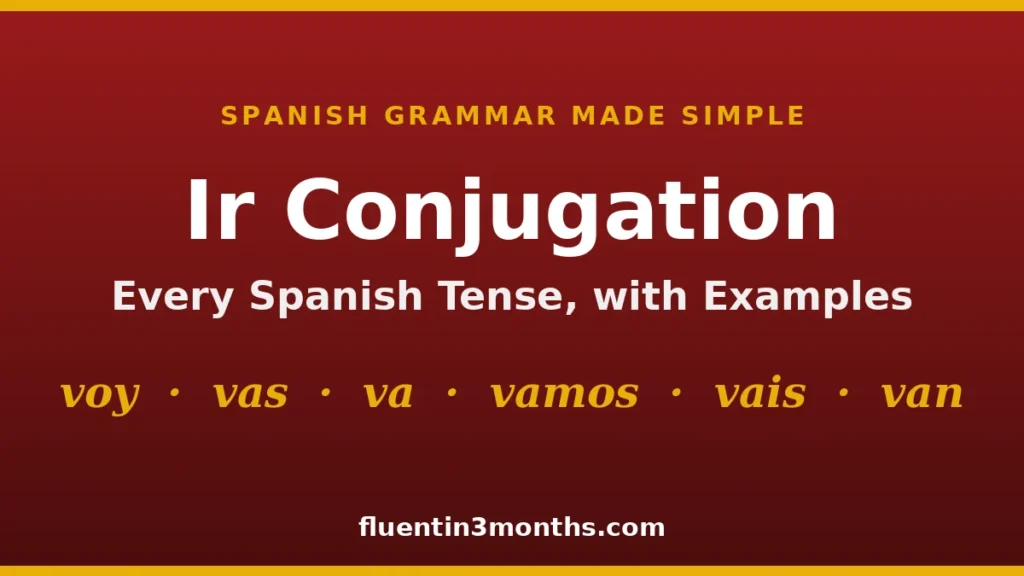
The indicative mood remains the bedrock of daily communication. The present tense—voy, vas, va, vamos, vais, van—is frequently leveraged in the "periphrastic future" construction: ir + a + infinitive. Statistical analysis of conversational Spanish indicates that this construction accounts for a significant portion of future-tense expression, often preferred over the synthetic future tense (e.g., iré) for its simplicity and immediate clarity.
The Imperfect Tense: Anomaly in Pattern
While many verbs in Spanish adhere to consistent patterns in the imperfect tense, ir remains an outlier. The conjugation—iba, ibas, iba, íbamos, ibais, iban—must be memorized as an irregular unit. This tense is critical for describing habitual actions in the past or providing background context, such as in the phrase iba a la escuela (I used to go to school).
The Subjunctive Mood: Expressing Subjectivity
The subjunctive is essential for navigating hypothetical situations, desires, and emotional responses. The present subjunctive (vaya, vayas, vaya, vayamos, vayáis, vayan) and the imperfect subjunctive (fuera/fuese) are indispensable for advanced communication. The usage of the -ra versus the -se suffix in the imperfect subjunctive often denotes regional preference, with the former being more prevalent in Latin American media and speech.
Supporting Data: Frequency and Pedagogical Prioritization
Research into language acquisition frequency indicates that ir consistently ranks within the top ten most utilized verbs in Spanish-language media, parliamentary records, and academic literature. Because of its high frequency, linguistic pedagogues advocate for a "modular" approach to learning:
- The Core Module: Master the present tense and the near-future construction (ir + a + infinitive). This combination covers approximately 60% of common usage.
- The Temporal Module: Learn the preterite and imperfect indicative. This is essential for narrative discourse.
- The Subjunctive Module: Focus on the present subjunctive for expressing commands, doubts, or wishes.
The table below summarizes the key forms required for professional-level proficiency:
| Tense | Yo Form | Nosotros Form | Function |
|---|---|---|---|
| Present | Voy | Vamos | Fact/Plan |
| Preterite | Fui | Fuimos | Completed Action |
| Imperfect | Iba | Íbamos | Habitual/Background |
| Subjunctive | Vaya | Vayamos | Doubt/Will |
Official Perspectives and Pedagogical Best Practices
Language experts often emphasize that the "irregularity" of ir should not be viewed as an obstacle but as a logical framework for understanding broader grammatical concepts. By drawing parallels between the preterite of ir and ser, learners effectively reduce their cognitive load. In academic settings, the "suppletive model" is taught to highlight how languages reorganize themselves over centuries to maintain efficiency.
From a pedagogical standpoint, the "imperative" form—specifically the command ve—is frequently highlighted as a point of confusion for beginners who may mistake it for the verb ver (to see). Contextual sensitivity, therefore, is not merely a stylistic choice but a functional necessity for speakers.
Broader Impact on Communication and Fluency
The ability to command the verb ir impacts the speaker’s ability to navigate both social and professional environments. In a business context, the use of ir is vital for coordinating schedules, managing logistics, and discussing future corporate strategy. In casual conversation, it acts as the primary tool for social planning.
Furthermore, the "near-future" construction (voy a) serves as a bridge between the present and the future, allowing speakers to communicate intent without needing to navigate the complex synthetic future or conditional tenses. This efficiency is a hallmark of native-level communication, where clarity and speed are often prioritized over formal synthetic constructions.
Implications for Future Linguistic Study
As digital language-learning platforms continue to integrate machine learning and big-data analytics, the instruction of irregular verbs like ir is becoming increasingly personalized. Advanced algorithms now track individual learner progress, focusing on the specific tenses that demonstrate the highest error rates.
The enduring nature of ir in the Spanish language suggests that while other grammatical structures may simplify over time, high-frequency irregular verbs are remarkably resilient. Their deep roots in Latin and their essential roles in human interaction ensure their stability for centuries to come. For the dedicated learner, mastering ir is not merely an exercise in rote memorization; it is an entry point into the structural logic of the Spanish language and a testament to the complex, historical journey of the Romance languages from their classical origins to their current, global application.
In conclusion, while the morphologically diverse nature of ir poses an initial hurdle, the strategic application of the "hack-based" approach—focusing on the most frequent tenses first—allows for rapid advancement. By integrating these forms into daily practice and recognizing the verb’s historical context, learners can effectively bridge the gap between intermediate comprehension and native-like fluency.