



The landscape of modern education stands at an unprecedented crossroads as institutions worldwide grapple with the rapid integration of artificial intelligence technologies. Against a backdrop of shifting pedagogical demands and emerging digital tools, Microsoft has announced a comprehensive, five-pillar strategic framework designed to guide the responsible deployment of AI across K-12 schools, higher education institutions, and workforce development programs. This initiative arrives during a pivotal technological moment where educational leaders increasingly weigh the efficiency gains of machine learning against the fundamental need for student safety, data privacy, and uncompromised cognitive development.
Background Context and Technological Evolution
Microsoft’s formal entry into the educational sector spans five decades, evolving from early computing hardware initiatives in classrooms to cloud-based productivity suites and, currently, generative AI ecosystems. Over the past fifty years, the technology sector and educational stakeholders have witnessed multiple waves of digital transformation, ranging from the widespread adoption of personal computers and the advent of the internet to the shift toward remote learning environments. Each transition has tested the resilience of traditional pedagogies and highlighted the delicate balance between technological acceleration and pedagogical integrity.
The current integration of artificial intelligence introduces a distinct paradigm. Unlike static software tools, generative AI possesses the capacity to synthesize information, generate text, write code, and simulate human-like interactions at scale. While these capabilities offer transformative potential for personalized learning, administrative burden reduction, and accelerated academic research, they simultaneously provoke urgent questions among educators and parents. Primary concerns center on whether digital systems inadvertently diminish critical thinking, whether automated grading introduces algorithmic bias, and whether student data remains adequately protected from commercial exploitation. Recognizing that education remains a fundamentally human endeavor built upon relational trust between teachers, students, and families, industry leaders face mounting pressure to establish rigorous operational guardrails.
Chronology of Policy Milestones and Industry Partnerships
The development of Microsoft’s current educational AI strategy is anchored by a deliberate sequence of institutional milestones and labor partnerships designed to bridge the gap between technological capability and classroom realities.
In the years leading up to the current framework, the technology sector experienced a reactive phase where educational institutions frequently banned generative AI tools entirely due to academic integrity concerns and vague privacy policies. In response to widespread fragmentation, Microsoft initiated targeted collaborative efforts to establish baseline industry standards.
Last week, this chronology culminated in a landmark agreement between Microsoft and the American Federation of Teachers (AFT), one of the nation’s largest labor organizations representing educators. This agreement yielded the newly introduced Privacy and Safety Standard for Schools, representing the first time a major technology corporation and a major teachers’ union have jointly defined binding parameters for trusted artificial intelligence in educational products.
Concurrent with this union agreement, the company has leveraged specialized feedback loops such as the Education Insiders Program, which invites educators and school administrators to evaluate and critique pre-release AI tools. Furthermore, programmatic expansions—including the rollout of the "Teach in Microsoft 365 Copilot" interface and specialized learning accelerators—have been methodically deployed following extensive pilot testing in global school districts.
Core Pillars of the Microsoft Educational AI Framework
The newly detailed strategy is anchored by five foundational principles intended to address safety, pedagogical control, cognitive integrity, systemic institutional efficiency, and long-term economic preparedness.
Safety, Privacy, Security, and Transparency by Design
The first pillar mandates that every AI system implemented within an educational context must incorporate robust architectural safeguards designed to protect student data privacy, mitigate security vulnerabilities, and actively reduce algorithmic bias. Under the newly established Privacy and Safety Standard for Schools, Microsoft Education products are subjected to stringent data usage limitations. Crucially, the agreement mandates strict human oversight for consequential administrative and academic decisions, establishes transparent reporting mechanisms for families, and legally affirms that educational institutions retain permanent intellectual property ownership over the knowledge and ideas generated within their ecosystems. By inviting competitors and industry peers to adopt identical compliance thresholds, the initiative seeks to establish a universal baseline of trust across the educational technology market.
Educators at the Center of Classroom AI Integration
Addressing widespread anxiety regarding labor displacement, the second pillar asserts that artificial intelligence must augment professional expertise rather than substitute for teacher judgment. Real-world applications demonstrate this principle in practice; for example, special education instructors in urban school districts utilize administrative AI assistants to draft differentiated, sensory-aware learning materials for students with complex medical and communication needs. By automating routine lesson planning and administrative paperwork, these tools reclaim instructional hours for direct student engagement.
Quantitative outcomes from early deployments illustrate the efficacy of this approach. Brisbane Catholic Education reported a 275% increase in learner agency among vulnerable and at-risk student cohorts following targeted technological integration. Similarly, institutional metrics from Miami Dade College indicate a 15% increase in overall student pass rates and a 12% reduction in course dropout rates following the institutional deployment of Microsoft 365 Copilot. To ensure instructional staff possess the requisite competencies, the "Elevate for Educators" program has connected over 17 million participants globally with professional development credentials and practical safety guidelines over the past year.
Preserving Critical Thinking and Cognitive Rigor
The third pillar tackles a prominent risk identified by learning scientists: cognitive offloading. When students utilize unoptimized AI tools that instantly provide final answers rather than guided inquiry, they risk engaging in a superficial imitation of learning that bypasses the deep cognitive struggle essential for long-term knowledge retention.
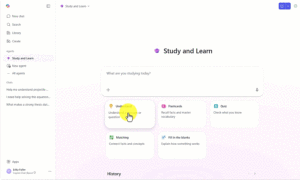
To counteract this phenomenon, Microsoft’s educational AI experiences are intentionally designed to be age-appropriate by default. In K-12 environments, access to conversational interfaces like Copilot Chat is set to "off" by default, requiring explicit administrative authorization aligned with student developmental progression. Younger students engage with foundational digital concepts through gamified platforms such as Minecraft Education and Learning Accelerators, while older students interact with scaffolded systems like the Study and Learn Agent. This specialized agent utilizes guided questioning and interactive problem-solving techniques to assist students through difficult academic concepts without executing the core cognitive labor on their behalf.
Strengthening Institutional Operations and Research
Beyond the direct classroom environment, the fourth pillar focuses on optimizing administrative efficiency and accelerating academic discovery within school districts and universities. Modern educational systems frequently struggle with fragmented data architectures that impede timely intervention for struggling students.
Case studies from major public school districts and research universities highlight the financial and operational impact of integrated cloud architectures. Broward County Public Schools, facing substantial budgetary constraints across 235 facilities, deployed enterprise AI analytics to evaluate operational inefficiencies. The implementation yielded projected facilities savings ranging between $40 million and $50 million over a five-year period, freeing up capital for reinvestment into frontline instruction and student support services. Concurrently, medical researchers at the University of North Carolina have leveraged secure, cloud-based research environments built on Azure infrastructure to advance clinical studies while maintaining rigorous compliance with patient data privacy regulations, supporting dozens of active research initiatives simultaneously.
Preparing Students for the Emerging AI Economy
The final pillar addresses macroeconomic shifts and workforce readiness. According to research published by the AI Economy Institute, individuals possessing verified artificial intelligence literacy and related technical competencies command wage premiums of up to 40%, frequently eclipsing the financial returns historically associated with traditional advanced degrees.
To prevent a socioeconomic "AI divide," educational institutions are embedding digital literacy across interdisciplinary curricula. Academic institutions such as Auburn University have developed faculty-facing AI instructional courses deployed to thousands of educators across multiple networks. Babson College has established specialized interdisciplinary laboratories integrating generative AI tools directly into daily operational workflows, while the University of South Florida has utilized student ambassador programs to achieve significant time efficiencies in administrative tasks. Furthermore, workforce development partnerships with entities like North America’s Building Trades Unions (NABTU) have expanded to include digital platforms like the "Jobs Machine," helping counselors and students navigate skilled trade careers alongside traditional academic trajectories.
Broader Implications and Analytical Outlook
The systematic codification of educational AI standards represents a critical maturation phase for the technology sector. For decades, the commercial software industry operated on a paradigm of rapid deployment followed by iterative patches, a methodology ill-suited to the sensitive developmental requirements of minors and the structural complexities of public education.
By tying product development to union agreements, learning science research, and strict privacy standards, major technology providers are attempting to reconcile commercial innovation with institutional accountability. Analysts note that while voluntary frameworks establish positive precedents, the ultimate success of these initiatives will depend on sustained regulatory scrutiny, equitable funding access for under-resourced school districts, and the continuous incorporation of empirical educational research. As artificial intelligence continues to permeate academic and professional spheres, the imperative to maintain human oversight, protect student autonomy, and foster genuine critical thinking remains the defining challenge for the future of global education.