



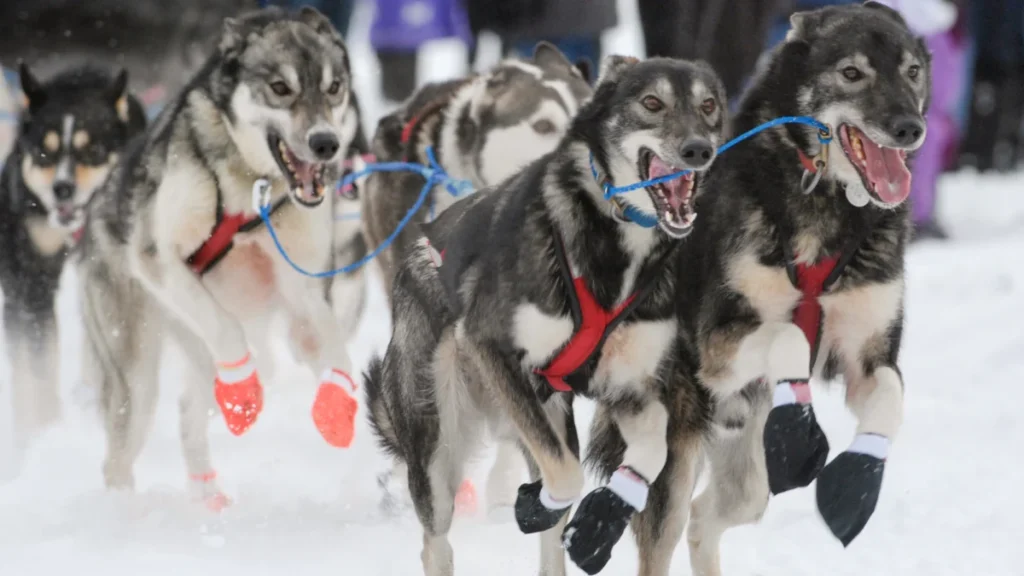
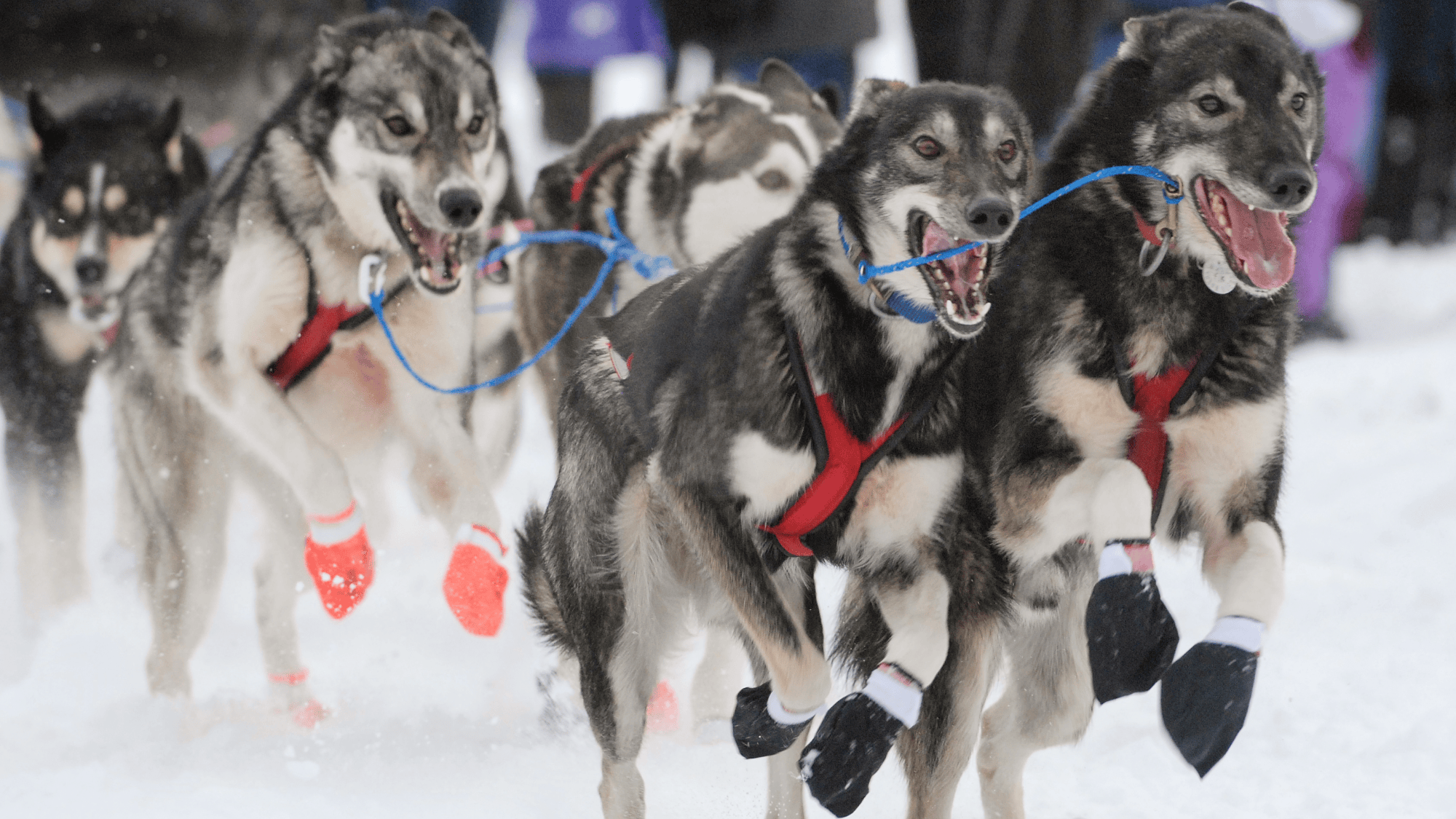
Sled dogs are among the most resilient and powerful endurance athletes in the animal kingdom, capable of traversing thousands of miles of unforgiving, frozen terrain under blinding snow and biting sub-zero winds. For millennia, these canine workers have served as the vital machinery of Arctic survival, hauling essential supplies, moving human settlements, and facilitating communication across treacherous ice sheets. Beyond their emotional role as loyal companions, this arduous, centuries-old partnership has left a permanent, measurable mark on the skeletal evolution of the species.
According to a groundbreaking study published in the journal iScience, modern and ancient sled dogs evolved distinctively shorter leg bones to pull heavy loads more efficiently. Researchers discovered that contemporary working sled dogs and ancient canines dating back approximately 2,000 years possess limb bones that are roughly six percent shorter than those of similar, non-working dog breeds and wild canids. This morphological shift provides scientists with a powerful new archaeological tool to identify ancient sled dogs and offers deeper insight into how human transportation networks expanded across the extreme polar regions over the past several millennia.
Unlocking the Physical Mechanics of Canine Traction
The research team, led by archaeologists and biomechanics experts including University of Haifa researcher Mitya Kletzerman, set out to understand the physiological demands placed on working dogs. Previous archaeological studies had already demonstrated that heavy physical labor leaves distinct markers on animal skeletons; for instance, reindeer utilized for racing and hauling loads exhibit limb bone differences compared to unburdened counterparts. Kletzerman and her colleagues hypothesized that sled dogs might have undergone a similar evolutionary optimization process to cope with the immense physical strain of tractive work.
To test this theory, the researchers developed an advanced biomechanical model simulating how a dog’s body handles the complex physics of pulling a heavy load. The mathematical and physical modeling revealed a fundamental principle of traction: when an animal or human attempts to pull a heavy sled, the physics of the load tend to tip the creature backward. By lowering its center of gravity and shortening the lever arms of its limbs, a canine can counteract this backward tipping force, thereby generating significantly greater pulling power with less muscular fatigue.
"When people or animals pull a load, it tends to tip them backward," Kletzerman explained in a statement regarding the findings. "A lower or more forward position of the center of mass counteracts this effect, allowing greater pulling force."
Empirical Evidence from Modern and Ancient Skeletons
Following the biomechanical modeling, the team tested whether modern sled dogs actually possess the anatomical proportions predicted by their equations. They conducted a comprehensive osteological analysis of 60 different modern canids, encompassing working sled dogs, wolves, spitz-type breeds, and generalized mongrels. By carefully measuring five specific limb bones—three in the forelegs (the humerus, radius, and ulna) and two in the hind legs (the femur and tibia)—and controlling for overall body size, the researchers uncovered a clear pattern.
The analysis revealed that modern sled dogs feature systematically shorter radius, ulna, and tibia bones compared to other canids. On average, these specific leg segments measured roughly six percent shorter. This reduction serves to lower the animal’s overall center of mass, optimizing its frame for forward-facing tractive effort rather than high-speed sprinting over flat, unencumbered ground.
To determine whether this anatomical trait is a recent development or an ancient adaptation, the research team expanded their study to the archaeological record. They examined 82 ancient dog bone fragments and three remarkably well-preserved complete skeletons. The intact skeletons originated from ritually buried dogs discovered at archaeological sites associated with ancestral Inuit populations in modern-day Chukotka, Russia, dating between 500 and 2,000 years ago.
The results of the osteological analysis were striking. Nearly 89 percent of the ancient bone fragments matched the modern sled-dog pattern of shortened distal limb bones. Furthermore, all three of the ritually buried dogs displayed the exact same anatomical profile. According to the research team, this high consistency indicates that shortened limb proportions can serve as a reliable bioarchaeological signature to identify ancient sled dogs, even at sites where sled equipment, harnesses, or wooden runners have long since decomposed.
Chronology of Canine Transportation in the Arctic
The origins of dog sledding represent a critical chapter in human history, marking the moment when Homo sapiens successfully unlocked the high latitudes of the planet. Prior to the widespread adoption of dog traction, human mobility in the Arctic was severely constrained by the sheer energy required to transport food, fuel, and shelter across vast, frozen expanses.
The earliest definitive archaeological evidence associated with dog sledding dates back approximately 9,000 years. In 2017, archaeologists working on Zhokhov Island in the Russian Arctic uncovered ancient wooden sled parts alongside well-preserved dog remains. Because organic materials like wooden sled runners and leather harnesses rarely survive the ravages of time in the archaeological record, researchers have historically struggled to map the precise timeline and geographic spread of dog-powered transport.
The identification of a skeletal biomarker for sled-pulling changes this dynamic. By examining canid remains excavated from archaeological sites across the Arctic and sub-Arctic regions, researchers can now reconstruct the historical timeline of dog sledding with unprecedented precision. This provides a proxy for human migration and technological diffusion, illuminating how ancient communities adapted to extreme environmental shifts.
"Sled dogs have played an indispensable role in communities in the Arctic," Kletzerman noted, emphasizing the broader historical stakes of the research. "Without dogs, people couldn’t move as efficiently to hunt, relocate as conditions changed, or travel between communities to exchange knowledge and share new ideas. Understanding how the practice evolved could give us new insights into how people adapted to life in the Arctic."
Broader Implications for Human-Animal Co-Evolution
The findings underscore the profound, reciprocal nature of the domestication process. While humans selectively bred dogs for docility, trainability, and coat density, the physical labor demanded of these animals imposed selective pressures that reshaped their underlying skeletal architecture. Over generations, human reliance on canine traction inadvertently sculpted the anatomy of the working dog, favoring individuals that could pull heavier loads with greater metabolic and mechanical efficiency.
This study also opens new avenues for paleozoologists and evolutionary biologists studying other working animals, such as pack horses, draft cattle, and sled-pulling reindeer. By applying similar biomechanical models and osteological metrics, scientists can better understand the morphological trade-offs inherent in animal labor across diverse historical cultures.
As researchers continue to unearth and analyze ancient faunal assemblages, the integration of biomechanics and archaeology promises to yield a richer narrative of our shared history with animals. Dogs have walked, run, and pulled alongside humanity for millennia, but modern science is only just beginning to decode the deep, structural ways in which that partnership transformed the anatomy of man’s oldest working ally.