



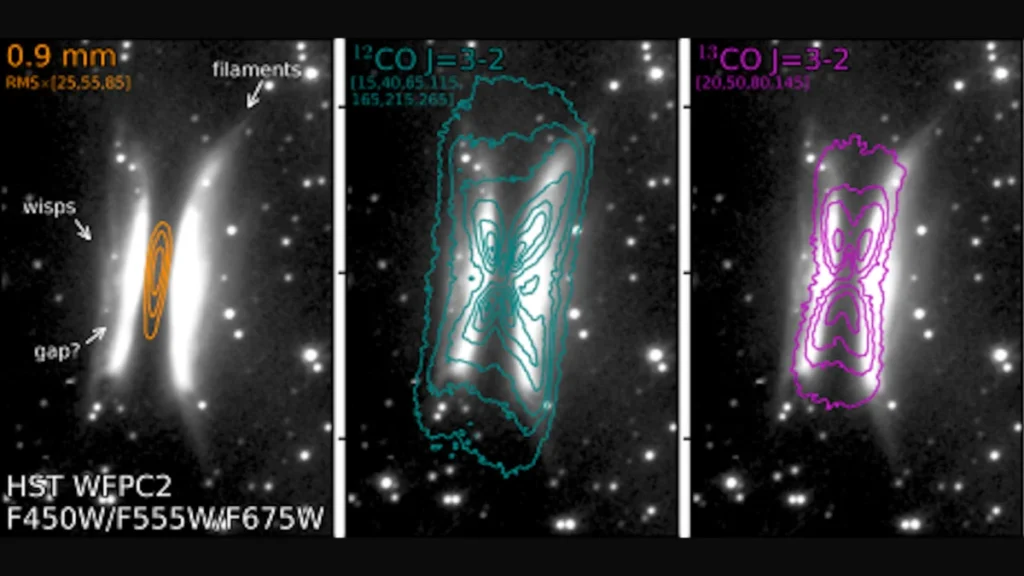
Deep within the Scorpius-Centaurus stellar association, roughly 453 light-years from Earth, a celestial formation affectionately dubbed "Gomez’s Hamburger" is providing astronomers with an extraordinarily clear, laboratory-grade window into the embryonic stages of planetary system development. Recent observations combining the infrared capabilities of the James Webb Space Telescope (JWST) with the high-resolution millimeter and submillimeter mapping of the Atacama Large Millimeter/submillimeter Array (ALMA) have unlocked new secrets regarding how colossal gas giants form and evolve. Published recently in The Astrophysical Journal, this latest research outlines the complex vertical and radial architecture of one of the largest protoplanetary disks ever identified by modern science.
The formation, formally designated as Gomez’s Hamburger (or GoHam for short), presents a nearly perfect edge-on perspective to observers on Earth. This rare orientation allows astrophysicists to slice visually through the dense layers of cosmic dust, gas molecules, and stellar winds that typically obscure the inner machinery of young stellar nurseries. By analyzing the structural stratigraphy of GoHam, researchers are testing longstanding theoretical models of planetary accretion, atmospheric stratification, and stellar evolution with unprecedented precision.
Main Facts and Structural Discoveries
Gomez’s Hamburger is not a modest stellar construct; it is an astronomical behemoth. Spanning an astonishing 93 billion miles in width, the protoplanetary disk possesses a dust mass exponentially larger than that found in typical planet-forming systems. This vast reservoir of material suggests that GoHam is not merely incubating a single, monolithic gas giant, but possesses the raw ingredients necessary to eventually birth an entire planetary system.
Data harvested by ALMA and JWST have allowed scientists to map the precise distribution of chemical species within the disk. As theoretical models predicted for decades, the vertical stratification of GoHam is neatly organized by molecular weight. Lighter gases, such as carbon monoxide, occupy the highest altitudes well above the disk’s central midplane. Heavier chemical components, including sulfur-bearing molecules, settle into denser layers immediately beneath. At the absolute core, compressed within the ultra-dense midplane itself, lies a concentrated, razor-thin ribbon of millimeter-sized dust grains.
However, despite its appetizing nickname, GoHam deviates significantly from symmetrical perfection. The dust clouds display distinct north-south asymmetries, with one side of the disk featuring notably brighter and wider thermal emissions. Researchers hypothesize that this asymmetry is driven by a localized cosmic disturbance, potentially a massive vortex capable of sweeping up and concentrating raw material to accelerate the accretion of embryonic planets. Furthermore, faint carbon monoxide emissions stretching along the northern periphery indicate that the central young star is actively venting gas into deep interstellar space via photoevaporative winds—a crucial mechanism that eventually dictates the lifespan of any planet-forming disk.
Chronology and Misidentification
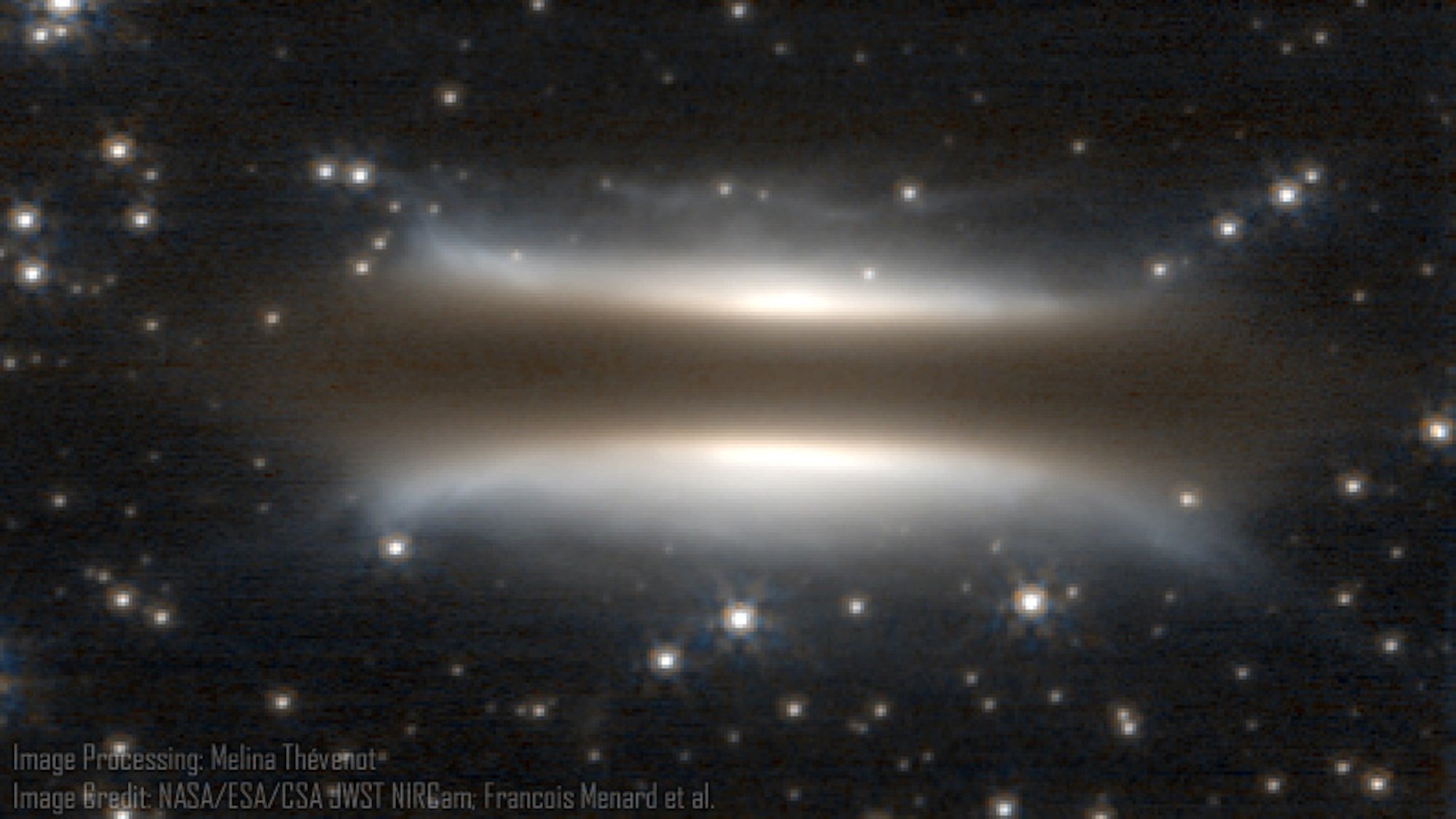
The journey to understanding Gomez’s Hamburger spans four decades of shifting astronomical paradigms. The object was first discovered in 1985 by amateur and professional astronomers scanning the southern skies. In its initial years of documentation, limited telescope resolution led researchers to misclassify the celestial body as a planetary nebula situated a staggering 6,500 light-years away from Earth. Under that erroneous classification, the object was viewed as the dying gasp of an aging star rather than the vigorous dawn of a new one.
It took decades of technological advancement, culminating in high-resolution radio astronomy and space-based infrared imaging, to correct the record. The deployment and maturation of the Atacama Large Millimeter/submillimeter Array in northern Chile fundamentally revolutionized the scientific community’s understanding of GoHam. By tuning into millimeter and submillimeter wavelengths, ALMA pierced through the optically thick dust lanes that had previously obscured the true nature of the object. Subsequent recalibrations slashed the distance estimate from 6,500 light-years down to a much closer 453 light-years, while simultaneously reidentifying the core engine not as a dying white dwarf, but as a young, actively accreting star surrounded by a sprawling protoplanetary disc.
The integration of the James Webb Space Telescope in recent years added a vital layer of infrared data, enabling astronomers to capture the fine-grained thermal signatures of the dust and gas layers with a clarity previously thought impossible.
Supporting Data and Expert Analysis
The scientific community has seized upon Gomez’s Hamburger as a prime benchmark for astrophysical modeling. Because edge-on disks inherently block the direct glare of their central stars, they provide a pristine environment for spectroscopy and coronagraphic imaging.
"GoHam gives us a rare and clear view of the vertical and radial structure of a very large, nearly edge-on disk," noted Charles Law, an astronomer at the University of Minnesota and co-author of the recent study. Law emphasized that the combination of massive disk dimensions, active cosmic winds, and pronounced structural asymmetries makes the formation an ideal natural laboratory for testing the mechanics of planet formation.
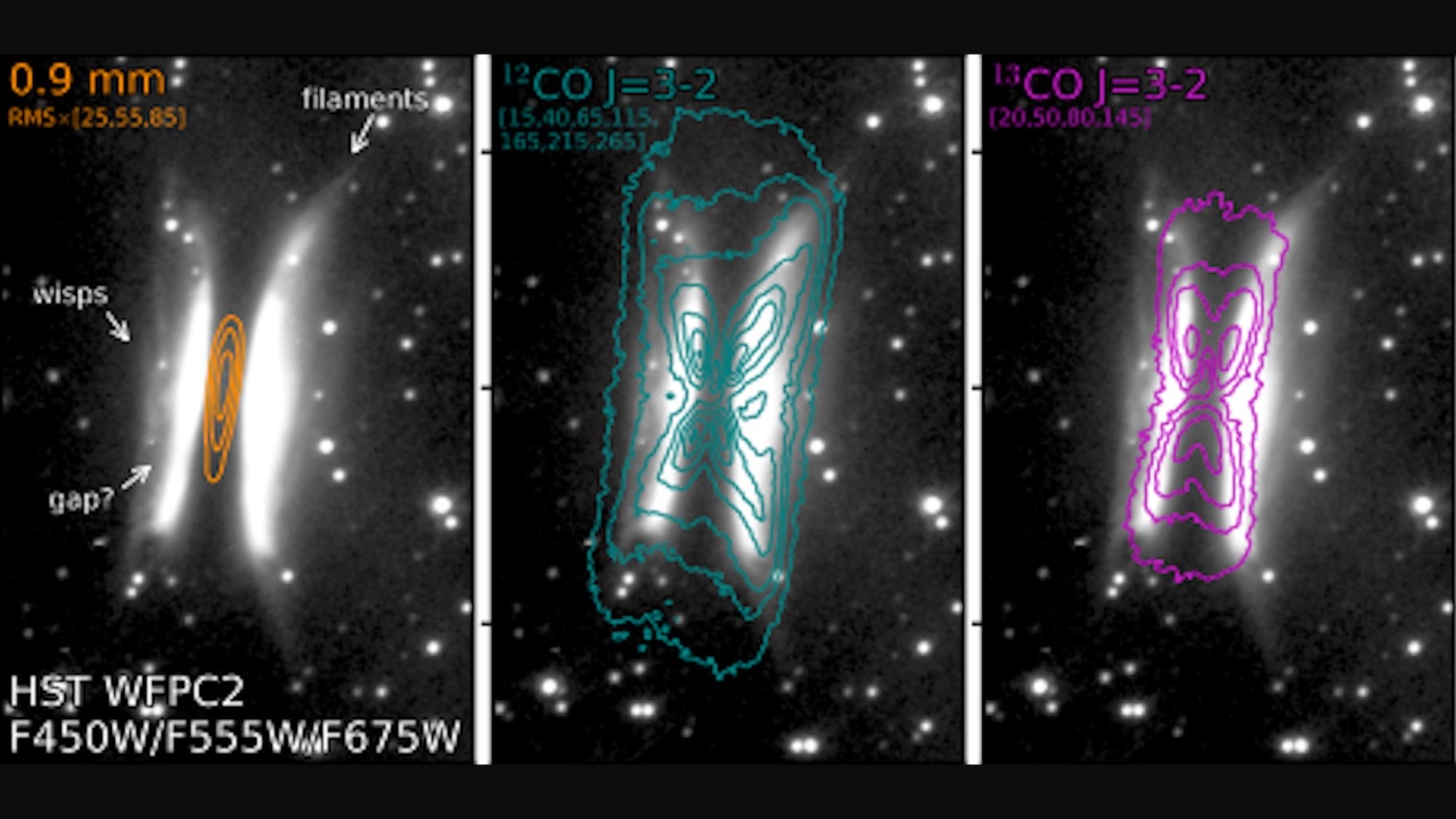
Astrophysicists analyzing the ALMA and JWST datasets note that the segregation of chemical elements observed in GoHam confirms fundamental theories about how solid particles settle toward the midplane of a disk while volatile gases remain suspended aloft. This settling process is the mandatory first step in forming the solid cores of gas giants like Jupiter and Saturn before they undergo runaway gas accretion.
Official Responses and Implications for Planetary Science
While NASA, the European Space Agency (ESA), and the Canadian Space Agency (CSA) have long championed the capabilities of JWST and international ground-based partnerships like ALMA, the findings at Gomez’s Hamburger highlight the immense value of multi-wavelength astronomy. By combining infrared data from space with radio-millimeter data from the ground, researchers can construct comprehensive, three-dimensional models of environments that are otherwise completely inaccessible.
The implications of the GoHam study extend far beyond the borders of the Scorpius-Centaurus association. Understanding how gas giants like the ones potentially forming within Gomez’s Hamburger aggregate their mass helps astronomers refine models of our own solar system’s genesis over 4.5 billion years ago. Furthermore, by observing photoevaporative winds—the streams of gas driven away from the disk by stellar radiation—scientists can better estimate the timeline that nascent planets face. If stellar winds strip away the disk too quickly, gas giants run out of building materials; if the disk persists, massive worlds have ample time to stabilize and mature.
As ongoing observations continue to analyze the physical dynamics driving GoHams asymmetrical dust distribution and embedded vortex structures, the cosmic Quarter-Pounder remains a cornerstone object for modern astrophysics. It stands as a testament to how far observational technology has advanced since 1985, transforming a confused smudge of light into a high-definition blueprint of planetary genesis.