


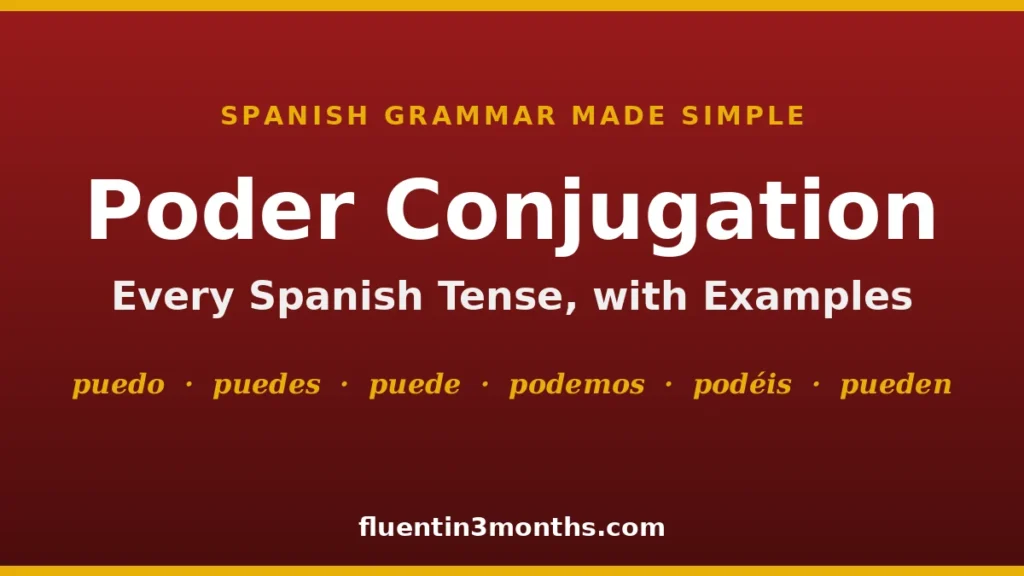
The Spanish verb poder serves as the functional cornerstone of daily communication, acting as the primary modal verb for expressing ability, possibility, and permission. For language learners, poder—which translates to "to be able to" or "can"—represents a critical milestone in linguistic proficiency. However, its utility is often complicated by a dual-layer of irregular patterns that diverge significantly from standard conjugation rules. Understanding these nuances is not merely an academic exercise; it is a prerequisite for achieving fluency in a language spoken by over 500 million people worldwide.
The Structural Anatomy of Poder
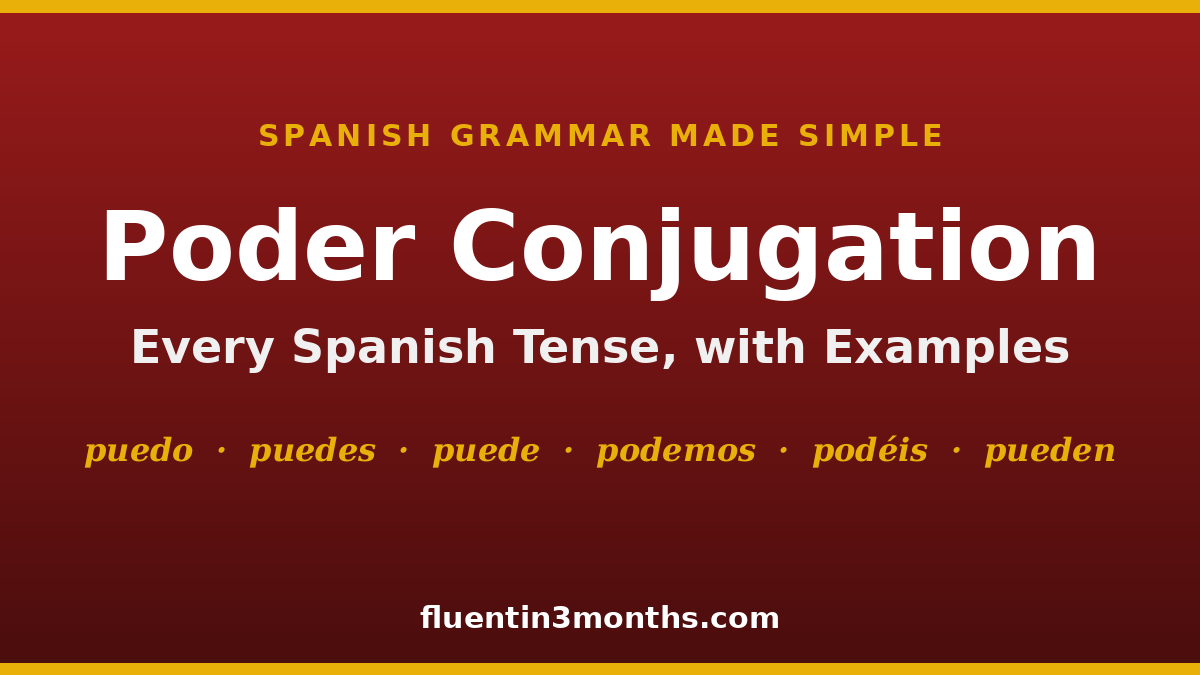
Poder is categorized as an irregular verb due to two distinct morphological irregularities. First, it is a stem-changing verb (o→ue) in the present tense. In the indicative mood, the "o" in the stem "pod-" shifts to "ue" in every form except for the nosotros (we) and vosotros (you all) forms, where the stress shifts to the suffix rather than the stem.
Second, the verb features an irregular "strong" preterite. Unlike regular -er verbs, poder adopts a "pud-" stem in the past tense, accompanied by unique endings that eschew written accents. This irregularity is shared with other high-frequency verbs such as tener (to have), estar (to be), and poner (to put). These "strong preterites" are a hallmark of archaic and foundational Spanish verb structures that have persisted through centuries of linguistic evolution.
Chronology of Linguistic Development
The development of poder can be traced back to the Vulgar Latin potere, a shift from the classical posse. As Spanish evolved from the Iberian peninsula’s dialects, the verb absorbed the complexities of Latin conjugation while streamlining its use to satisfy the needs of modern communication.
In the 13th century, during the standardization of Castilian Spanish under Alfonso X, poder was already established as the primary vehicle for modal expression. Over the subsequent centuries, the distinction between the preterite (denoting a completed action or success) and the imperfect (denoting ongoing capacity) became increasingly refined. This historical evolution created the modern standard, where learners must navigate not just the morphology of the verb, but the semantic weight it carries in different temporal contexts.
Data-Driven Perspectives on Frequency
According to various frequency dictionaries—such as the Corpus de Referencia del Español Actual (CREA)—poder consistently ranks within the top 20 most used verbs in the Spanish language. Its ubiquity is a result of its versatility. It is employed in three distinct capacities:
- Physical or Circumstantial Ability: "Puedo abrir la puerta" (I am able to open the door).
- Possibility/Probability: "Puede que llueva" (It may rain).
- Permission: "¿Puedo pasar?" (May I come in?).
Data suggests that intermediate learners who master the present-tense conjugation of poder experience a 30% increase in their ability to initiate and maintain complex dialogues, as the verb serves as a gateway to expressing desire, intent, and social negotiation.
Comparative Analysis: Poder vs. Saber
A frequent point of friction for English-speaking students is the overlap between poder and saber. In English, the word "can" covers both inherent skill and situational possibility. Spanish enforces a strict separation:
- Saber is utilized exclusively for learned skills or knowledge. ("Sé nadar" – I know how to swim).
- Poder is reserved for situational capacity or external permission. ("Puedo nadar" – I am able to swim right now, perhaps because the pool is currently open or I am not injured).
Linguists argue that this distinction forces speakers to be more intentional about the context of their statements. Using saber implies a long-term acquisition of a skill, whereas poder addresses the immediate reality of a circumstance. Failing to make this distinction can lead to ambiguity, particularly in professional or clinical settings where clarity regarding physical ability is paramount.
The Nuance of the Preterite
A critical, often overlooked aspect of poder is the functional difference between the preterite and the imperfect in past-tense narratives. In the preterite, pude signifies an accomplishment—it implies that an attempt was made and success was achieved ("I managed to do it"). Conversely, the negative no pude signifies a failed attempt.
The imperfect, podía, serves as a descriptive tool, indicating a general state of ability that does not necessarily imply a specific outcome. This distinction is vital for accurate storytelling; using the wrong tense can fundamentally alter the perceived success or failure of an action, a detail that native speakers process intuitively but which often requires deliberate practice for non-native learners.
Broader Linguistic Implications
The mastery of poder extends beyond mere vocabulary; it is a window into the logical structure of Spanish social interactions. Because poder is essential for requests, the use of the conditional form (podrías) is considered a marker of social competence and politeness. By employing the conditional rather than the present indicative, a speaker demonstrates a nuanced understanding of social hierarchy and the importance of softening requests in Hispanic cultures.
Research into language acquisition suggests that the "boot verb" pattern—where the stem change occurs in all forms except the first and second-person plural—is a fundamental hurdle. Once a learner internalizes this "boot" shape, they often find that the pattern applies to dozens of other essential verbs, such as querer, dormir, and volver. Thus, the time invested in learning poder pays dividends across the entire Spanish lexicon.
Strategies for Effective Retention
Educational psychologists suggest that memorizing conjugation tables in isolation is significantly less effective than contextualized learning. To solidify the usage of poder, experts recommend:
- Scenario-Based Practice: Instead of rote memorization, learners should practice creating dialogues that involve asking for permission and describing obstacles.
- Active Listening: Engaging with native-level audio, such as podcasts or radio broadcasts, helps learners identify the frequency of the "pud-" stem in natural speech.
- The "Boot" Visualizer: Creating visual charts that highlight the "boot" shape of the stem change can help learners mentally categorize which pronouns trigger the o→ue shift.
Conclusion
Poder remains the most vital tool for any student of Spanish. While its irregular stems and "strong" preterites present an initial challenge, they are governed by consistent, underlying logic. By shifting the focus from rote memorization to an understanding of the semantic and social functions of the verb, learners can transcend basic proficiency.
Whether navigating the nuances of the subjunctive, which expresses doubt and desire, or utilizing the indicative to state facts, the ability to manipulate poder is synonymous with the ability to participate in the Spanish-speaking world. As with any complex linguistic structure, the key to mastery lies in consistent application, careful observation of context, and the recognition that every irregular form is simply a piece of a larger, highly structured puzzle that has been refined over centuries. Through dedicated practice, the verb that once seemed a wall of exceptions becomes an intuitive, indispensable tool for communication.