



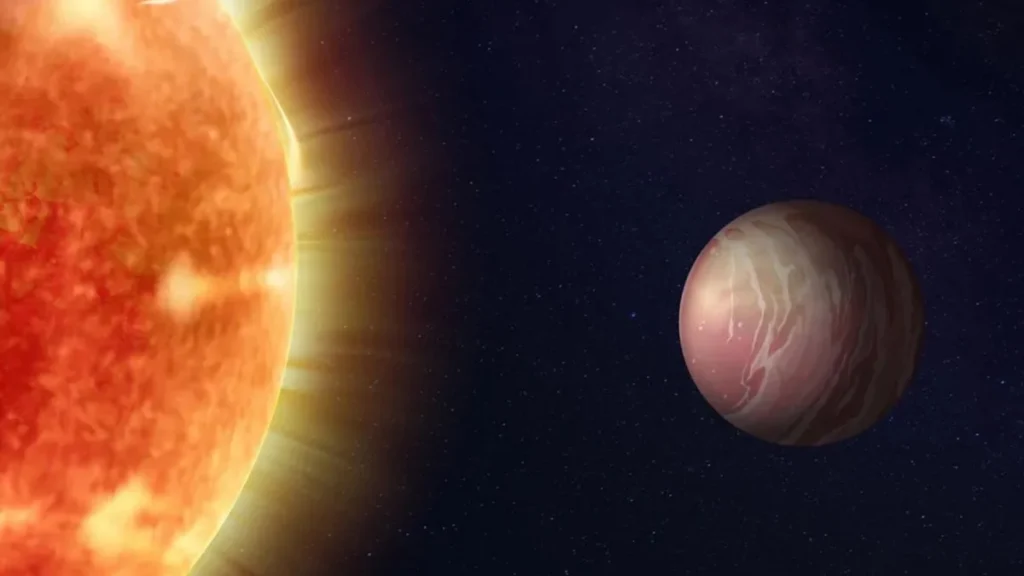
Located approximately 280 light-years away from Earth, the exoplanet TOI-561 b has long captivated astronomers as an extreme and hostile celestial body. Covered by an endless, roiling ocean of molten lava and subjected to intense stellar radiation from its host star, the planet was initially dismissed as a barren rock. Conventional astrophysical models suggested that any primordial atmosphere surrounding such a heavily irradiated world would have been stripped away billions of years ago by stellar winds and ultraviolet bombardment. However, recent data gathered by the James Webb Space Telescope (JWST) has fundamentally upended these long-held assumptions, revealing that TOI-561 b maintains a thick, protective atmospheric envelope that continues to baffle researchers.
The findings, recently published in The Astronomical Journal, stem from a meticulous 37-hour observation window conducted by an international team of astronomers. This observation period spanned nearly four complete orbits of the exoplanet, allowing researchers to construct a comprehensive phase curve measuring how the planet’s brightness and thermal emission shift as it revolves around its star. The resulting data presented a scientific puzzle: the dayside of TOI-561 b was measured to be significantly cooler than expected for a tidally locked world exposed to such intense heat, while the nightside temperatures failed to account for the missing thermal energy. These anomalies pointed directly to the existence of a substantial atmosphere capable of redistributing heat globally while reflecting a significant portion of incoming starlight.
Background Context and Discovery Timeline
The discovery of TOI-561 b builds upon years of incremental exoplanetary research. The planet was initially flagged as a candidate by NASA’s Transiting Exoplanet Survey Satellite (TESS), a space telescope designed primarily to search for periodic drops in stellar brightness caused by planets crossing in front of their host stars. Subsequent ground-based radial velocity measurements and space-based follow-up observations helped establish TOI-561 b as an ultra-short-period rocky world, completing an orbit around its host star in less than half an Earth day.
Because of its extremely tight orbit, TOI-561 b became tidally locked, meaning the same hemisphere faces its star indefinitely, resulting in a permanent dayside and a perpetual nightside. Prior to the recent JWST campaign, standard theoretical models of ultra-short-period planets orbiting sun-like or older metal-poor stars assumed that extreme photoevaporation would strip these worlds of volatile elements early in their histories. The assumption was that TOI-561 b would resemble an airless rock, glowing intensely on its sunlit side with little to no capacity to transport heat to its unilluminated hemisphere.
The allocation of precious JWST observation time marked a turning point in investigating the planet’s true nature. Utilizing the telescope’s advanced Near-Infrared Imager and Slitless Spectrograph (NIRISS) and Mid-Infrared Instrument (MIRI), researchers were able to capture high-precision thermal phase curves. The anomaly in the phase curve data forced the science team to reconsider the planet’s atmospheric retention capabilities, transitioning the object from a simple rocky cinder to a dynamic laboratory for extreme planetary meteorology.
Scientific Analysis and Data Interpretation
The presence of an atmosphere on a lava world subjected to such intense radiation requires complex physical explanations. According to detailed computer simulations of TOI-561 b’s climate, the atmosphere is not composed of standard gases like nitrogen or oxygen, but is instead likely saturated with vaporized silicate minerals, including silicon dioxide and magnesium silicate.
This mineral-rich vapor layer serves a dual purpose. First, it acts as a highly efficient reflector, bouncing a substantial fraction of the star’s harmful radiation back into space. Second, global circulation patterns within the atmosphere transport thermal energy from the blistering dayside toward the cooler nightside, preventing extreme temperature spikes that would otherwise melt or destabilize the planetary crust.
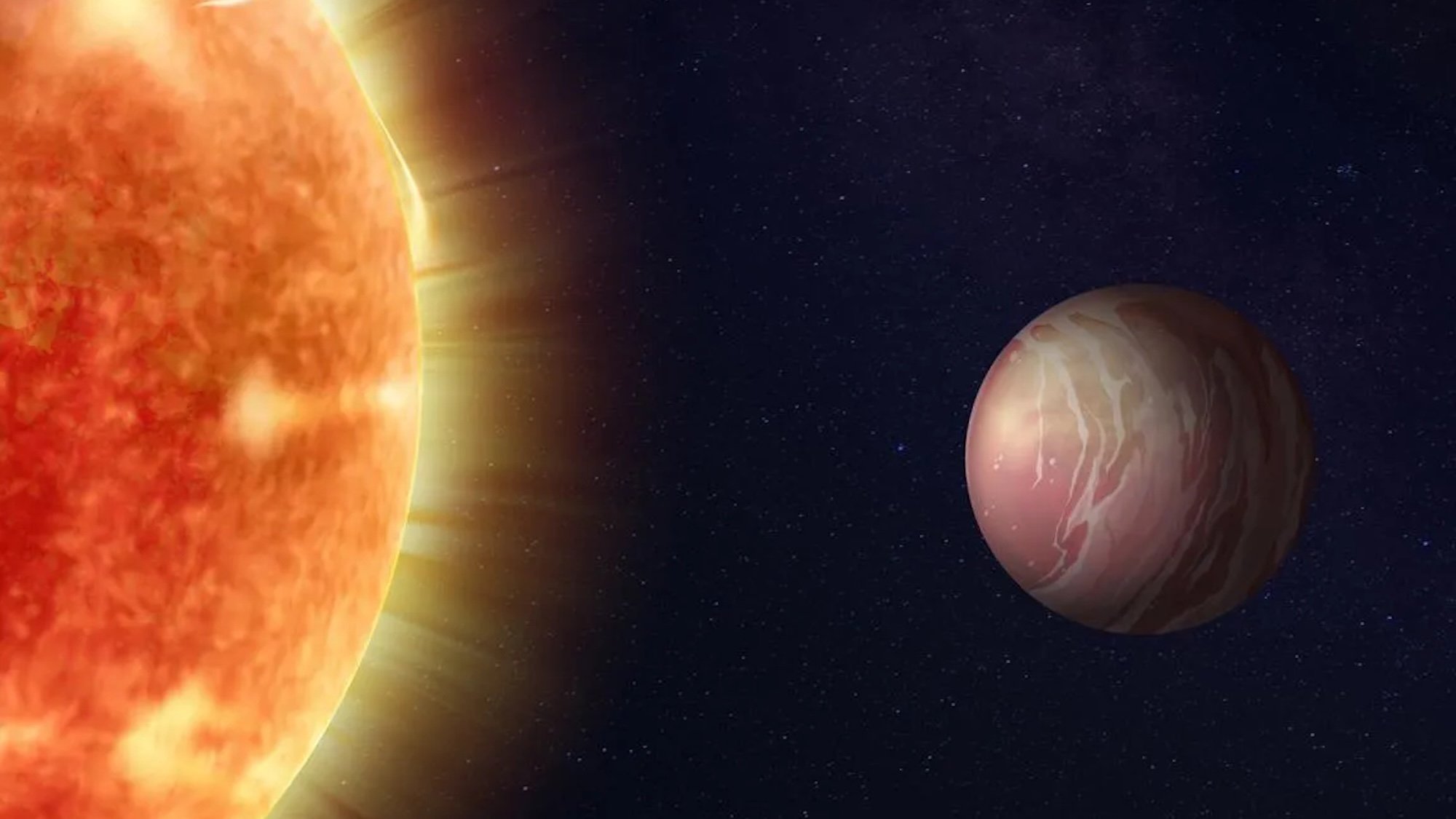
Astrophysicists analyzing the data have proposed two primary hypotheses to explain how TOI-561 b managed to retain or continuously replenish this envelope. The first theory suggests that the planet formed with an extraordinarily massive volatile inventory—a gargantuan envelope of gas that has resisted total photoevaporation over billions of years. The second, more dynamic theory posits that the planet’s global lava ocean acts as a colossal, planet-wide volcano. In this scenario, continuous outgassing from the molten interior replenishes the atmospheric components at a rate that matches or exceeds the ongoing loss driven by stellar winds.
Statements and Reactions from the Research Community
The unexpected findings have generated considerable discussion within the exoplanet research community, challenging established paradigms regarding the survivability of atmospheres on ultra-short-period rocky worlds.
"Our discovery challenges current theories," said study co-author Anjali Piette, an astronomer at the University of Birmingham. "We would expect a heavily irradiated rocky planet like TOI-561 b to have lost its atmosphere billions of years ago."
The realization that heat is being effectively redistributed across the planet rather than remaining trapped on the sunlit hemisphere further reinforces the atmospheric hypothesis.
"We revealed that the planet reflects a significant amount of light from its star, and that heat is being redistributed around the planet instead of only on the sunlit side," explained Lisa Dang, an astrophysicist at the University of Waterloo and co-author of the study. "Together, these point to the presence of an atmosphere."
Researchers emphasize that the atmospheric shell is robust. "The evidence suggests it still has a significant atmosphere today," Piette added, noting that further spectroscopic analysis will be required to confirm the exact molecular composition of the vaporized rock clouds.
Broader Implications and Future Research Directions
The confirmation of an atmosphere on TOI-561 b opens new avenues for understanding planetary evolution under extreme conditions. The planet currently occupies a unique observational niche, forcing scientists to determine whether it represents an exceptionally hot, highly reflective variant of Venus or functions as a massive, superpowered analogue to Io, the volcanically active moon of Jupiter.
To resolve these questions, the research team intends to petition for additional observation time using JWST. By targeting the planet at longer infrared wavelengths, astronomers hope to peer deeper into the thermal emission profiles and atmospheric layers. These upcoming observations aim to provide definitive insights into the mechanisms that allow a planet situated so close to its parent star to defy conventional astrophysical expectations and hold onto an atmosphere across geological timescales. Ultimately, the study of TOI-561 b will refine theoretical models governing planetary retention, atmospheric outgassing, and the resilience of rocky worlds throughout the galaxy.