




The ongoing discourse surrounding literacy education has intensified significantly in recent years, yet a critical component—writing instruction—remains largely absent from the forefront of these vital conversations. While debates about phonics, fluency, and reading comprehension dominate educational policy and pedagogical discussions, the deeply intertwined nature of reading and writing is often overlooked. This glaring omission in the national literacy agenda has prompted a concerted effort by educational specialists to spotlight the foundational skills necessary for effective written communication.
The Overlooked Pillar: Writing in the Literacy Debate
For decades, literacy instruction has predominantly focused on reading, with writing often relegated to a secondary, less emphasized role. This imbalance persists despite compelling evidence from cognitive science and educational research affirming that reading and writing are reciprocal processes that reinforce each other. Proficiency in one skill significantly aids development in the other. Students who write regularly tend to become better readers, and strong readers often possess superior writing abilities. The National Assessment of Educational Progress (NAEP), often referred to as "The Nation’s Report Card," has consistently shown concerning trends in writing proficiency among American students across various grade levels. For instance, recent NAEP data reveals that only a fraction of students achieve proficiency in writing, with scores often lagging behind reading scores. This persistent gap underscores an urgent need for re-evaluation and recalibration of instructional priorities.

The recent surge in attention to the "Science of Reading" movement has been instrumental in advocating for evidence-based reading instruction, particularly in phonics and phonemic awareness. While this movement has brought much-needed rigor to reading pedagogy, its singular focus has inadvertently overshadowed the equally critical need for explicit, systematic writing instruction. Educators and policymakers are increasingly recognizing that a truly comprehensive literacy framework must encompass both reading and writing with equal gravity, acknowledging that neglecting one undermines the potential for mastery in the other.
A New Framework: Melanie Meehan and Maggie Roberts’ Contribution
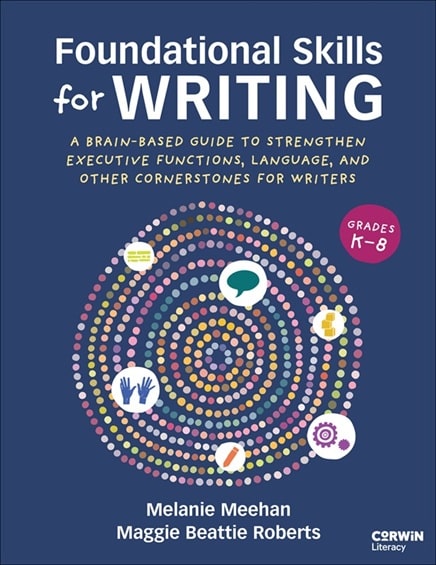
Addressing this significant instructional lacuna are Melanie Meehan, a former curriculum coordinator who recently established an in-person writing center, and Maggie Roberts, a literacy consultant and former middle school teacher with nearly two decades of classroom support experience. Earlier this month, Meehan and Roberts released their collaborative work, Foundational Skills for Writing: A Brain-Based Guide to Strengthen Executive Functions, Language, and Other Cornerstones for Writers. The book serves as a timely intervention, offering a comprehensive exploration into the intricate cognitive processes involved in writing and identifying the common barriers that impede student progress.
Their work posits that the act of writing is not a monolithic skill but rather a complex interplay of various cognitive and motor functions. By dissecting the larger task of writing into manageable, foundational skill categories, Meehan and Roberts provide educators with a practical roadmap for intervention and instruction. They argue that many students struggle with writing not due from a lack of creativity or ideas, but because they lack automaticity in underlying skills, which consumes valuable cognitive resources that should otherwise be dedicated to higher-order thinking, such as idea generation, organization, and argumentation.
Deconstructing the Writing Process: Key Skill Categories
The authors meticulously break down writing into three primary skill categories, each essential for developing a proficient writer:
-
Transcription Skills: This category encompasses the mechanical aspects of writing, including handwriting, keyboarding, spelling, and both large and small motor development. These are the physical acts of putting thoughts onto paper or screen. For many students, difficulties in transcription, such as illegible handwriting or slow typing speeds, can significantly hinder their ability to express complex ideas, as the sheer effort required to form letters or spell words drains cognitive energy.
-
Oral Language: Recognized as a fundamental precursor to written expression, oral language skills involve speaking and listening proficiency, including vocabulary acquisition, sentence construction, and narrative development. A student’s ability to articulate thoughts coherently and construct grammatically correct sentences verbally directly impacts their capacity to do so in written form. Robust oral language provides the mental framework upon which written language is built.

-
Executive Functioning: This critical category encompasses a suite of higher-order cognitive processes, including working memory, cognitive flexibility, and inhibitory control. Working memory is crucial for holding ideas in mind while simultaneously planning, drafting, and revising. Cognitive flexibility allows writers to adapt their approach, consider different perspectives, and make revisions effectively. Inhibitory control helps writers resist distractions and focus on the task at hand. Deficits in executive functions can manifest as disorganization, difficulty initiating tasks, or struggles with self-correction during the writing process.
Meehan and Roberts emphasize that for students to become proficient writers, systematic development and practice across all three of these skill categories are indispensable. Their book provides teachers with actionable strategies to cultivate these foundational abilities in students, moving beyond generic writing prompts to targeted, brain-based interventions.
"Minute Moves": High-Impact, Low-Effort Strategies
At the heart of Meehan and Roberts’ pedagogical approach is a collection of practical strategies they term "Minute Moves." These are short, flexible activities designed to be easily integrated into the daily classroom routine—whether as quick warm-ups, transition activities, or brief interludes. The overarching goal of Minute Moves is to help students automatize foundational skills, thereby freeing up cognitive energy for the more complex, creative, and critical aspects of writing.

Spelling Minute Moves: Cultivating Word Awareness
Recognizing that spelling is a common stumbling block, the authors propose strategies that foster curiosity and deep understanding of word structures.
-
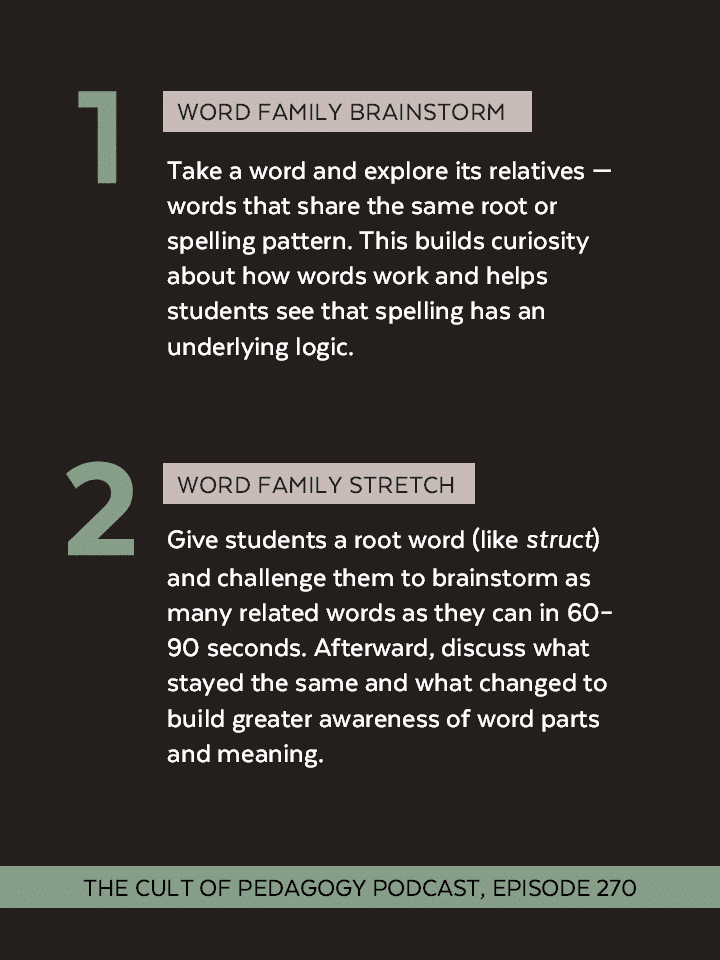
Word Family Brainstorm: Inspired by spelling researcher Rebecca Treiman, this activity encourages students to explore the etymological and morphological connections between words. Instead of merely memorizing isolated words, students uncover "relatives." For instance, rather than teaching two, to, and too in isolation, students might examine the numerical root of two by linking it to twin, twine, and twenty, revealing a consistent "TW" pattern associated with duality. Similarly, struggling with decision can lead to exploring its connection to decide, incision, concise, and even scissors, all tracing back to a Latin root meaning "to cut." This approach transforms spelling from rote memorization into an engaging linguistic detective game, fostering a deeper appreciation for language structure.
-
Word Family Stretch: This closely related activity builds on the concept of word families. Given a bound root like struct (meaning "to build"), students are challenged to brainstorm as many related words as possible within a short time frame (e.g., 60-90 seconds). Examples include structure, destruction, construct, structural, instruct, instruction. The critical follow-up is a debriefing session where students discuss what elements remained constant, what changed, and how prefixes or suffixes altered the meaning. This cultivates an internalized understanding that word parts carry meaning, revealing patterns across academic vocabulary. Roberts highlights the distinction between "bound" roots (like struct) and "free" roots (like form, which can stand alone or be part of reform, transform, inform). This nuanced understanding further enriches students’ linguistic intuition.
-
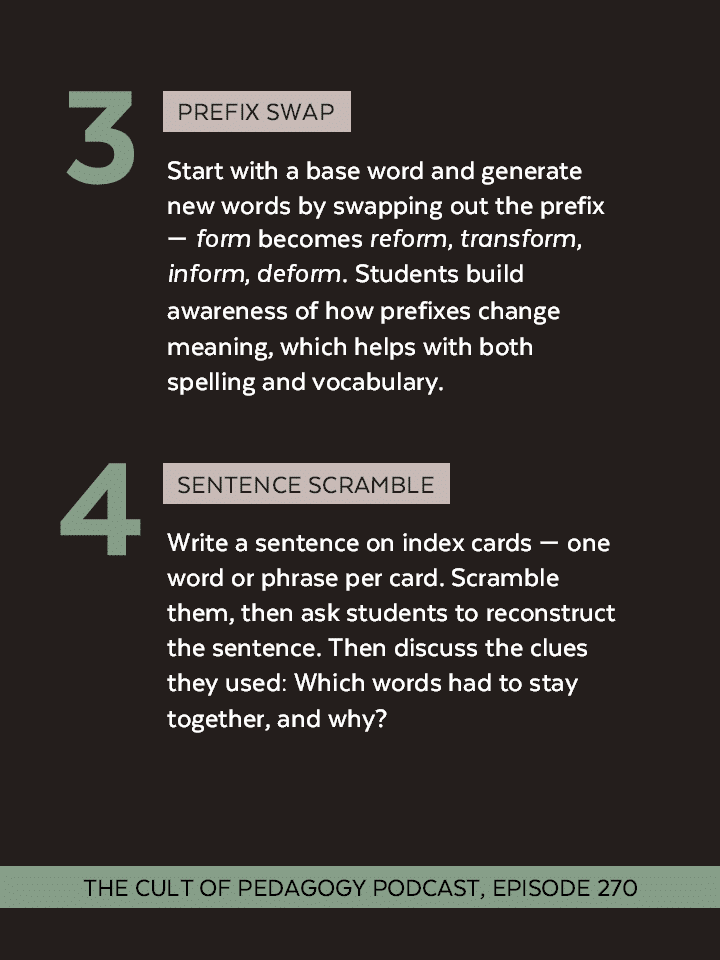
Prefix Swap: Directly building on the previous activities, Prefix Swap focuses specifically on the role of prefixes in modifying word meaning. Students are given a base word, such as form, and tasked with generating variations by changing its prefix: reform, transform, inform, deform. The emphasis is on observing how the meaning shifts with each prefix alteration. This exercise is particularly beneficial for multilingual learners, who often recognize common prefixes (like bene and mal in benevolent and malevolent) from their native languages, accelerating their English vocabulary acquisition. Meehan notes that these three spelling activities collectively build "neurological pathways" that help students encode and retrieve words more efficiently, reducing the cognitive load associated with spelling.
Sentence Construction Minute Moves: Building Syntactic Fluency
Beyond individual words, the ability to construct clear, varied, and grammatically sound sentences is paramount. These moves aim to build students’ intuitive grasp of sentence structure.
-
Sentence Scramble: This tactile activity involves breaking a sentence into its component words or phrases, typically written on index cards. Students then physically rearrange these cards to reconstruct the original sentence. The use of physical manipulatives allows for experimentation and visual processing. Following the reconstruction, teachers facilitate a discussion: How did you determine the order? What clues were helpful? Which words or phrases needed to stay together? The activity can be scaffolded by removing punctuation, introducing a distractor word, or challenging students to extend the sentence. Roberts emphasizes that this practice helps students develop an "internalized understanding of sentence patterns and sentence construction," which they can then apply to their own writing.
-
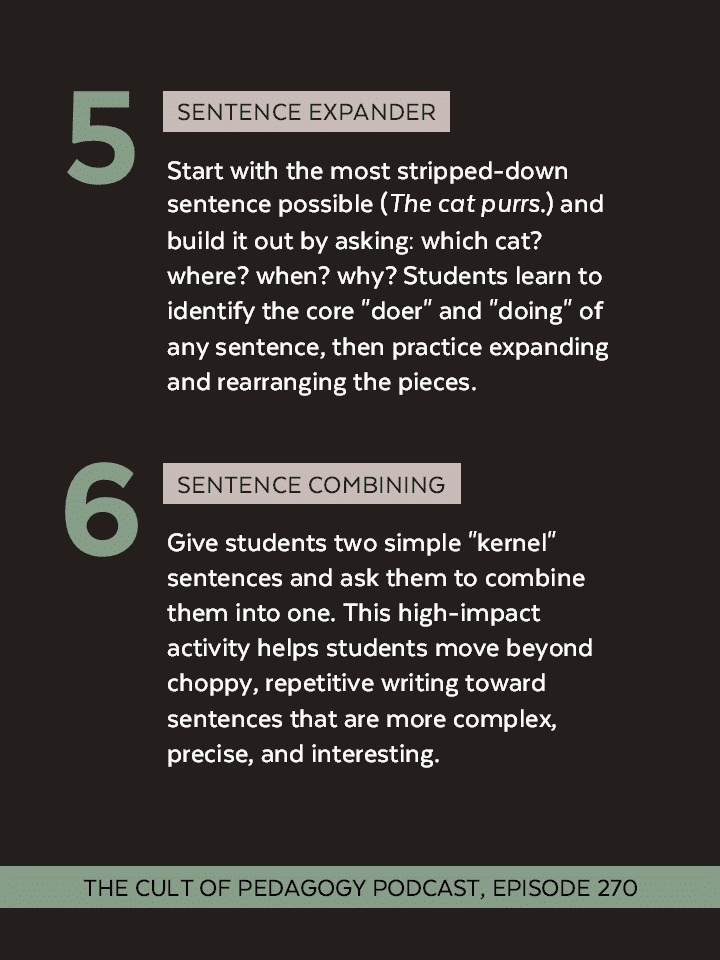
Sentence Expander: Beginning with a simple "kernel sentence" (e.g., The cat purrs), students collaboratively expand it by answering a series of questions: Which cat? What color? Where? When? Why? Meehan advocates for using more accessible terms like "doer" and "doing" instead of the potentially abstract "subject" and "predicate" to help students identify the core elements of a sentence. Once a sentence is fully expanded (e.g., The orange cat is sleeping on the couch in the afternoon because he is tired), students experiment with rearranging its components to create variations. This play fosters an understanding of how word order impacts meaning and emphasis, enabling students to craft richer and more complex sentences.
-
Sentence Combining: Roberts describes sentence combining as a "high-impact, quick way for kids to graduate from writing a series of simple sentences to ones that are more syntactically complex, interesting, and precise." Students are given two short, basic sentences (e.g., My cat is orange. My cat is big.) and asked to merge them into one more sophisticated sentence (e.g., My big orange cat…). For beginners, scaffolding can involve underlining words to be "harvested" and inserted. As proficiency grows, students can combine three or more sentences, experimenting with various conjunctions (e.g., because, and, but) to alter meaning and flow. This practice directly translates into students’ independent writing, helping them naturally transition from choppy, simple sentences to more fluent, complex expressions.
Executive Functioning Minute Moves: Sharpening Cognitive Flexibility
Cognitive flexibility, a key executive function, is crucial for effective writing, allowing writers to adapt, revise, and consider multiple perspectives. These activities directly target this skill.
-
What’s Another Way?: This minute move hones cognitive flexibility at the sentence level. Students are presented with a sentence and challenged to rewrite it in multiple ways. This might involve starting with a dependent clause instead of an independent one, substituting nouns with pronouns, or intentionally shortening the sentence for impact. Meehan stresses that effective writing is not solely about complexity; sometimes, a concise sentence is the most powerful choice. Teaching students the "art and craft of writing" involves developing the skill to intentionally vary sentence structure and length. Crucially, Meehan notes the empowering effect of explicitly naming this skill as "cognitive flexibility" for students, particularly those who have struggled with writing, giving them a sophisticated vocabulary to understand their own developing cognitive abilities.
-
New Angle: This activity broadens the focus from sentence structure to narrative perspective, directly targeting cognitive flexibility at the story level. Students are asked to retell a familiar scene—from a class text, a book, or a short film—from the viewpoint of a different character. Roberts vividly illustrates this with a personal anecdote: retelling a ninth-grade cafeteria food fight from the perspective of the teacher who had applesauce poured on her head. This exercise demands that students hold multiple viewpoints simultaneously, making deliberate choices about voice, detail, and interpretation. Meehan utilizes short videos, such as Pixar’s "Snack Attack," which presents the same event from two contrasting perspectives. In one tutoring session, she and a student each wrote a character’s perspective, then swapped documents to continue writing from the other’s point of view. This not only enhanced writing skills but also fostered a competitive spirit and, more profoundly, cultivated empathy and the ability to understand diverse perspectives—a skill that extends far beyond the writing classroom into civic engagement and democracy.
Broader Implications and the Future of Literacy Education
The work of Melanie Meehan and Maggie Roberts arrives at a pivotal moment in education. As school districts nationwide grapple with improving literacy outcomes, their brain-based approach to writing instruction offers a compelling argument for a more balanced and integrated strategy. By explicitly addressing the foundational skills that underpin effective writing, they provide educators with the tools to demystify the writing process for students, making it less daunting and more accessible.
The implications of adopting such a comprehensive approach are far-reaching. Enhanced writing skills contribute to improved academic performance across all subjects, as writing is a primary mode of demonstrating understanding and critical thinking. Furthermore, strong written communication is a cornerstone of success in higher education and the modern workforce. By equipping students with these foundational skills, educators can foster a generation of articulate, critical thinkers capable of navigating complex information and expressing themselves effectively in an increasingly communication-driven world.
The emphasis on "Minute Moves" also speaks to the practical realities of teaching, offering high-impact strategies that don’t require extensive instructional time or radical curriculum overhaul. This pragmatic approach makes the integration of robust writing instruction more feasible for busy educators. As the educational community continues to refine its understanding of effective literacy instruction, the insights offered by Foundational Skills for Writing are poised to spark a much-needed conversation, ensuring that writing assumes its rightful place as an indispensable pillar of comprehensive literacy development.