


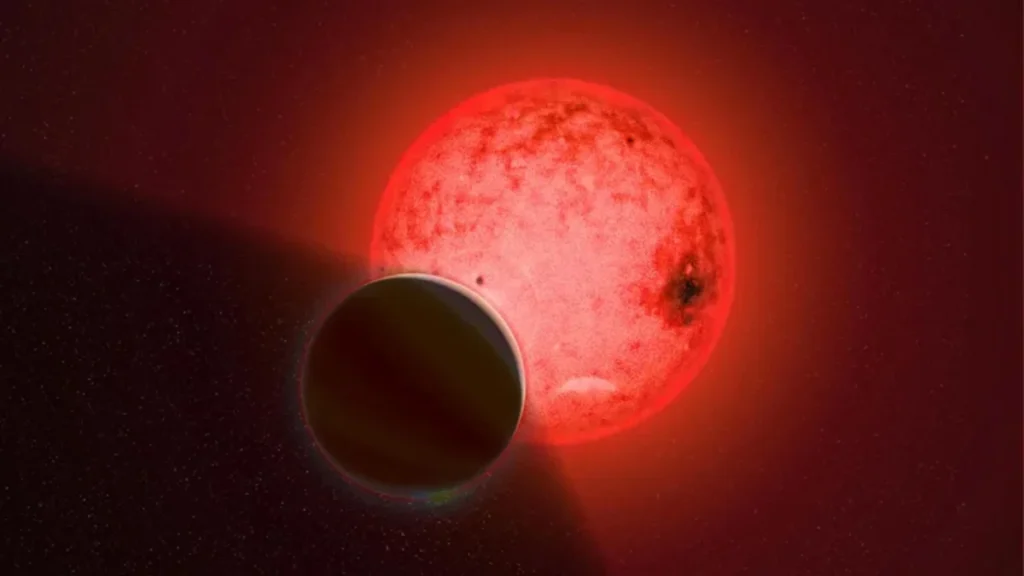
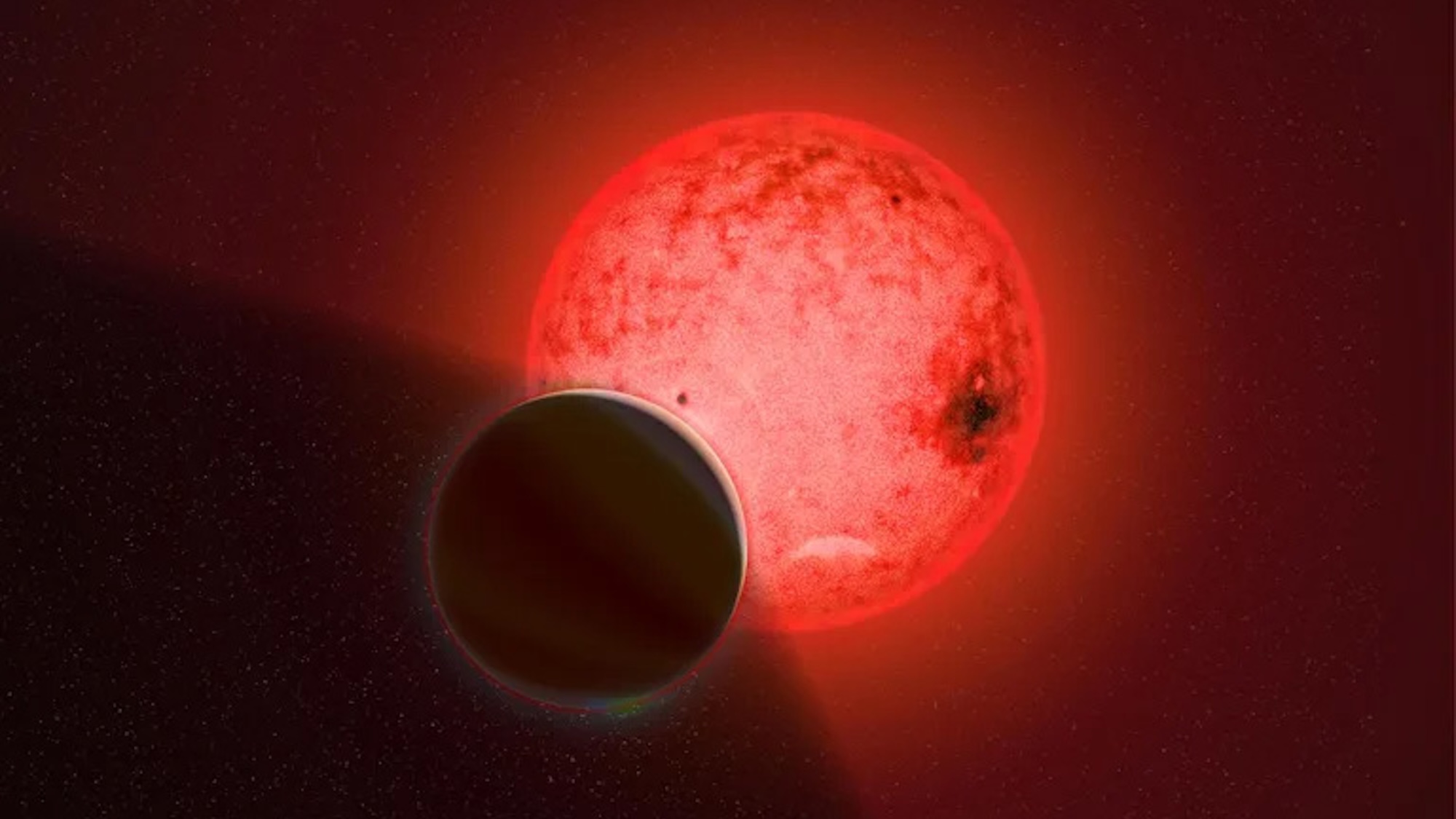
The discovery of TOI-5205 b, a massive gas giant located approximately 282 light-years from Earth, has sent ripples through the astrophysical community, fundamentally questioning established models of how planets and stars interact during their formative years. Identified as a "forbidden" planet due to its unlikely existence around a small, cool red dwarf star, TOI-5205 b represents a significant anomaly in the catalog of known exoplanets. While the universe is populated by billions of planets, this specific Jupiter-sized object possesses an atmospheric and internal composition that defies the standard predictions of cosmic evolution, suggesting that our understanding of planetary lifecycles remains incomplete.
According to a study published in The Astronomical Journal by an international team of researchers, TOI-5205 b is the first exoplanet of its kind to exhibit an atmosphere containing significantly fewer heavy elements than other similarly sized gas giants, despite orbiting a star that is comparatively small and low-mass. The host star, TOI-5205, is an M-dwarf—the most common type of star in the Milky Way—but it possesses only about 40 percent of the mass of our Sun and is roughly four times the size of Jupiter. The sheer scale of the planet relative to its sun creates a "pea-to-lemon" ratio that was previously thought to be physically improbable under the core accretion model of planet formation.
The Discovery and Detection Methodology
The journey to uncovering TOI-5205 b began in 2023 with NASA’s Transiting Exoplanet Survey Satellite (TESS). TESS is designed to scan the sky for periodic dips in stellar brightness, which indicate a planet passing in front of its host star—a phenomenon known as a transit. When TOI-5205 b transits its star, it blocks an unprecedented six percent of the star’s total light output. For context, a Jupiter-sized planet transiting a Sun-sized star typically blocks only about one percent of the light. This deep transit depth made the planet an ideal candidate for follow-up characterization using ground-based and space-based spectrography.
To analyze the planet’s atmosphere, astronomers utilized the power of spectrography to break down the light filtering through the planet’s outer layers during transit. By examining the specific color bands or wavelengths of light that were absorbed, researchers identified the chemical fingerprints of the atmosphere. These observations revealed the presence of methane and hydrogen sulphide. However, the most startling discovery was not what was present, but what was missing: the atmosphere was notably depleted of "metals"—a term astronomers use to describe any element heavier than hydrogen and helium.
A Paradox of Composition: Atmosphere vs. Interior
The central mystery of TOI-5205 b lies in the discrepancy between its atmospheric chemistry and its internal structure. Using advanced computer modeling that factored in the planet’s measured mass and radius, the research team determined that the planet’s interior is likely 100 times more metal-rich than its atmosphere. Furthermore, the overall metallicity of the planet is significantly lower than that of its host star, a finding that contradicts the general trend where giant planets tend to mirror or exceed the metal content of their parent stars.
Shubham Kanodia, a Carnegie Science astronomer and co-author of the study, noted that the observed metallicity was much lower than what models predicted for a planet of this bulk composition. This suggests a unique formation history where heavy elements migrated toward the planet’s core early in its development, leaving an atmosphere that is carbon-rich but oxygen-poor. The lack of mixing between the interior and the atmosphere indicates a stable, stratified structure that is rarely seen in gas giants of this magnitude, especially those orbiting such small stars.
The Theoretical Challenge to Core Accretion
The existence of TOI-5205 b poses a direct challenge to the "core accretion" theory, the prevailing explanation for how gas giants form. According to this theory, a planet begins as a solid core of rock and ice within the protoplanetary disc of gas and dust surrounding a young star. Once this core reaches a critical mass—typically about ten times the mass of Earth—it exerts enough gravitational pull to rapidly accumulate gas from the surrounding disc, ballooning into a gas giant like Jupiter.
For a star as small as TOI-5205, the protoplanetary disc should, in theory, lack the sufficient material required to form a ten-Earth-mass core quickly enough before the gas in the disc dissipates. The fact that TOI-5205 b exists suggests that either the disc was unexpectedly massive, or the process of core formation and gas accretion happened much faster than current physics can explain. The planet is effectively a "forbidden" entity because, by all traditional calculations, the "seeds" of such a giant should not have been able to grow in such a resource-poor environment.
Chronology of Research and International Collaboration
The scientific investigation into TOI-5205 b has been a multi-stage process involving global cooperation:
- Early 2023: Initial detection by NASA’s TESS mission identified the TOI-5205 system as a high-priority target due to the extreme transit depth.
- Mid-2023 to 2024: Ground-based follow-up observations were conducted using the Habitable-zone Planet Finder (HPF) on the Hobby-Eberly Telescope and the ARCTIC camera on the Apache Point Observatory. These tools confirmed the planet’s mass and orbital period.
- 2025: Detailed spectrographic analysis provided the first glimpses into the atmospheric composition, leading to the discovery of the methane and hydrogen sulphide signatures.
- 2026: The release of the comprehensive study in The Astronomical Journal, detailing the metallicity paradox and the implications for planetary formation theories.
Official Responses and Scientific Reactions
The broader astronomical community has reacted with a mixture of excitement and caution. Anjali Piette, a study co-author and astronomer at the University of Birmingham, emphasized that TOI-5205 b stands out among all giant planets studied to date. "The planet having a lower metallicity than its own host star makes it a unique laboratory for testing our theories of how planets are built," Piette stated.
The findings have prompted calls for a re-evaluation of how M-dwarf systems are surveyed. Historically, astronomers focused on finding Earth-like, rocky planets around M-dwarfs because these stars are cool enough for planets to orbit in the "habitable zone" where liquid water might exist. The discovery of TOI-5205 b proves that these small stars can also host massive, exotic gas giants, expanding the scope of what researchers expect to find in the "neighborhood" of the galaxy’s most common stars.
Broader Implications and Future Observations
The discovery of TOI-5205 b has significant implications for the future of exoplanetary science. First, it suggests that the diversity of planetary systems is far greater than previously imagined. If "forbidden" planets can form around small stars, then the total number of gas giants in the Milky Way may be significantly higher than current estimates suggest.
Second, the unique atmospheric composition of TOI-5205 b makes it a primary candidate for future observations with the James Webb Space Telescope (JWST). While current spectrography has identified methane and hydrogen sulphide, the JWST’s superior infrared capabilities could provide a more detailed map of the planet’s chemical abundances, including potential detections of water vapor, carbon monoxide, and clouds of exotic minerals.
Furthermore, this discovery impacts the search for life elsewhere in the universe. While TOI-5205 b itself is a gas giant and unlikely to host life as we know it, understanding the formation of such large planets is crucial for understanding the architecture of solar systems. Giant planets often act as "gravitational shields," protecting smaller, inner rocky planets from asteroid impacts, or "gravitational stirrers," potentially flinging water-rich comets toward inner planets. By decoding the mystery of the "forbidden" planet, scientists are essentially refining the map of how habitable environments are created.
As the scientific community continues to digest the data from TOI-5205 b, one thing is certain: the "forbidden" planet has opened a new chapter in astronomy. It serves as a reminder that the universe is under no obligation to conform to human models, and that every new discovery carries the potential to rewrite the textbooks on cosmic evolution. The anomalous nature of TOI-5205 b ensures it will remain a focal point of planetary research for years to come, challenging astronomers to bridge the gap between what they see and what they thought was possible.