



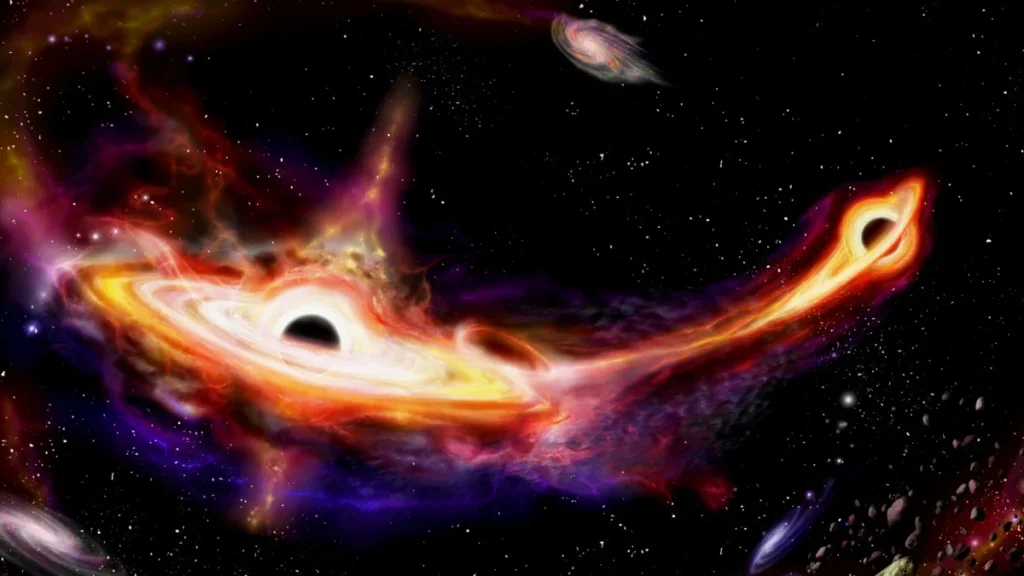
The fundamental understanding of how the universe’s most massive structures evolve has long been challenged by a persistent mathematical discrepancy known as the growth problem of supermassive black holes. While these gravitational titans, often millions or billions of times the mass of our sun, are observed at the centers of nearly every large galaxy, standard models of gas accretion—the process by which a black hole "feeds" on surrounding matter—cannot account for their immense size within the current age of the universe. For decades, the leading hypothesis has suggested that these giants grow through the violent mergers of smaller black holes during galactic collisions. Now, a landmark study from the Max Planck Institute for Radio Astronomy in Germany has provided the most compelling evidence to date of this process in action, identifying a binary pair of supermassive black holes in the galaxy Markarian 501 that are locked in a cosmic dance toward an inevitable collision.
The Mathematical Paradox of Supermassive Growth
To understand the significance of the discovery in Markarian 501 (Mrk 501), one must first grasp the "Final Parsec Problem" and the limitations of accretion-based growth. Under the standard Eddington limit, there is a physical ceiling on how quickly a black hole can consume matter because the outward pressure of the radiation generated by infalling gas eventually offsets the inward pull of gravity. Even if a black hole were to feed at this maximum theoretical rate continuously since the Big Bang, many of the supermassive black holes observed by telescopes like the James Webb Space Telescope and the Event Horizon Telescope simply should not be as large as they are.
Astrophysicists have long posited that the missing link is the "merger pathway." When two galaxies collide, their respective central black holes eventually sink toward the center of the newly formed galaxy due to dynamical friction. As they draw closer, they form a binary system. Proving this, however, has been notoriously difficult. While many galaxies show evidence of having two distinct nuclei during the early stages of a collision, finding a pair of black holes that have reached the "close binary" stage—where they are separated by only a fraction of a light-year—has remained one of the most elusive goals in modern astronomy.
The 23-Year Investigation of Markarian 501
Markarian 501 is a massive elliptical galaxy located approximately 440 million light-years from Earth in the constellation Hercules. It is classified as a "blazar," a type of active galactic nucleus (AGN) characterized by a powerful jet of ionized matter traveling at relativistic speeds—nearly the speed of light—pointed almost directly toward Earth. This orientation makes Mrk 501 an exceptionally bright and valuable laboratory for studying high-energy astrophysics.
The breakthrough published in the Monthly Notices of the Royal Astronomical Society is the culmination of more than two decades of rigorous observation. Between the late 1990s and 2022, a team led by astronomer Silke Britzen utilized Very Long Baseline Interferometry (VLBI), a technique that links radio telescopes across continents to create a virtual telescope with the resolution necessary to peer into the hearts of distant galaxies. By analyzing a spectrum of radio frequencies over 23 years, the researchers began to notice anomalies in the behavior of the galaxy’s central jet.
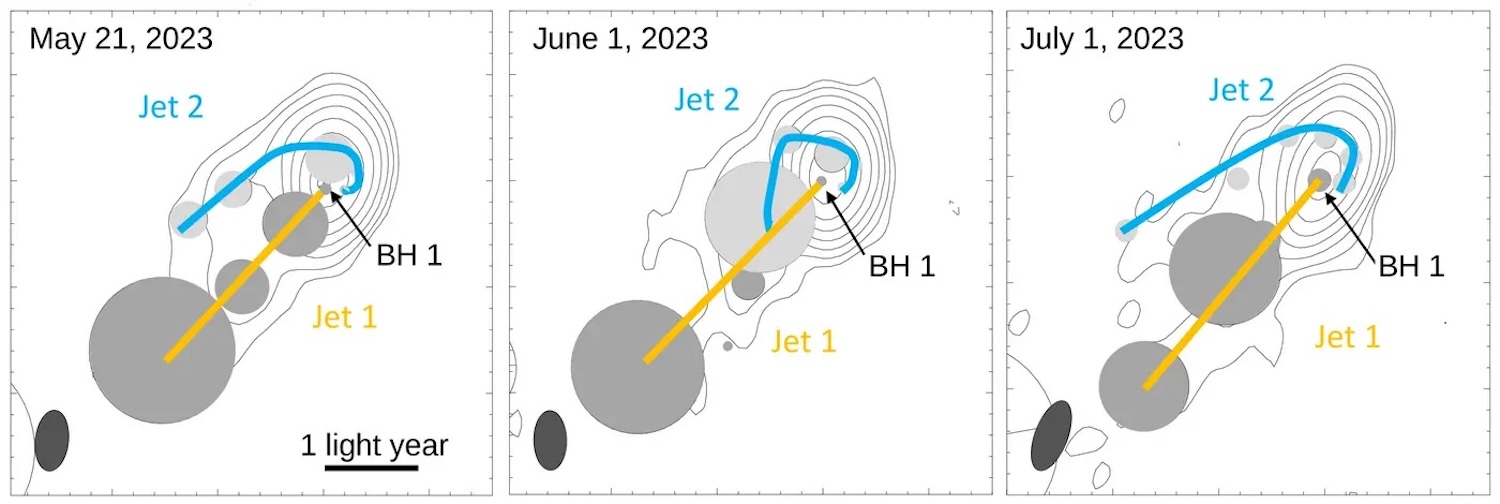
Typically, a single supermassive black hole produces a relatively stable, albeit turbulent, jet. However, the data from Mrk 501 revealed a far more complex architecture. Researchers identified not one, but two distinct jets emerging from the galactic core. While the primary jet had been the subject of study for years, the second, subtler jet exhibited a motion that suggested it was orbiting a central point of mass.
A Chronology of Discovery: The 2022 Einstein Ring
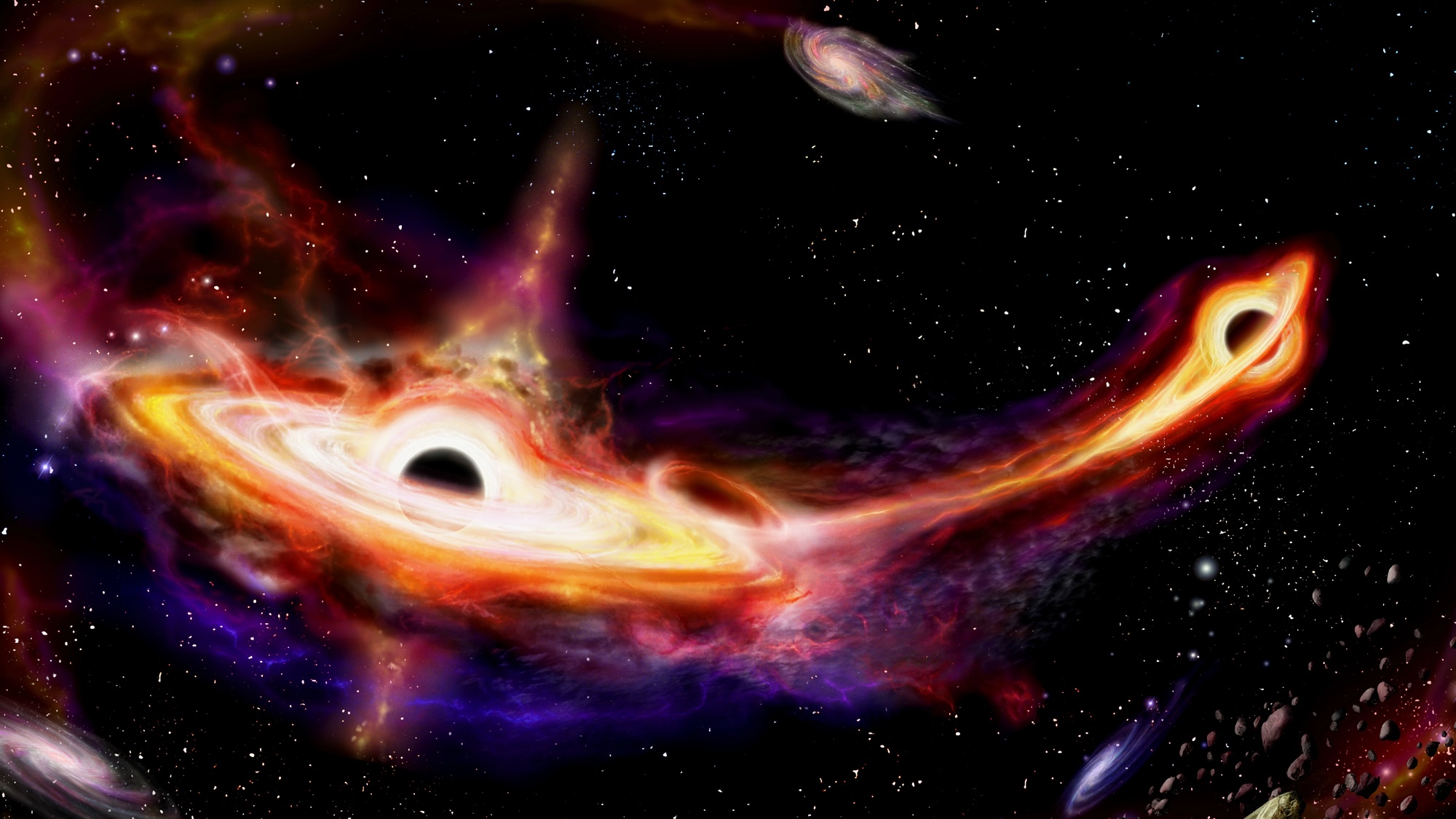
The most definitive evidence for the binary system arrived in June 2022. During this period, the researchers observed a phenomenon known as an Einstein ring—a rare manifestation of gravitational lensing. In this instance, the light and radiation from the second black hole’s jet were perfectly aligned behind the first black hole from the perspective of Earth. The immense gravitational field of the foreground black hole acted as a cosmic magnifying glass, bending the light of the background jet into a nearly perfect circle.
This event allowed the team to confirm the presence of two distinct gravitational centers. Over the course of several weeks, the astronomers tracked the second jet as it moved counterclockwise around the first. This "wobble" in the jet’s emission, combined with repeating cycles of brightness, allowed the team to calculate the orbital mechanics of the system with unprecedented precision.
Technical Analysis: Mass, Orbit, and Proximity
The data revealed a system of staggering proportions. The two black holes in Mrk 501 are estimated to have a combined mass ranging from 100 million to 1 billion solar masses. Despite their enormous scale, they are locked in a remarkably tight orbit.
Key data points from the study include:
- Orbital Period: The two black holes complete a full orbit around one another every 121 days.
- Separation Distance: The pair is separated by a distance of approximately 250 to 540 Astronomical Units (AU). For context, 1 AU is the distance between the Earth and the Sun. While this distance is vast by human standards, it is incredibly small for objects of this mass, placing them well within the final stages of a binary merger.
- Relative Velocity: The black holes are moving at significant fractions of the speed of light relative to one another as they spiral inward.
"We searched for it for so long, and then it came as a complete surprise that we could not only see a second jet but even track its movement," Silke Britzen stated in a release from the Max Planck Institute. The ability to resolve the movement of a second jet within such a compact system represents a major leap in observational radio astronomy.
The Final Countdown to a Cosmic Merger
The proximity of the two black holes suggests that they have already passed the most difficult stages of their journey toward one another. In the world of astrophysics, the "Final Parsec Problem" describes the theoretical difficulty of two black holes shedding enough angular momentum to actually collide once they get within a few light-years of each other. The system in Mrk 501 appears to have solved this problem, likely through interactions with surrounding gas and stars that have carried away the necessary energy to allow the orbit to decay.
Current projections suggest that the two black holes could merge within the next century. While 100 years is a blink of an eye in cosmic terms, it presents a challenge for human observation. Because the galaxy is 440 million light-years away, any light we see now actually left the galaxy during the Mid-Paleozoic era on Earth. Therefore, the physical merger may have already occurred, but the information of that event has not yet reached our solar system.
Implications for Gravitational Wave Astronomy
The discovery has profound implications for the burgeoning field of gravitational wave astronomy. When two black holes of this magnitude merge, they do not merely produce light; they warp the very fabric of spacetime. While the LIGO and Virgo observatories are designed to detect the high-frequency gravitational waves produced by the mergers of stellar-mass black holes (those only a few dozen times the mass of the sun), they are "deaf" to the low-frequency hum of supermassive mergers.
The Mrk 501 system is expected to be a potent source of extremely low-frequency gravitational waves. These waves are currently being sought by Pulsar Timing Arrays (PTAs), which monitor the ultra-precise flashes of dead stars across the galaxy to detect the slight stretching and squeezing of space caused by passing supermassive binaries. The confirmation of a close binary in Mrk 501 provides a "standard candle" for what these signals should look like, offering a roadmap for future detections.
Broader Impact on Galactic Evolution
Beyond the physics of black holes, this discovery validates the hierarchical model of galaxy formation. This model suggests that the universe grew from the "bottom up," with small galaxies merging to form larger ones like the Milky Way. If supermassive black holes are indeed the product of these mergers, then every large galaxy should contain the "scars" of past collisions in the form of a central titan.
The observations in Mrk 501 suggest that dual jet emissions may be a more common feature of active galaxies than previously thought, but they are often obscured by distance or poor alignment. As telescope technology improves—specifically with the advent of the Next Generation Very Large Array (ngVLA) and space-based radio interferometry—astronomers expect to find more of these binary systems.
For now, Markarian 501 stands as the clearest evidence yet that the universe’s most massive objects grow by joining forces. The impending merger of these two giants will eventually create a single, even more massive black hole, potentially triggering a new era of star formation or galactic quenching as the resulting energy blast clears the galaxy of its remaining gas. While the final collision may be hidden from our current view, the data gathered over the last 23 years has already fundamentally altered our understanding of the violent, rhythmic life of the cosmos.