

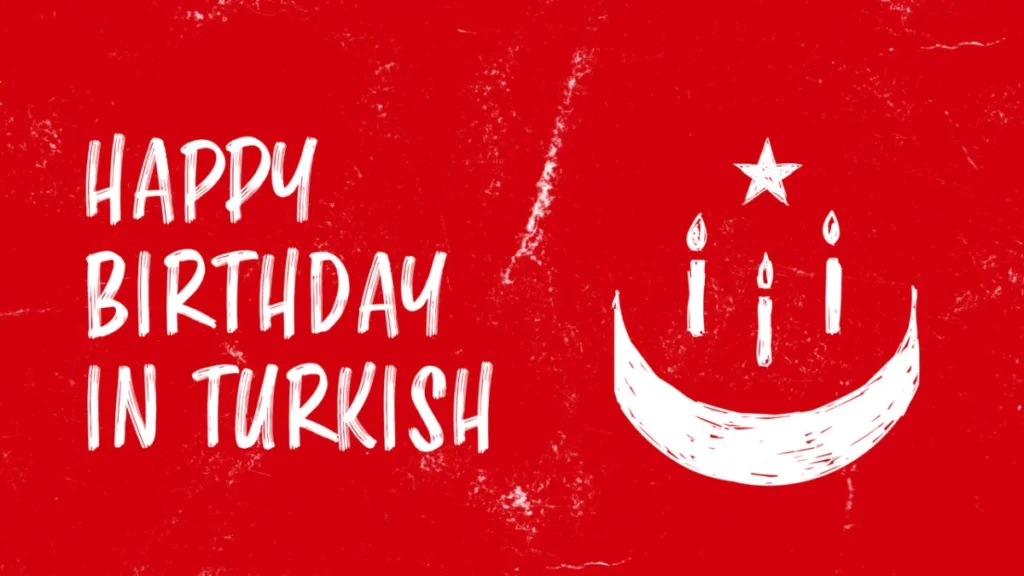
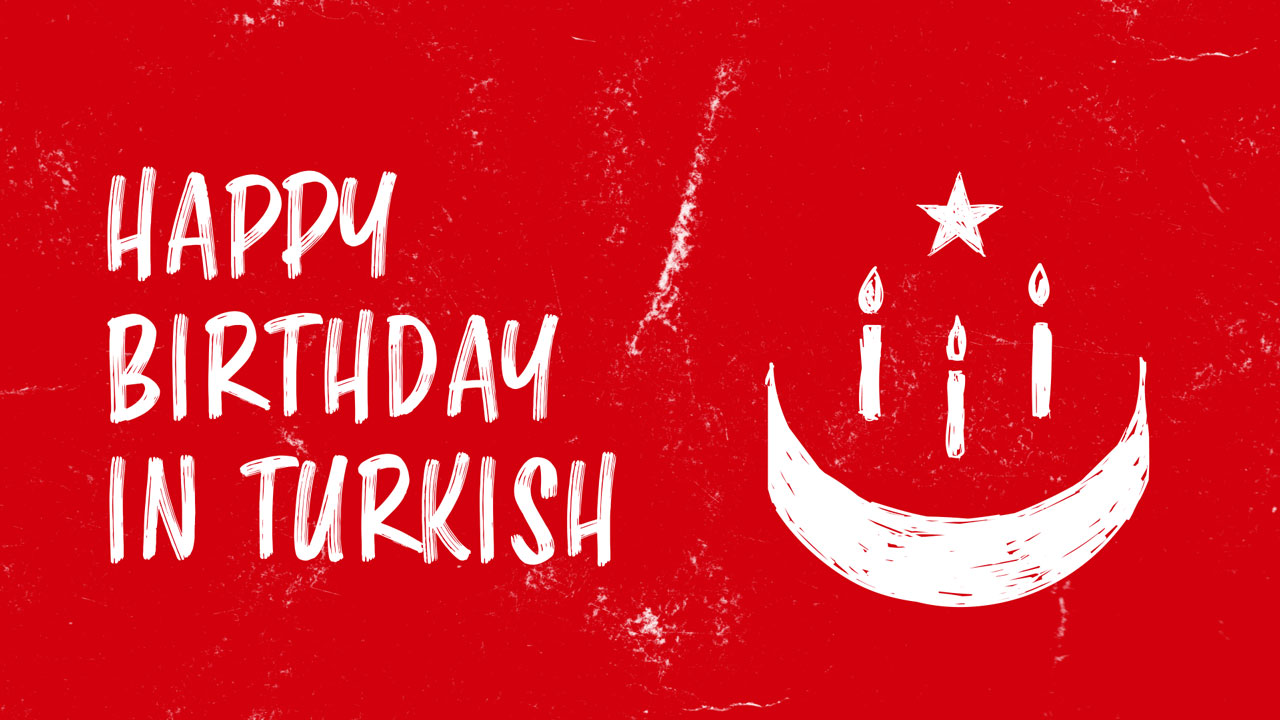
The celebration of birthdays in the Republic of Turkey represents a unique intersection of ancient linguistic roots, Ottoman-era influences, and modern Westernized customs. For international observers and language learners, understanding the appropriate way to convey birthday wishes requires more than a simple translation; it necessitates an appreciation of the social hierarchy, the distinction between formal and informal addresses, and the evolution of the Turkish language since the alphabet revolution of 1928. While the primary phrase for "happy birthday" is widely recognized as "Doğum günün kutlu olsun," the Turkish lexicon offers a diverse array of expressions tailored to specific social contexts, ranging from digital shorthand to religiously-inflected blessings.
The Foundation of Turkish Birthday Greetings
In the modern Turkish language, the most standard and versatile expression for a birthday wish is "Doğum günün kutlu olsun." This phrase is constructed from "doğum" (birth), "gün" (day), and the possessive suffix "-ün" (your), followed by "kutlu olsun," which translates to "may it be blessed" or "may it be celebrated." Historically, the word "kut" in Old Turkic refers to a divine blessing or life force, suggesting that even in secular modern usage, the phrase carries a weight of deep well-wishing.
Linguistic experts categorize "Doğum günün kutlu olsun" as a safe, all-purpose greeting suitable for friends, colleagues, and family members. However, for those seeking to convey a more intimate or affectionate sentiment, the phrase "İyi ki doğdun" is frequently employed. Literally translating to "It is good that you were born," this expression emphasizes the speaker’s personal appreciation for the individual’s existence. Sociolinguistic studies of Turkish communication patterns indicate that "İyi ki doğdun" is the preferred choice among romantic partners and close-knit family units due to its emotional resonance.
Chronological Evolution and Calendar Transitions
To understand the context of modern Turkish birthdays, one must look at the chronological shift that occurred during the early years of the Republic. Prior to 1926, the Ottoman Empire utilized the Rumi and Hijri calendars. The transition to the Gregorian calendar under the leadership of Mustafa Kemal Atatürk standardized the tracking of birth dates in a manner consistent with international norms. This administrative shift paved the way for the adoption of Western-style birthday celebrations, including the "birthday party" (doğum günü partisi), which has since become a staple of urban Turkish life.
A notable feature of the Turkish language is the existence of synonyms for the word "year," specifically "yıl" and "sene." While both are used interchangeably in birthday wishes, they have different etymological origins. "Yıl" is of Turkic origin, while "sene" is borrowed from Arabic. This duality is reflected in common birthday phrases:
- Mutlu yıllar: Meaning "happy years," used for both birthdays and New Year celebrations.
- Nice senelere: Meaning "to many years," implying a wish for longevity and many more birthdays to come.
- Nice yıllara: A Turkic-rooted variation of the above, carrying the same sentiment.
The Digital Shift and Modern Acronyms
As with many global languages, the rise of social media and instant messaging has significantly altered Turkish birthday etiquette. The full phrase "Doğum günün kutlu olsun" is often deemed too cumbersome for rapid digital communication. Consequently, the acronym "DGKO" has emerged as the Turkish equivalent of the English "HBD" (Happy Birthday).
Data from social media usage trends in Turkey suggest that younger demographics (Gen Z and Millennials) are the primary drivers of this abbreviated language. Despite the brevity of "DGKO," it remains a socially acceptable way to acknowledge an acquaintance’s birthday on platforms like Instagram, X (formerly Twitter), and WhatsApp. For closer relationships, however, digital users often supplement the acronym with "İyi ki varsın," which translates to "I am glad you exist," reinforcing the emotional bond through text.
Musical Traditions and the Localization of Celebration
The auditory landscape of a Turkish birthday party is strikingly similar to that of the West, yet it maintains distinct linguistic markers. The melody of the "Happy Birthday" song used in Turkey is identical to the internationally recognized version composed by Patty and Mildred J. Hill. However, the lyrics are localized to fit the rhythm of the Turkish language.
The most common lyrics sung during the cake-cutting ceremony are "Mutlu yıllar sana" (Happy years to you). In many gatherings, participants will alternate between "Mutlu yıllar sana" and "İyi ki doğdun [Name]." The choice of lyrics often depends on the region and the age of the celebrant, with younger generations leaning toward the "İyi ki doğdun" variation.
Culinary Vocabulary and the "Pasta" Phenomenon
A point of frequent confusion for English speakers learning Turkish is the word "pasta." In Turkish, "pasta" does not refer to noodles or Italian cuisine (which is called "makarna"); rather, it refers exclusively to cake. The birthday cake, or "doğum günü pastası," is the centerpiece of the celebration.
The ritual of the birthday cake in Turkey involves several key steps, each with its own specific vocabulary:
- Mumları üflemek: To blow out the candles.
- Dilek tutmak: To make a wish.
- Pasta kesmek: To cut the cake.
- Alkışlamak: To applaud.
Statistical data regarding consumer behavior in Turkey shows a high demand for "yaş pasta" (fresh cream cake) during the spring and summer months, coinciding with a statistically higher number of births recorded in the country during these seasons.
Socio-Religious Context and Traditional Blessings
While modern celebrations are often secular, Turkey’s rich cultural heritage allows for birthday wishes that carry religious or traditional overtones. The phrase "Hayırlı yaşlar" is a prime example. "Hayır" translates to "goodness" or "blessedness" in a spiritual sense. Wishing someone "hayırlı yaşlar" implies a hope that their new age brings spiritual prosperity and divine favor.
This expression is more commonly used among older generations or in more conservative social circles. It highlights the linguistic diversity of the country, where one can choose a greeting that aligns with the recipient’s personal values and the speaker’s relationship with them.
Gift-Giving Etiquette and Social Obligations
The concept of the "hediye" (gift) is central to Turkish hospitality and social cohesion. Attending a birthday celebration without a gift is generally frowned upon in Turkish culture, where the act of giving is seen as a reinforcement of social ties.
Common birthday gifts in Turkey range from clothing and accessories to "altın" (gold) in more formal or traditional family settings, particularly for milestone birthdays or for children. The phrase "Kesenize bereket" (May your purse be fruitful) is sometimes said by the recipient to the giver, acknowledging the financial effort made in purchasing the gift.
Comparative Analysis: Turkish vs. Regional Neighbors
When compared to neighboring regions, Turkish birthday customs show a blend of Mediterranean and Central Asian influences. Unlike some cultures in the Levant where name days are celebrated with equal or greater fervor than birthdays, Turkey focuses almost exclusively on the date of birth.
Linguistically, Turkish birthday wishes are more varied than those in many European languages. While French uses "Joyeux anniversaire" and Spanish uses "Feliz cumpleaños," the Turkish ability to mix and match phrases—such as "İyi ki doğdun, mutlu yıllar, nice senelere"—allows for a tiered level of enthusiasm that is highly characteristic of the Turkish "samimiyet" (sincerity/intimacy) in social interactions.
Broader Implications and Future Trends
As Turkey continues to integrate into the global digital economy, the language of celebration is likely to see further evolution. The influence of English is already visible in the occasional use of "Happy Birthday" in urban centers like Istanbul and Ankara, particularly among the elite and expatriate communities. However, the core Turkish expressions remain resilient.
The Turkish Language Association (Türk Dil Kurumu – TDK) continues to monitor the influx of foreign loanwords, yet the traditional birthday greetings have largely remained immune to replacement, likely because they are deeply rooted in the grammatical structure of the language. For the foreseeable future, "Doğum günün kutlu olsun" will remain the gold standard for honoring the anniversary of one’s birth in the Republic.
In conclusion, wishing a Turkish friend a happy birthday is an exercise in cultural navigation. Whether choosing the formal "Doğum günün kutlu olsun," the intimate "İyi ki doğdun," or the longevity-focused "Nice senelere," the speaker is participating in a social ritual that has been refined over decades of Republic history. Understanding these nuances not only aids in linguistic fluency but also serves as a bridge to deeper cultural integration within the vibrant social fabric of Turkey.