

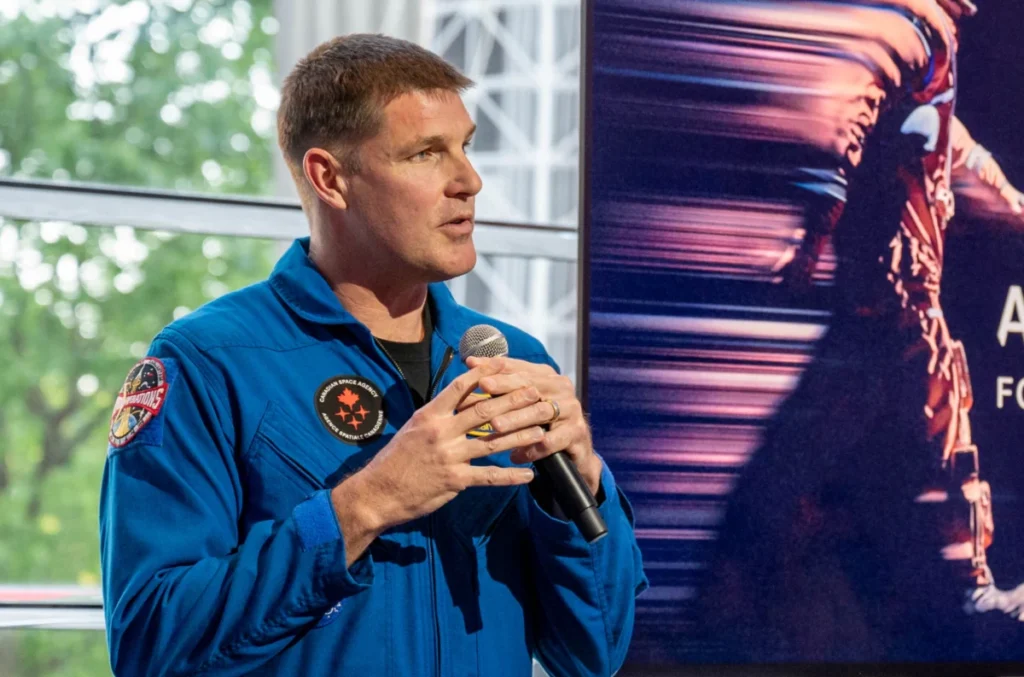
Colonel Jeremy Hansen is making history on the Artemis II mission as the first Canadian to fly around the Moon. Beyond his distinguished military career, Hansen possesses a profound academic foundation in physics and space sciences, honed through rigorous education and practical application. His journey to the lunar vicinity is a testament to decades of dedication to scientific inquiry and a lifelong dream fueled by the pioneers of space exploration.
From Young Dreamer to Aspiring Pilot
Born in London, Ontario, in 1976, Colonel Hansen’s fascination with the cosmos was ignited at an early age, drawing inspiration from the monumental achievements of Neil Armstrong. This early spark quickly evolved into a tangible pursuit. At the age of 12, he joined the Air Cadets, an experience that provided him with invaluable early exposure to aviation. This foundational involvement proved pivotal, as it facilitated his acquisition of a glider pilot’s license at 16, followed swiftly by a private pilot’s license at 17. These early accomplishments in aviation were not merely recreational; they represented a disciplined approach to mastering complex skills, a trait that would define his future endeavors.
The Crucible of Academia: Royal Military College
Colonel Hansen’s formal academic journey commenced in Quebec at the Royal Military College Saint-Jean, a prestigious institution known for its demanding curriculum and commitment to developing future leaders. He subsequently continued his studies at the Royal Military College of Canada (RMC) in Kingston, Ontario. It was at RMC that Hansen’s academic prowess in the scientific realm truly blossomed. In 1999, he graduated with honours, earning a Bachelor of Science degree in Space Science. This was not the end of his academic pursuits; he went on to complete a Master of Science degree in Physics the following year.
Specialization in Satellite Tracking: A Foundation for Space
During his master’s program, under the esteemed supervision of Professor Erwin Batalla, Colonel Hansen specialized in the intricate field of Wide Field of View satellite tracking. Professor Batalla, now retired, fondly recalls Hansen’s exceptional capabilities. "He really stood out from the crowd," Batalla remarked. "He was a very determined student with an exceptional work ethic, very patient, and who got along well with everyone. I know he’s very happy today, because this is exactly what he wanted to do." This specialization provided Hansen with a deep understanding of orbital mechanics, the complexities of satellite operations, and the precise methods required to monitor objects in Earth’s orbit. This knowledge is fundamental to any space mission, offering crucial insights into spacecraft navigation and data acquisition.
The Space Science program at RMC is recognized as one of the select few in Canada to offer specialized training in space physics. Its comprehensive curriculum encompasses a broad range of critical areas, including orbital mechanics, the design and analysis of space missions, advanced satellite tracking techniques, remote sensing technologies, and space communications. This rigorous academic environment at RMC provided Colonel Hansen with a robust theoretical framework, preparing him for the practical challenges of space exploration.
Field Expeditions: Preparing for the Lunar Landscape
The Artemis II mission, designed to return humans to the vicinity of the Moon for the first time in over fifty years, requires astronauts to possess not only technical expertise but also a keen understanding of planetary geology. Colonel Gordon Osinski, a professor of planetary geology at Western University in London, Ontario, played a significant role in the geological training of the Artemis II astronauts, including Colonel Hansen.
Dr. Osinski’s long-standing relationship with Colonel Hansen began in 2012, shortly after Hansen was selected as an astronaut. The Canadian Space Agency (CSA) sought to enhance the geological training for its new cohort of astronauts, and Dr. Osinski, a leader in field expeditions in the Canadian Arctic, was tasked with providing a combination of scientific instruction and operational preparation.
The Arctic, with its extreme isolation and unique geological formations, serves as an exceptional terrestrial analogue for extraterrestrial environments such as Mars and the Moon. Dr. Osinski’s research has extensively focused on sites like the Kamestastin Lake impact crater in northern Labrador, where he conducted field research in 2021 and 2023. This particular site holds immense scientific value. "This site is unique in the world for two reasons: it’s a perfectly preserved meteorite impact crater, similar to the millions of craters that dot the Moon, and it’s made of anorthosite. This is the white rock that glows when you look at the Moon; it’s very rare on Earth, but ubiquitous up there," Dr. Osinski explained.
Through these intensive field exercises, astronauts like Colonel Hansen learned to identify geological features, interpret geological processes, and collect scientific samples – skills directly transferable to lunar exploration. The practical experience gained in these harsh, Earth-bound environments is invaluable for preparing astronauts for the scientific objectives of missions like Artemis II.
Dr. Osinski expressed his profound satisfaction with the astronauts’ preparedness. "Listening to the astronauts talk about craters and geology from space, I thought to myself that all that training was worth it. They’re finally putting into practice what they learned with us in the field," he stated. His sentiment underscores the critical link between advanced academic training and practical, hands-on preparation for space missions. Notably, Dr. Osinski has been selected as part of the geology team for future Artemis missions, marking him as the sole researcher from a Canadian university to hold such a position, further highlighting the caliber of Canadian contributions to the Artemis program.
A Legacy of Canadian Astronauts from RMC
Colonel Hansen’s ascent to lunar orbit places him in the esteemed company of distinguished Royal Military College of Canada graduates who have previously ventured into space. This legacy includes pioneering figures such as Marc Garneau, the first Canadian in space; Chris Hadfield, renowned for his command of the International Space Station and his engaging outreach; and Joshua Kutryk, another accomplished astronaut. Hansen’s journey is a powerful illustration of the pivotal role that Canadian universities, particularly RMC, play in cultivating the talent and expertise required for astronautical endeavors and the advancement of scientific knowledge. As Canada continues to solidify its commitment to human lunar exploration, the contributions of institutions like RMC are increasingly vital.
The Royal Military College of Canada views its graduates who achieve such extraordinary feats as profound sources of pride. Pascal Godbout, the Commandant and Vice-Chancellor of RMC, articulated this sentiment: "As we reflect on our 150 years of training leaders to serve the country, we feel immense pride in seeing one of our own take part in the Artemis II mission. His journey embodies the valour and sense of duty that we cultivate here every day."
Godbout further emphasized the significance of humanity’s renewed focus on lunar exploration: "Humanity’s return to the Moon is a truly remarkable moment. His participation in this mission inspires us to excel and strive for excellence. His journey, from student to astronaut, embodies the dedication and leadership we strive to cultivate." This perspective highlights RMC’s enduring commitment to fostering individuals who not only excel in their chosen fields but also embody the core values of service, duty, and leadership.
Artemis II: A New Chapter in Lunar Exploration
The Artemis II mission is a critical stepping stone in NASA’s ambitious Artemis program, which aims to establish a sustainable human presence on the Moon and eventually pave the way for missions to Mars. This four-person crewed mission will embark on a roughly ten-day journey, traveling farther into space than any humans have gone before. The primary objectives of Artemis II include testing the Orion spacecraft’s life support systems, navigation capabilities, and communication systems in the deep space environment. The mission will also provide valuable insights into the effects of deep space radiation on the human body, crucial data for planning longer-duration missions.
The selection of Colonel Hansen as the first Canadian to journey around the Moon is a landmark achievement for Canada’s participation in the Artemis program. It signifies the nation’s growing capabilities and its significant contributions to international space exploration. The mission builds upon Canada’s established role in space, including its contributions to the International Space Station and its development of the Canadarm robotic systems.
Broader Implications and Future Prospects
Colonel Hansen’s historic flight on Artemis II carries profound implications for Canada and the global scientific community. It underscores the importance of investing in STEM education and research, demonstrating that a strong academic background, particularly in physics and space sciences, is a direct pathway to achieving the highest echelons of space exploration. The mission serves as a powerful inspiration for a new generation of Canadian scientists, engineers, and aspiring astronauts, encouraging them to pursue their dreams in fields that were once considered beyond reach.
The success of Artemis II will pave the way for future Artemis missions, including Artemis III, which is slated to land the first woman and the next man on the Moon. Canada’s commitment to the Artemis Accords, a set of principles guiding space exploration, positions the nation as a key partner in this new era of lunar exploration. Colonel Hansen’s journey is not just a personal triumph; it is a beacon of Canadian ingenuity and a testament to the enduring human spirit of discovery. His academic rigor, military discipline, and unwavering passion for space have culminated in a historic moment, solidifying his place in the annals of Canadian and international space exploration. The lessons learned and the experiences gained on this mission will undoubtedly inform future endeavors, pushing the boundaries of human knowledge and our understanding of the cosmos.