


The Turkish language, a member of the Turkic language family spoken by over 80 million people globally, offers a numerical system characterized by its remarkable logic, regularity, and phonetic consistency. For the growing number of expatriates, digital nomads, and international investors entering the Republic of Turkey, mastery of the Turkish counting system serves as a foundational pillar for social integration and economic participation. Whether navigating the complexities of the Grand Bazaar, coordinating logistics with local telecommunications providers, or engaging in formal financial transactions, understanding the structure of Turkish numerals is an essential skill for functional literacy in the region.
The Foundational Framework: Counting from 1 to 10
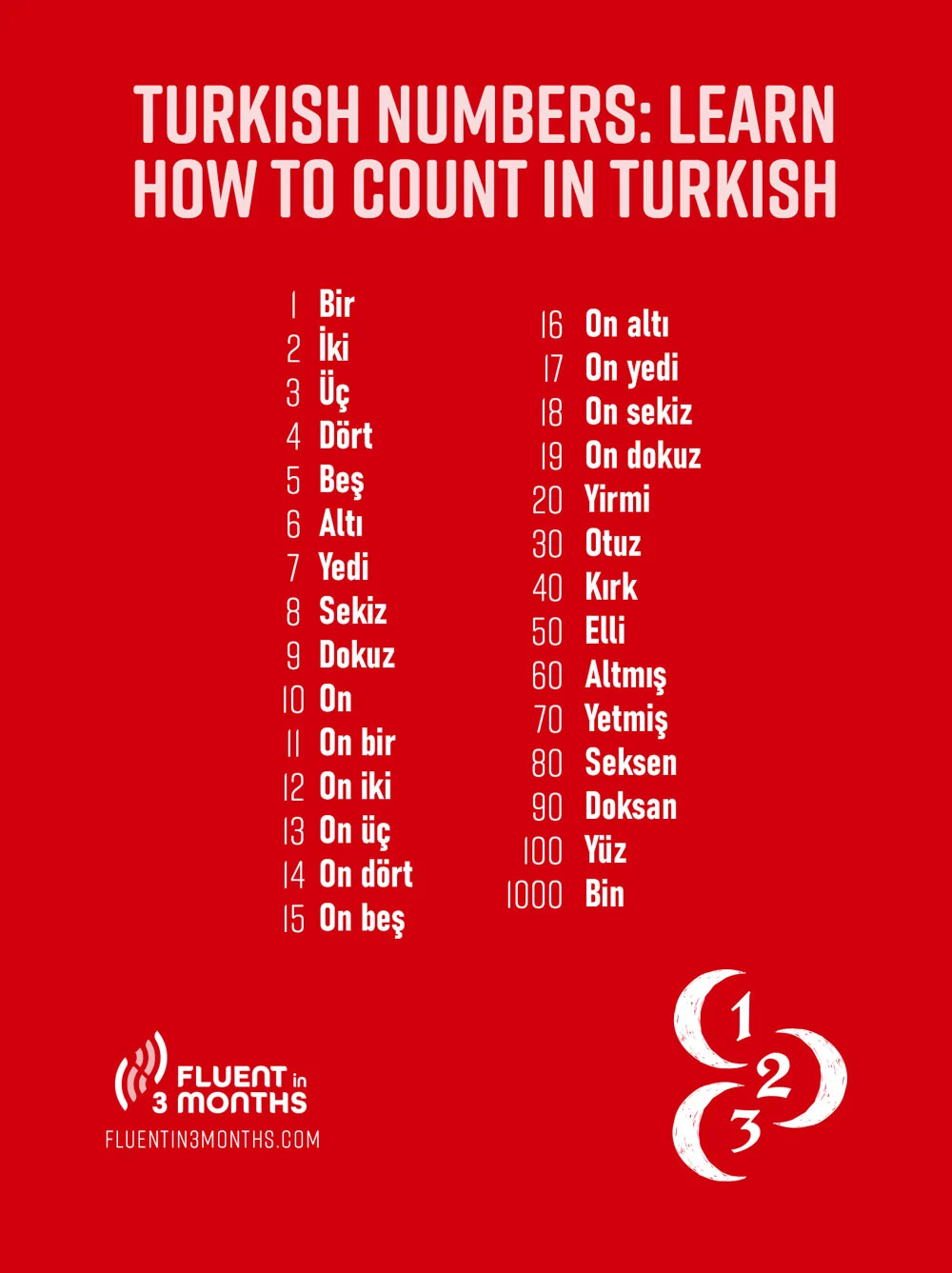
The Turkish numerical system is built upon ten primary digits. Unlike English, which features irregular forms for "eleven" and "twelve," Turkish remains strictly additive and logical from the very beginning. The basic digits are as follows:
1 – Bir
2 – İki
3 – Üç
4 – Dört
5 – Beş
6 – Altı
7 – Yedi
8 – Sekiz
9 – Dokuz
10 – On
Linguists point out that Turkish is a highly phonetic language; words are generally pronounced exactly as they are written. For instance, the number six (altı) utilizes the undotted "ı," a high back unrounded vowel that is distinct from the front "i" found in iki (two). Mastering these subtle phonetic differences is crucial for clear communication, particularly in high-stakes environments such as banking or emergency services.
Structural Logic: The Progression to 100
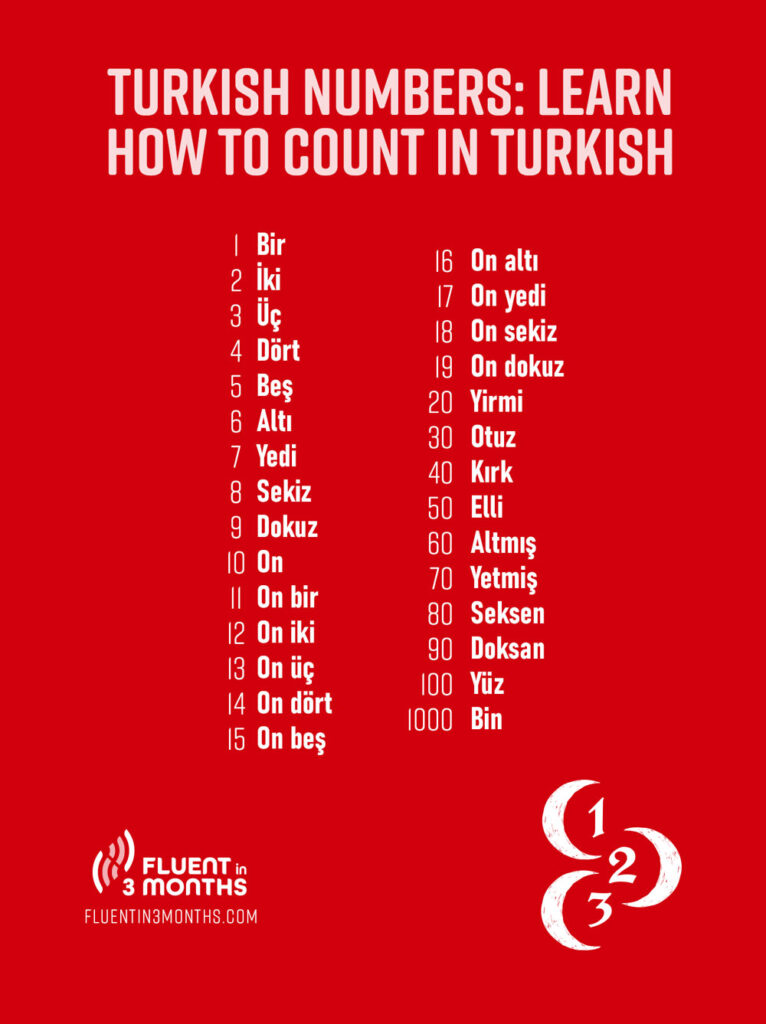
Once the primary digits are mastered, the transition to higher numbers follows a predictable mathematical pattern. To form numbers between 11 and 19, the speaker simply places the word for ten (on) before the single digit. For example:
11 – On bir (Ten + One)
12 – On iki (Ten + Two)
15 – On beş (Ten + Five)
19 – On dokuz (Ten + Nine)
This logical consistency extends into the multiples of ten. To navigate the Turkish marketplace or discuss dates, one must memorize the unique terms for each decimal interval:
20 – Yirmi
30 – Otuz
40 – Kırk
50 – Elli
60 – Altmış
70 – Yetmiş
80 – Seksen
90 – Doksan
To construct any number between these intervals, the speaker combines the decimal term with the single digit. For instance, 45 is expressed as kırk beş, and 87 is seksen yedi. There are no hyphens used in the written form of these compound numbers in standard Turkish prose, though they are separated by spaces.
Scaling the System: Hundreds, Thousands, and Millions
The Turkish system for larger denominations is similarly streamlined. The word for one hundred is yüz. To express multiples of one hundred, one simply places the multiplier before the word yüz.
100 – Yüz
200 – İki yüz
500 – Beş yüz
900 – Dokuz yüz
When building complex numbers, the order remains strictly descending: hundreds, then tens, then units. For example, 365 is expressed as üç yüz altmış beş.
The word for one thousand is bin. Following the same multiplicative logic, 2,000 becomes iki bin, and 10,000 is on bin. In the context of the Turkish economy, which has experienced significant fluctuations in the value of the Lira over the past decade, the ability to quickly calculate and articulate large numbers is vital for both residents and visitors.
Chronology of Linguistic Evolution: The 1928 Reform
The modern Turkish numerical system and its Latin-script representation are relatively recent developments in the nation’s history. Prior to 1928, the Ottoman Empire utilized the Ottoman Turkish alphabet, a version of the Arabic script. As part of the sweeping "Alphabet Reform" (Harf Devrimi) led by Mustafa Kemal Atatürk, the founder of the Republic of Turkey, the nation transitioned to a Latin-based alphabet.
This shift was not merely aesthetic; it was a strategic move to increase literacy rates and align Turkey more closely with Western administrative and scientific standards. The Turkish Language Association (Türk Dil Kurumu – TDK), established in 1932, continues to oversee the standardization of the language, ensuring that the numerical system remains uniform across all educational and governmental platforms.
The Complexity of Ordinal Numbers and Vowel Harmony
A unique feature of the Turkish language is its use of suffixes to denote order (e.g., first, second, third). These are known as ordinal numbers. In Turkish, the formation of ordinals is governed by the "Four-Way Vowel Harmony" rule, one of the most distinctive characteristics of Turkic grammar. The suffix added to a number depends on the final vowel of that number:
- If the last vowel is a/ı, the suffix is -ıncı
- If the last vowel is e/i, the suffix is -inci
- If the last vowel is o/u, the suffix is -uncu
- If the last vowel is ö/ü, the suffix is -üncü
Examples include:
1st – Birinci
2nd – İkinci
3rd – Üçüncü
4th – Dördüncü (Note: the ‘t’ in dört changes to ‘d’ when a vowel suffix is added, a process known as consonant voicing).
Practical Application: Navigating Real-World Scenarios
The utility of Turkish numbers extends far beyond rote counting. They are integrated into five primary sectors of daily life:
1. Temporal Logistics: Telling Time
In Turkey, formal schedules (such as flight or train departures) utilize the 24-hour clock. For instance, 16:00 is on altı. In casual conversation, however, speakers often use a 12-hour system with modifiers. The word buçuk is used for "half-past" (e.g., iki buçuk for 2:30), and çeyrek signifies a "quarter" (e.g., saat beşi çeyrek geçiyor for a quarter past five).
2. Financial Transactions: The Lira and Kuruş
The Turkish Lira (TL) is the official currency. Prices are articulated by stating the Lira amount followed by the kuruş (cents). A price tag of 15.50 TL would be read as on beş lira elli kuruş. It is important to note that in Turkey, the decimal comma (,) is used to separate fractions, while the period (.) is used as a thousands separator—the opposite of the standard used in the United States and the United Kingdom.
3. Telecommunications: Phone Number Grouping
When sharing a phone number, Turks typically group the ten digits (following the initial zero) into a specific 3-3-2-2 rhythm. For example, a number might be dictated as: "Five hundred five (505), six hundred twenty-one (621), forty-two (42), zero eight (08)."
4. Demographics: Age and Identity
In formal interviews or bureaucratic filings, age is expressed using the phrase yaşındayım (I am … years old). For example, Otuz yaşındayım translates to "I am thirty years old."
5. Commerce: Weights and Measures
Turkey utilizes the metric system. When shopping at a local pazar (market), quantities are requested in kilo (kilograms) or gram. A common request might be iki kilo domates (two kilos of tomatoes).
Institutional Perspectives and Educational Impact
The Turkish Ministry of National Education emphasizes numerical literacy as a core component of the primary curriculum. According to recent data from the Turkish Statistical Institute (TÜİK), Turkey has seen a steady rise in international student enrollment, with over 300,000 foreign students currently studying in the country. For these students, the logical structure of Turkish numbers is often cited as one of the most accessible aspects of the language, facilitating quicker entry into technical and scientific fields.
Linguistic experts from Istanbul University suggest that the regularity of the Turkish numerical system reduces the cognitive load on learners compared to languages with more irregular counting systems, such as French or Danish. This "mathematical transparency" allows for faster mental calculation and is believed to contribute to the strong performance of Turkish students in regional mathematics competitions.
Global Implications and Conclusion
As Turkey continues to strengthen its role as a bridge between Europe, Asia, and the Middle East, the Turkish language is gaining traction as a secondary language in neighboring regions. The expansion of Turkish television series (Dizi) and the growth of Turkish Airlines have further exported the language’s sounds and structures to a global audience.
Mastering Turkish numbers is more than a linguistic exercise; it is an act of cultural respect and a practical tool for success. By understanding the foundational 1-10, the logic of decimal progression, and the rules of vowel harmony, individuals can navigate the Turkish landscape with confidence. In an increasingly interconnected world, such localized knowledge remains a powerful asset for international diplomacy, commerce, and personal growth.