


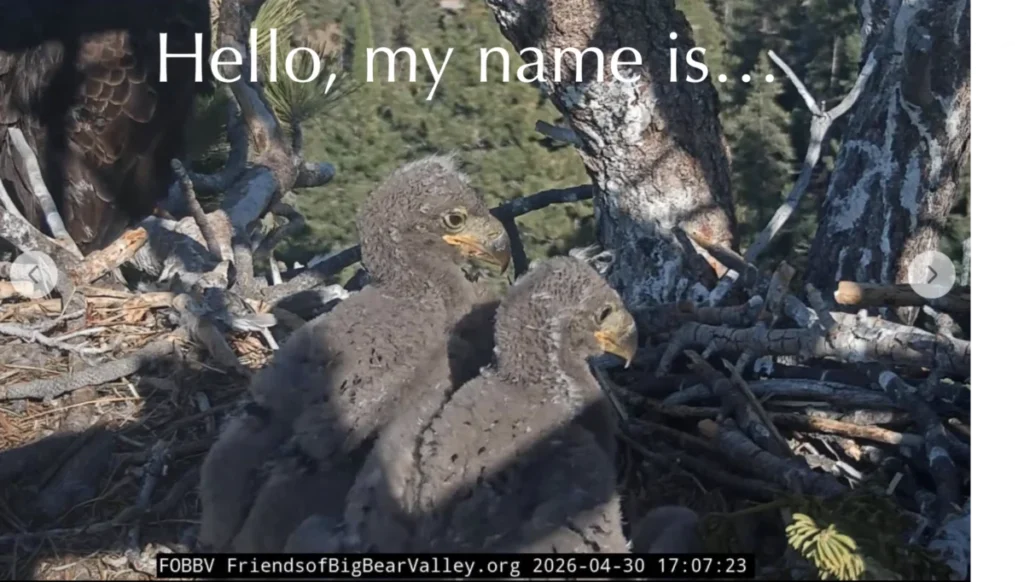
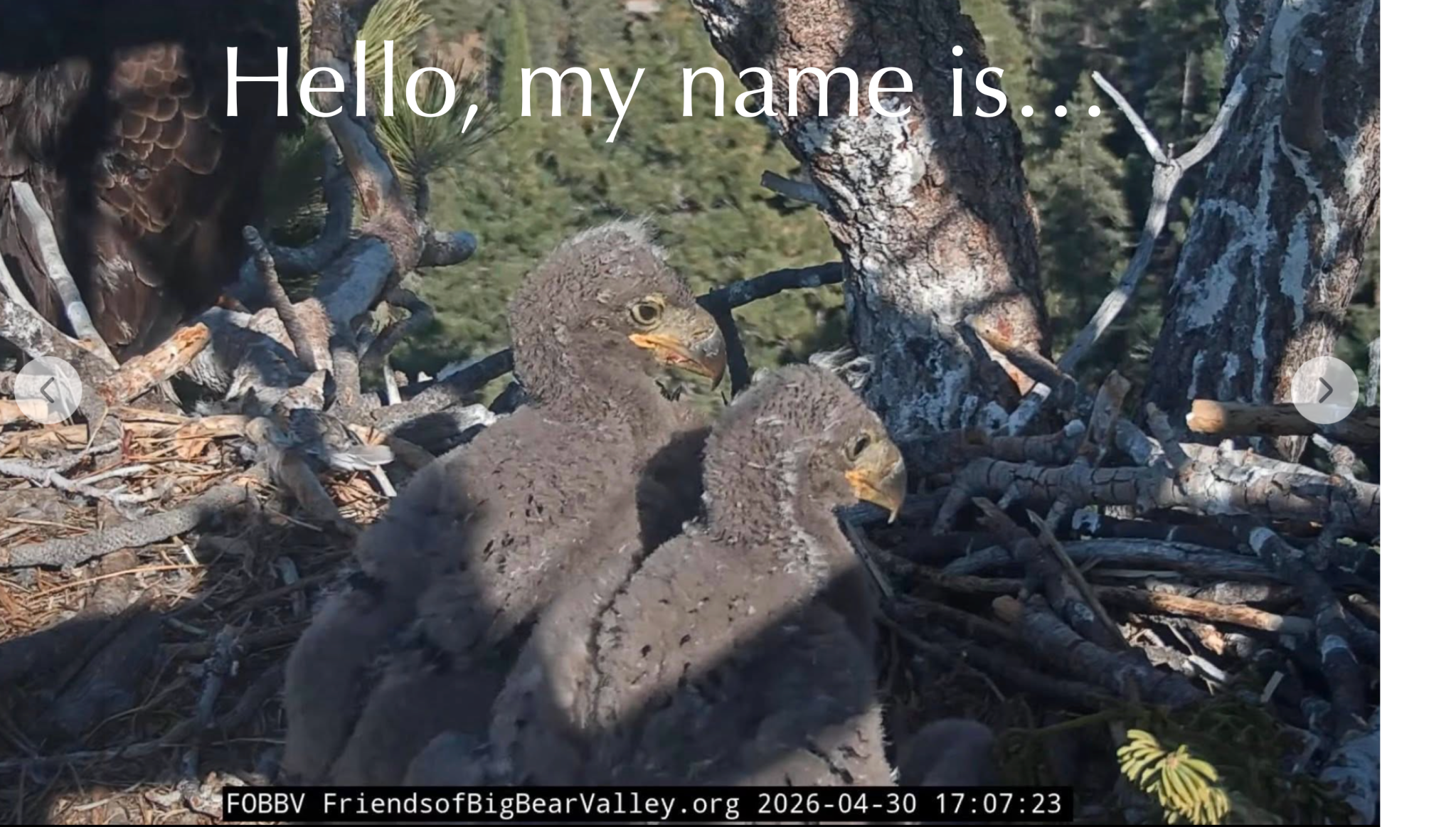
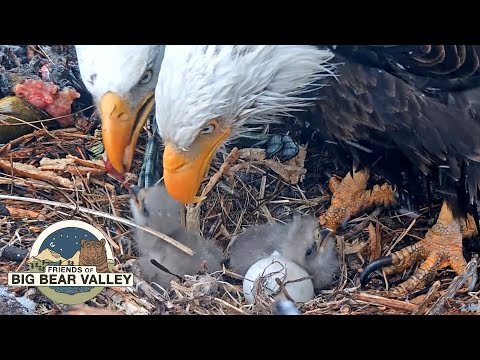
The San Bernardino National Forest has officially welcomed its newest named residents as the 2026 bald eagle chicks, offspring of the world-famous pair Jackie and Shadow, have been christened Sandy and Luna. The announcement, made by the nonprofit organization Friends of Big Bear Valley (FOBBV), follows an extensive community-driven process involving thousands of submissions and a final selection by local students. This milestone marks a high point in what has been a tumultuous but ultimately successful nesting season for the eagle pair, whose lives are broadcast 24/7 to a global audience of millions.
The naming of the eaglets is a tradition that blends scientific observation with community engagement. According to FOBBV data, Chick 1 has been named Sandy, while Chick 2 has been named Luna. The name Sandy emerged as the clear favorite among the public, receiving 3,706 of the staggering 63,915 total names submitted during the open nomination period. The selection of Sandy serves as a poignant tribute to the late Sandy Steers, the former executive director of FOBBV who passed away in February. Steers was instrumental in establishing the live-stream infrastructure and was a tireless advocate for the protection of the Big Bear eagles. While FOBBV representatives noted that Steers herself might have been too humble to suggest her own name for an eagle, they expressed that she would have been deeply honored by the students’ choice to commemorate her legacy through the 2026 brood.
The final selection process was entrusted to local students, who chose from a curated list of 30 randomly drawn names. Among the potential monikers were Windy, Kazoo, River, and Hazy, while the runners-up included Star, Chip, and Phoenix. This educational outreach highlights the broader mission of the Big Bear eagle project: to foster environmental stewardship among the younger generation.
A Chronology of the 2026 Nesting Season
The path to the successful hatching of Sandy and Luna was fraught with the natural challenges typical of the Southern California wilderness. The 2026 season began with a significant setback in January when Jackie and Shadow’s initial clutch of two eggs was destroyed by ravens. Such predation is a common hurdle for bald eagles, yet the resilience of the pair was on full display when Jackie laid a second clutch shortly thereafter.
The timeline of the successful hatchings is as follows:
- Late January/Early February: Jackie lays a second clutch of two eggs following the loss of the first set to ravens.
- April 4, 9:33 p.m. PDT: Chick 1 (Sandy) successfully completes the hatching process, known as "pipping," and emerges into the nest.
- April 5, 8:30 a.m. PDT: Chick 2 (Luna) hatches less than 12 hours later, ensuring a closely aged pair of siblings.
Since their birth, the eaglets have been under the constant care of Jackie and Shadow. The parents share duties, with Shadow frequently providing high-protein meals such as fish and coots, while Jackie focuses on brooding the chicks to maintain their body temperature against the fluctuating mountain climate.
Historical Context: The Legacy of Jackie and Shadow
Jackie and Shadow have become an internet sensation since they first paired in 2018. Their nest, located in a tall Jeffrey pine in the Big Bear Valley, provides a rare window into the life cycle of a species that was once on the brink of extinction in the United States. However, their journey has been characterized by both triumph and heartbreak.
The pair successfully raised chicks in 2019 and 2022, but the intervening years demonstrated the harsh realities of nature. In 2023 and 2024, their eggs failed to hatch, a common occurrence given that only about 50 percent of bald eagle eggs successfully produce viable chicks. The 2025 season was particularly harrowing; though Jackie laid three eggs and all three hatched in early March, a severe late-season snowstorm intervened. On March 13, 2025, a storm dropped two feet of snow on the nest accompanied by gale-force winds. Despite Jackie’s best efforts to shield her young, one of the three chicks perished during the event. The two survivors of that season were eventually named Sunny and Gizmo.
Biological Data and Environmental Challenges
The survival of Sandy and Luna is by no means guaranteed, as the "fledgling" stage—the period between hatching and taking their first flight—is one of the most dangerous times in an eagle’s life. Biological data suggests that approximately 70 percent of bald eagles survive the fledging stage.
The primary threats facing Sandy and Luna over the coming weeks include:
- Predation: Even as they grow, the chicks remain vulnerable to other large birds of prey, including hawks, owls, and rival eagles, as well as terrestrial predators if they accidentally fall from the nest.
- Weather Extremes: Big Bear Valley is prone to sudden spring snowstorms and high winds. While the chicks’ downy feathers are replaced by thermal-regulating juvenile feathers, extreme cold can still lead to hypothermia.
- Human Interference and Infrastructure: One of the leading causes of mortality for young eagles after they leave the nest is collisions with vehicles. Fledglings often scavenge for food on the ground and may be struck by cars while feeding on roadkill near mountain highways.
The chicks are expected to remain in the nest for 10 to 14 weeks. During this period, they will undergo rapid physical development, growing from small, grey fluff-balls into large, dark-brown juveniles with wingspans that can reach up to seven feet. Males typically fledge slightly earlier than females, often taking their first tentative flights into the surrounding pines by mid-summer.
The Broader Impact of Wildlife Livestreams
The Big Bear eagle cam is more than just a source of entertainment; it is a vital tool for scientific observation and public education. The nonprofit Friends of Big Bear Valley uses the platform to gather data on nesting behavior, prey selection, and the impact of climate change on high-altitude avian populations.
The livestream has also created a unique "citizen science" community. Thousands of viewers monitor the nest around the clock, documenting every meal and milestone. This collective vigilance has occasionally led to real-world conservation actions, such as alerting forest rangers to potential threats or disturbances near the nesting site.
Moreover, the project serves as a reminder of the successful recovery of the bald eagle under the Endangered Species Act. Once decimated by habitat loss and the use of the pesticide DDT, bald eagles have made a remarkable comeback across North America. The presence of a breeding pair in the San Bernardino National Forest is a testament to the health of the local ecosystem and the success of long-term conservation efforts.
Future Implications and Analysis
As Sandy and Luna prepare for their eventual departure from the nest, their movements will become much harder to track. FOBBV does not utilize GPS tagging or banding for their eagles, citing a philosophy of minimal human intervention. Consequently, once the eaglets fledge, their specific journeys remain a mystery. Historical data from other Southern California fledglings suggests they could travel vast distances; past Big Bear eagles have been spotted as far north as British Columbia and as far east as the Yellowstone National Park region.
The naming of Sandy and Luna provides a sense of narrative and emotional connection for the public, but for the eagles, it is the beginning of a rigorous test of survival. The success of this 2026 brood is a vital contribution to the local eagle population, especially given the failures of previous years.
In the coming weeks, viewers of the FOBBV livestream will witness the "branching" phase, where Sandy and Luna begin to hop onto nearby branches to practice their balance and wing-flapping. These exercises are the final steps before they commit to the air. For the community of Big Bear and the millions of followers worldwide, the names Sandy and Luna represent hope, resilience, and the enduring legacy of the natural world and those who work to protect it.
As the season progresses, FOBBV continues to encourage the public to engage with the livestream, emphasizing that every view helps fund the maintenance of the cameras and the protection of the habitat. While the names have been settled, the story of Sandy and Luna is only just beginning.