

Language acquisition experts and linguists increasingly advocate for a strategic approach to learning Turkish, emphasizing that fluency is not predicated on exhaustive memorization but on the mastery of high-frequency vocabulary. By focusing on the most common nouns, verbs, and adjectives, learners can navigate daily life, describe their environment, and engage in meaningful dialogue. Turkish, a primary member of the Turkic language family, is spoken by approximately 80 to 90 million people worldwide. As Turkey’s geopolitical and cultural influence expands through trade, tourism, and the global popularity of its television industry, the demand for accessible Turkish language education has reached unprecedented levels.
The Strategic Foundation of Turkish Communication
The "Pareto Principle" in linguistics suggests that roughly 20% of a language’s vocabulary accounts for 80% of daily interactions. In Turkish, this core lexicon serves as the structural scaffolding for more complex grammatical developments. Unlike Indo-European languages, Turkish is agglutinative, meaning it builds meaning through the addition of suffixes to root words. This unique structure makes the initial acquisition of root nouns and verbs particularly critical, as they serve as the "building blocks" for all subsequent communication.
Historical Context and the Evolution of Modern Turkish
The current state of the Turkish language is the result of one of the most radical linguistic shifts in modern history. Following the establishment of the Republic of Turkey in 1923, President Mustafa Kemal Atatürk initiated the Language Reform of 1928. This transition replaced the Arabic-script-based Ottoman Turkish with a Latin-based alphabet and sought to "purify" the language by removing many Persian and Arabic loanwords in favor of Turkic roots.
This chronology is essential for learners to understand because it explains the presence of "doublets" in the language—where a traditional word and a modern Turkic word may coexist—and the phonetic consistency of the modern script. Today, the Turkish Language Association (Türk Dil Kurumu or TDK) continues to oversee the evolution of the language, ensuring it remains adaptable to modern technological and social needs.
Essential Social Interaction: Greetings and Etiquette
In Turkish culture, social harmony is highly valued, and the use of appropriate greetings and polite phrases is a prerequisite for effective integration. The language distinguishes between formal and informal registers, particularly in the use of the second-person pronoun.
Primary Greetings and Farewells
- Merhaba (Hello): The standard greeting used in almost any context.
- Selam (Hi): An informal variant used among friends.
- Günaydın (Good morning): Essential for early-day interactions.
- İyi akşamlar (Good evening): Used both as a greeting and a farewell after sunset.
- Hoş geldin / Hoş geldiniz (Welcome): The former is informal (singular), while the latter is formal or plural.
- Görüşürüz (See you later): A common way to conclude a conversation.
The Nuances of Turkish Politeness
Turkish contains several "untranslatable" polite phrases that reflect the country’s deep-seated values of hospitality (misafirperverlik) and respect for labor.
- Lütfen (Please): A universal requirement for polite requests.
- Teşekkür ederim / Teşekkürler (Thank you / Thanks): The standard expressions of gratitude.
- Sağ ol (Thanks/Stay healthy): An informal way to thank someone.
- Geçmiş olsun (Get well soon): Used not only for illness but also after someone has experienced a difficult situation.
- Afiyet olsun (Enjoy your meal): Used both before and after eating.
- Elinize sağlık (Health to your hands): A specific compliment paid to a cook or someone who has performed manual work.
- Kolay gelsin (May it come easy): A polite acknowledgement of someone currently working, whether they are a shopkeeper or a colleague.
Navigating Daily Life: High-Frequency Nouns
Nouns related to sustenance, family, and navigation form the backbone of a learner’s functional vocabulary. Understanding these terms allows for independent movement within Turkish cities and social circles.
Culinary Terms and Dietary Staples
Food is central to Turkish social life. For travelers and expatriates, recognizing these terms is vital for grocery shopping and dining out.
- Yemek (Food/To eat): Acts as both a noun and a verb.
- Ekmek (Bread): The most fundamental staple of the Turkish diet.
- Su (Water): An essential word for any traveler.
- Çay (Tea): More than a drink, çay is a social institution in Turkey.
- Kahve (Coffee): Usually referring to Turkish coffee unless specified.
- Et, Tavuk, Balık (Meat, Chicken, Fish): Essential for identifying proteins.
- Peynir, Süt, Yumurta (Cheese, Milk, Egg): Common breakfast items.
- Makarna (Pasta): A critical word to distinguish from the "false friend" pasta, which in Turkish means "cake."
The Complexity of the Turkish Family Unit
Turkish vocabulary regarding family is significantly more specific than English. It distinguishes between maternal and paternal relatives, reflecting a traditional emphasis on lineage.
- Anne (Mother) and Baba (Father): Basic parental terms.
- Abla (Older sister) and Abi (Older brother): These are also used as respectful titles for slightly older strangers.
- Amca (Paternal uncle) vs. Dayı (Maternal uncle): Crucial distinctions in family gatherings.
- Hala (Paternal aunt) vs. Teyze (Maternal aunt): Similarly distinct based on the parent’s side.
Linguistic Mechanics: Verbs and Sentence Structure
Turkish follows a Subject-Object-Verb (SOV) word order, which differs from the Subject-Verb-Object (SVO) order of English. This means the action typically comes at the very end of the sentence. Furthermore, Turkish does not have a standalone verb for "to be" or "to have" in the way English does; these are expressed through suffixes or the words var (there is/exists) and yok (there is not/does not exist).
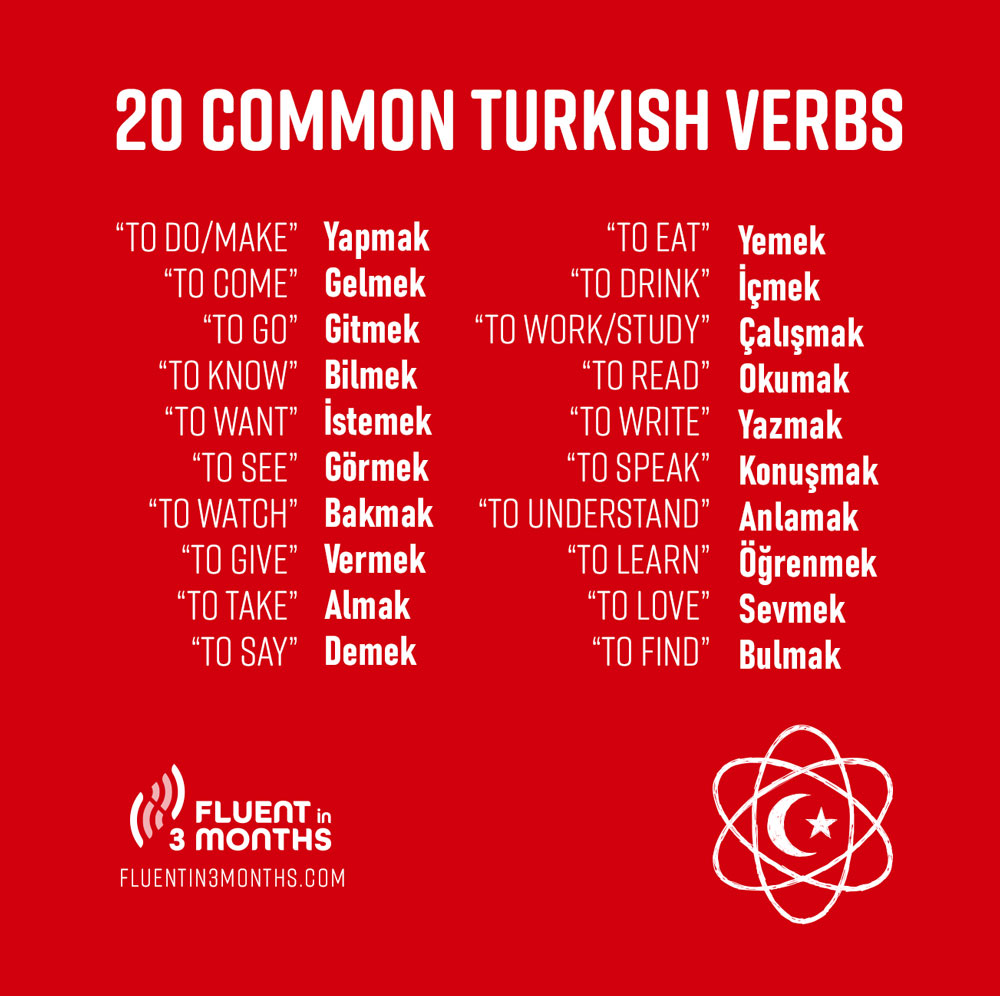
Core Verbs for Daily Interaction
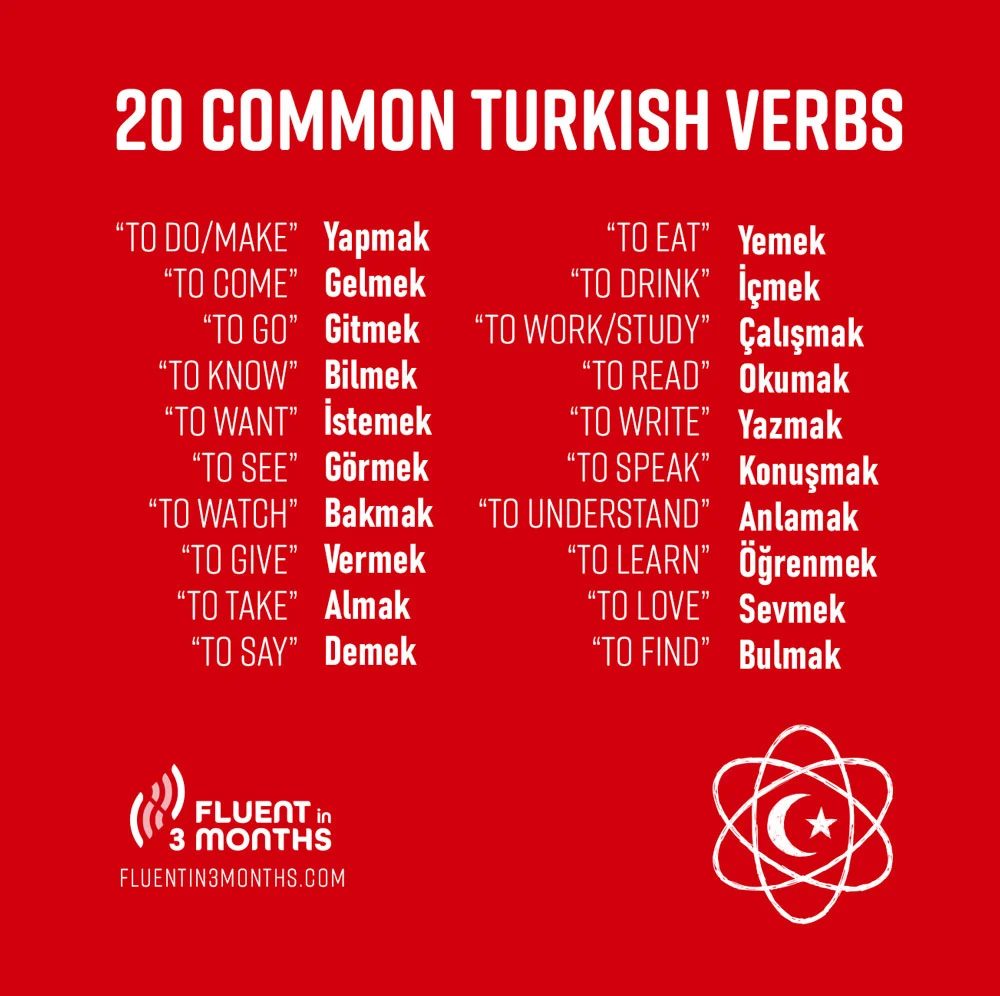
- Yapmak (To do/make): A versatile verb used in many compound expressions.
- Gelmek (To come) and Gitmek (To go): Fundamental for movement and planning.
- İstemek (To want): Necessary for expressing needs or desires.
- Bilemk (To know) and Anlamak (To understand): Key for gauging comprehension during the learning process.
- Çalışmak (To work/study): Covers both professional and academic effort.
- Öğrenmek (To learn): The primary goal of any student of the language.
Descriptive Language: Adjectives and Colors
In Turkish grammar, adjectives consistently precede the nouns they modify. This placement is intuitive for English speakers, though the lack of grammatical gender in Turkish simplifies the process significantly—adjectives do not need to "agree" with nouns in gender, as no such distinction exists.
Common Opposites and Descriptors
- Büyük / Küçük (Big / Small)
- Güzel / Çirkin (Beautiful / Ugly)
- İyi / Kötü (Good / Bad)
- Yeni / Eski (New / Old – for objects)
- Sıcak / Soğuk (Hot / Cold)
- Kolay / Zor (Easy / Difficult)
- Pahalı / Ucuz (Expensive / Cheap)
The Palette of Turkish Colors
Colors are used frequently in commerce and descriptions.
- Kırmızı (Red), Mavi (Blue), Sarı (Yellow), Yeşil (Green), Beyaz (White), Siyah (Black).
Supporting Data: The Rise of Turkish as a Foreign Language
The interest in Turkish vocabulary is supported by significant statistical trends. According to the Yunus Emre Institute, a non-profit organization that promotes Turkish culture and language, there has been a 300% increase in students enrolling in Turkish language courses globally over the last decade. Much of this interest is attributed to the "Soft Power" of Turkish media.
Turkey is currently the second-highest exporter of television series worldwide, trailing only the United States. Fans of Turkish "Dizis" (dramas) often report learning high-frequency words such as Canım (My dear), Aşkım (My love), and İnşallah (God willing) through immersion. This cultural phenomenon has created a unique "informal learning" environment that complements formal vocabulary study.
Expert Analysis: The Agglutinative Advantage
Linguists point out that while Turkish might seem daunting due to its unfamiliar roots and SOV structure, it is remarkably logical. Dr. Geoffrey Lewis, a renowned scholar of Turkish, famously described the language as a "brilliant architectural structure." Unlike English, which is rife with irregular verbs and inconsistent spelling, Turkish is almost entirely phonetic and follows strict grammatical rules with very few exceptions.
Once a learner masters the "building block" nouns and verbs, they can utilize the suffix system to create complex sentences. For example, the root Göz (Eye) can become Gözlük (Glasses), which can become Gözlükçü (Optician), and then Gözlükçülük (the profession of being an optician). This "mathematical" quality of the language means that a small initial investment in vocabulary yields exponential results in comprehension.
Broader Impact and Implications
The mastery of basic Turkish vocabulary has implications far beyond tourism. Economically, Turkey serves as a bridge between Europe, Central Asia, and the Middle East. For professionals in logistics, textiles, and energy, a functional command of Turkish provides a competitive edge in one of the world’s most dynamic emerging markets.
Furthermore, learning the language fosters deeper cultural empathy. By understanding the specific ways Turkish speakers greet one another or describe family relations, learners gain insight into the social fabric of the Anatolian peninsula. As global connectivity increases, the transition from being a "tourist" to a "communicator" begins with the very words outlined in this guide. The strategic acquisition of high-frequency Turkish vocabulary remains the most efficient path to unlocking the rich historical and contemporary landscape of the Turkish-speaking world.