


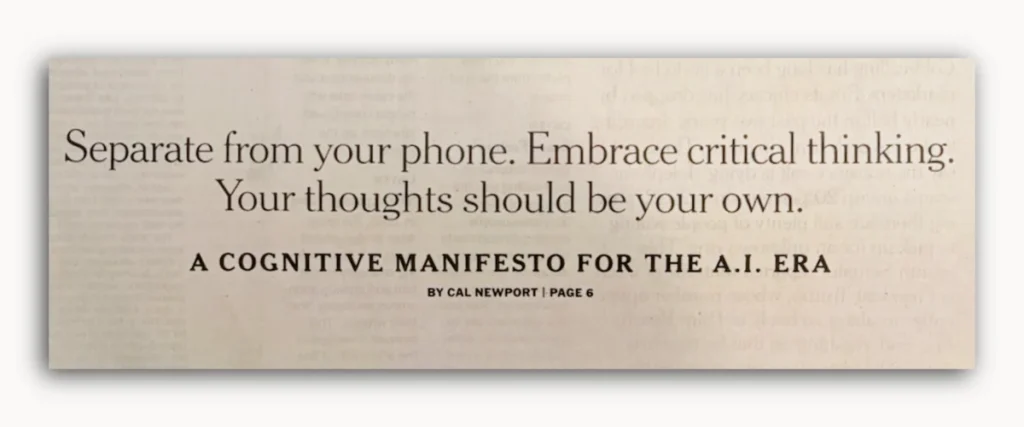
Ten years after the publication of his seminal work, Deep Work: Rules for Focused Success in a Distracted World, author and computer science professor Cal Newport is observing a landscape increasingly hostile to sustained concentration. What began as an exploration of the economic and philosophical benefits of deep focus has evolved into a pressing call for a "revolution in defense of thinking," as Newport articulated in a recent New York Times essay. His reflection on the book’s enduring relevance and the alarming trajectory of digital distraction underscores a critical juncture for knowledge workers and society at large.
The Genesis of a Movement: Deep Work‘s Unconventional Path
Published in 2016, Deep Work emerged as Newport’s second mainstream hardcover idea book, following So Good They Can’t Ignore You. The latter, despite its insightful message, had not met initial sales expectations, setting a lower bar for its successor. This unexpected freedom, Newport recounts, allowed him to craft Deep Work with a singular focus on his own intellectual curiosities, delving into the conceptual edges of the issues surrounding distraction without the pressures of commercial expectations.
Newport was particularly fascinated by the pervasive economic reality that many knowledge work organizations systematically undervalued focus. He posited that this oversight presented a significant opportunity for individuals and entities willing to correct this "mistake," likening his perspective to a "Moneyball" approach for the "cubicle class"—identifying an undervalued asset (deep focus) that could yield disproportionate returns. Beyond the economic calculus, Newport held a firm conviction in the act of thinking itself, viewing it as fundamental to the post-Paleolithic human experience, the wellspring of our greatest ideas, satisfactions, and even moments of transcendence.
This blend of economic pragmatism and philosophical depth distinguished Deep Work from many contemporary books in the productivity genre. Readers might have anticipated a conventional narrative: an opening anecdote about an overwhelmed executive, followed by a regurgitation of statistics on interruptions, leading into a series of practical, yet not overly challenging, tips presented in a conversational tone, often bolstered by carefully curated case studies. However, Newport veered sharply from this template.
His re-reading of the book reveals its inherent "weirdness and intensity." Instead of focusing solely on the modern knowledge sector, Newport drew from a remarkably diverse array of sources. He quoted philosophers of religion, profiled a blacksmith forging swords with ancient techniques, explored the mind of a memory champion, and discussed chavruta, the Jewish practice of studying sacred texts in pairs. Rather than opening with the struggles of a frustrated corporate leader, the book commenced with Carl Jung’s determined efforts to break free from the intellectual confines imposed by Sigmund Freud. This idiosyncratic, deeply personal approach, rooted in the ideas that most resonated with him, ultimately proved to be its strength.
A Resounding Success and Retrospective Vindication
Despite its unconventional style, Deep Work resonated deeply with an audience grappling with an increasingly fragmented attention economy. The book quickly found traction, going on to sell more than two million copies and being translated into over forty-five languages. This widespread success not only solidified Newport’s reputation as a leading voice in the field of productivity and attention but also provided a measure of retrospective vindication for his earlier work; So Good They Can’t Ignore You subsequently found its own audience, quietly selling over half a million copies in its wake. The commercial and critical reception of Deep Work underscored a latent societal hunger for strategies to combat the rising tide of digital distraction.
The Worsening Crisis: A Decade of Escalating Distraction
The decade since Deep Work‘s publication has witnessed a dramatic acceleration in the very problems the book sought to address. Newport’s recent inquiry into how things have changed since 2016 led him to a stark, "not optimistic" conclusion, articulated in his recent long-form essay for the New York Times. "The problems I focused on in Deep Work, and in my writing since, have been getting steadily worse," he wrote. "In 2016 my main concern was helping people find enough free time for deep work. Today I think we’re rapidly losing the ability to think deeply at all, regardless of how much space we can find in our schedules for these efforts."
This deterioration can be attributed to several compounding factors:
-
Explosion of Workplace Communication Tools: Post-2016, the corporate landscape saw an exponential adoption of instant messaging platforms like Slack and low-friction digital meeting programs such as Zoom. While initially lauded for enhancing collaboration and remote work capabilities, these tools have inadvertently created an "always-on" culture, where constant pings, notifications, and scheduled meetings fragment attention, reduce uninterrupted work blocks, and blur the lines between urgent and important tasks. Studies consistently show that knowledge workers are interrupted every few minutes, often taking significant time to regain focus after each disruption. The pandemic, which forced a global shift to remote work, only cemented these tools as ubiquitous, often indispensable, but also profoundly distracting, components of daily professional life.
-
The TikTok-ification of Social Media: In 2016, social media, though already a significant presence, still harbored a degree of public admiration for its connective potential. The intervening years have seen a profound transformation. Platforms have increasingly optimized for hyper-short-form content, algorithmic curation, and dopamine-driven engagement loops, epitomized by the rise of TikTok. This "TikTok-ified slurry of optimized brain rot," as Newport starkly describes it, has cultivated a pervasive culture of instant gratification and diminished attention spans outside of work, bleeding into professional contexts and eroding the very neurological pathways necessary for sustained concentration. The average daily time spent on social media has surged globally, with users consuming highly fragmented, rapidly changing content that trains the brain for constant novelty rather than deep engagement.
-
The Double-Edged Sword of AI: The recent advent of sophisticated AI tools, particularly generative AI, presents another layer of complexity. While offering unprecedented capabilities for automation and augmentation, these tools also introduce the temptation of "quick-fix shortcuts" for intellectually engaging work activities. The concern is that instead of leveraging AI to free up time for deeper thought, individuals and organizations might increasingly rely on AI to bypass the cognitive effort required for original analysis, critical thinking, and creative problem-solving. This could further diminish the opportunities and perceived necessity for deep work, transforming knowledge workers into mere editors or prompt engineers rather than true intellectual architects.
A Call to Arms: The Revolution in Defense of Thinking
Newport’s assessment paints a bleak picture of a society steadily losing its capacity for deep cognition. Yet, he is not merely lamenting a decline; he is issuing a clarion call for a systemic response. While acknowledging the immediate utility of revisiting Deep Work itself, or encouraging others to do so, he emphasizes that such individual actions are but "a small step toward our larger goal of a world in which we once again respect the act of cognition."
In his New York Times piece, Newport advocates for a more robust and collective response: a "revolution in defense of thinking." This isn’t a passive plea but an urgent demand for concrete action. While specific suggestions were not detailed in the provided excerpt, the spirit of his proposed revolution is clear: a radical re-evaluation of our relationship with technology and an assertive reclamation of our cognitive autonomy.
The broader implications of this cognitive erosion are profound, extending far beyond individual productivity. For businesses, a workforce unable to engage in deep work may struggle with innovation, strategic planning, and complex problem-solving. Critical thinking, a cornerstone of effective leadership and informed decision-making, could be severely compromised. For society, the loss of deep thinking capability threatens our collective capacity to address complex global challenges, foster cultural richness, and maintain a vibrant intellectual discourse. The rise of misinformation and the difficulty in discerning truth from noise are arguably symptoms of a population trained to skim and react rather than analyze and reflect.
Moving Beyond Fretting: Concrete Actions and Systemic Change
Newport’s conclusion in his Times op-ed serves as a powerful manifesto: "I’m done ceding my brain – the core of all that makes me who I am – to the financial interests of a small number of technology billionaires or the shortsighted conveniences of hyperactive communication styles. It’s time to move past fretting about our slide into the cognitive shallows and decide to actually do something about it."
This revolutionary spirit suggests a multi-faceted approach, potentially encompassing:
- Individual Discipline and Digital Minimalism: Encouraging personal practices like scheduled "deep work" blocks, digital detoxes, and intentional use of technology. This aligns with principles Newport has explored in subsequent works, such as Digital Minimalism.
- Organizational Policy Shifts: Companies implementing stricter guidelines on communication tools, establishing "no-meeting" days, promoting asynchronous communication, and creating dedicated focus zones. Some progressive organizations are already experimenting with these models, reporting improved employee well-being and productivity.
- Educational Reform: Integrating explicit training in sustained attention, critical thinking, and the value of deep work from early education through higher learning.
- Technological Re-design: Advocating for ethical design principles in technology that prioritize user well-being and focus over perpetual engagement, potentially through regulatory frameworks or industry-led initiatives.
- Public Awareness Campaigns: Elevating the discourse around cognitive health and the importance of deep thinking to a societal priority, much like physical health or environmental sustainability.
The call for a revolution in thinking is not merely an academic exercise; it is a vital imperative for navigating an increasingly complex and distracted world. As Cal Newport’s decade-long journey with Deep Work demonstrates, the insights he offered in 2016 have only grown in urgency, underscoring the profound challenge—and immense opportunity—that lies in reclaiming our minds. The battle for focus is, in essence, a battle for the future of human cognition itself.