
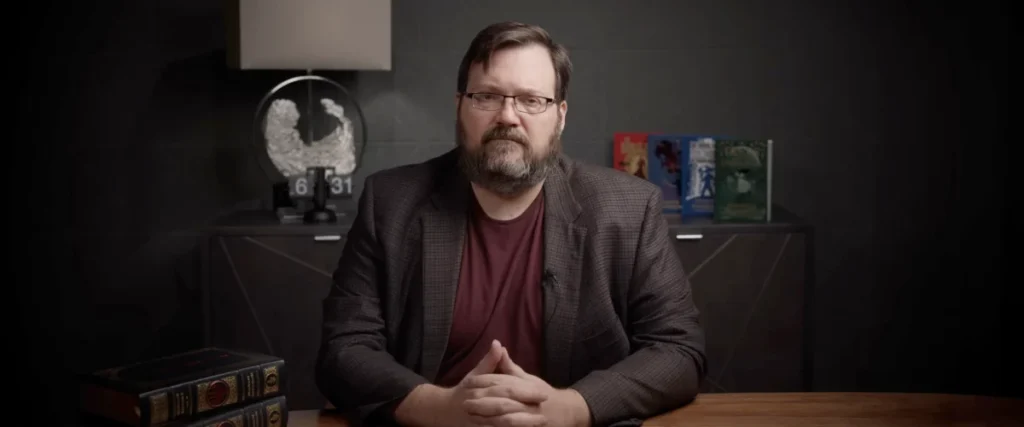
At the annual Dragonsteel Nexus conference held late last year, renowned fantasy novelist Brandon Sanderson delivered a keynote address titled “The Hidden Cost of AI Art,” a presentation that has since resonated widely within the creative community and sparked renewed discussions about the evolving relationship between human artistry and generative artificial intelligence. The conference, organized by Sanderson’s media company, serves as a focal point for his dedicated readership and the broader fantasy and science fiction genres, making it an influential platform for such a critical topic. Sanderson, a prolific and commercially successful author known for intricate world-building and an exceptionally direct engagement with his fanbase, approached the contentious subject of AI art with a characteristic blend of intellectual curiosity and deeply held conviction.
Setting the Stage: AI’s Ascent and the Creative Conundrum
The period leading up to Sanderson’s talk was marked by an unprecedented acceleration in the development and public accessibility of generative AI tools. Throughout 2022 and 2023, platforms like Midjourney, DALL-E, and Stable Diffusion transitioned from niche technological curiosities to widespread applications capable of producing sophisticated imagery and text from simple prompts. This rapid advancement ignited a fierce debate across creative industries, from visual arts and illustration to writing and music composition. Artists, writers, and designers voiced a spectrum of concerns, ranging from intellectual property theft, given that many AI models are trained on vast datasets of copyrighted human work without explicit permission or compensation, to the potential for job displacement and the fundamental devaluation of human creative effort.
Simultaneously, proponents of generative AI heralded its potential to democratize creativity, accelerate design processes, and open new avenues for artistic expression, particularly for individuals lacking traditional artistic skills. Investment in AI companies surged, and the integration of AI tools into professional workflows became an increasingly common, albeit often controversial, practice. It was against this backdrop of rapid technological change and profound industry apprehension that Sanderson chose to address "The Hidden Cost of AI Art."
Sanderson’s Initial Assessment: Beyond Common Objections
Early in his address, Sanderson articulated his nuanced position, stating, "The surge of large language models and generative AI raises questions that are fascinating, and even if I dislike how the movement is going in relation to writing and art, I want to learn from the experience of what’s happening.” While making it clear that he harbors a strong aversion to AI-generated art—a sentiment he vividly described as his "stomach turns"—he expressed a desire to understand the deeper, underlying reasons for this visceral reaction beyond surface-level critiques.
Sanderson systematically examined and ultimately dismissed several prevalent objections to AI art, a process that underscored his search for a more profound philosophical grounding. Among the commonly cited concerns he considered were:
- Copyright Infringement and Plagiarism: While acknowledging the significant legal and ethical quagmires surrounding the use of copyrighted material in AI training data, Sanderson implied this was a solvable problem, perhaps through new legislation or licensing models, rather than the ultimate "hidden cost." The legal landscape is indeed evolving, with numerous lawsuits filed by artists and authors against AI companies, challenging the legality of scraping their work. For instance, in late 2023, the Authors Guild, alongside several prominent authors, filed a lawsuit against OpenAI, alleging widespread copyright infringement.
- Economic Displacement: The fear that AI could render human artists redundant, leading to widespread job losses in creative fields, is a tangible and well-documented concern. Reports from organizations like the World Economic Forum have highlighted the potential for AI to automate various tasks, including some creative ones. However, Sanderson suggested that while economically impactful, this might not represent the core philosophical objection he sought.
- Lack of "Soul" or Emotion: Many critics argue that AI-generated art lacks the genuine emotion, intention, or lived experience that imbues human art with its power. Sanderson likely touched upon this, but his deeper exploration sought a more fundamental principle.
- Absence of Originality or Innovation: The argument that AI merely remixes existing data rather than creating truly novel concepts is also frequently raised. While generative AI can produce unique combinations, its foundational reliance on existing patterns can lead to a perception of derivative output.
By moving past these significant, yet, in his view, not ultimate, objections, Sanderson paved the way for his central thesis.
The Artist’s Transformation: The True Hidden Cost
Sanderson ultimately anchored his primary objection to AI art in a deeply personal and introspective understanding of the creative process itself. Drawing on his own experiences, particularly his struggles with his first, ultimately unpublished, book manuscripts, he identified the crucial, often overlooked, value of art: its transformative impact on the artist.
He elaborated: “Maybe someday the language models will be able to write books better than I can. But here’s the thing: Using those models in such a way absolutely misses the point, because it looks at art only as a product. Why did I write [my first manuscript]?… It was for the satisfaction of having written a novel, feeling the accomplishment, and learning how to do it. I tell you right now, if you’ve never finished a project on this level, it’s one of the most sweet, beautiful, and transcendent moments. I was holding that manuscript, thinking to myself, ‘I did it. I did it.’”
This perspective shifts the focus from the output (the painting, the book, the song) to the internal journey of its creation. The "hidden cost" of AI art, in Sanderson’s view, is the bypass of this arduous yet profoundly rewarding developmental process. For the human artist, the act of creation is not merely the production of an artifact; it is an act of learning, problem-solving, skill acquisition, emotional processing, and self-discovery. Each failed attempt, each revision, each breakthrough contributes to the artist’s growth, shaping their identity and refining their craft. An AI, by contrast, operates on algorithms and data, producing outputs without undergoing any such personal or existential transformation. The "doing" is as important, if not more important, than the "done."
Art as Human Telepathy: A Broader Philosophical Framework
Expanding on Sanderson’s insights, many cultural critics and artists articulate a complementary perspective that positions art as an act of profound human communication. This view suggests that through a tangible medium—be it a painted canvas, a sculpted form, a musical composition, or a meticulously crafted narrative—the artist endeavors to transmit a complex internal cognitive state, an emotion, an idea, or an experience, from their consciousness to that of their audience. In this sense, art functions as a form of "telepathy," bridging the subjective worlds of individuals.
This concept underpins the intrinsic value placed on human intent and expression in art. When an audience engages with a piece of art, they are not merely consuming a product; they are participating in a dialogue with another human mind, interpreting the echoes of their experiences and emotions. This reciprocal act of communication fosters empathy, connection, and a shared understanding of the human condition.
From this philosophical vantage point, the idea of engaging with a book authored by a language model or a film generated by a prompt becomes, for some, intrinsically absurd or even anti-human. If the essence of art lies in the transmission of a unique human internal state, then an output generated by an algorithm, devoid of subjective experience or consciousness, inherently lacks this vital component. It becomes, as some have metaphorically described it, a "quixotic simulation of love," offering a semblance of connection without the underlying reality of human consciousness. The product may superficially resemble art, but it misses the fundamental communicative intent and the profound human exchange that defines true artistic engagement.
Reclaiming Agency: Defining Art in the Age of AI
The most striking and empowering aspect of Sanderson’s address was his conclusion, which served as a powerful call to action. If art is fundamentally human, he argued, then its definition and meaning ultimately rest with humanity. “That’s the great thing about art — we define it, and we give it meaning,” he asserted. “The machines can spit out manuscript after manuscript after manuscript. They can pile them to the pillars of heaven itself. But all we have to do is say ‘no.’”
This statement stands in stark contrast to a prevalent trend observed in much of the contemporary discourse surrounding AI. A segment of commentary has adopted a tone of what might be characterized as "nihilistic passivity." These analyses often present grim scenarios where AI inevitably disrupts or dismantles sacred human domains, followed by a seemingly resigned acceptance of these outcomes, as if human agency were rendered moot in the face of technological advancement. Such narratives, often characterized by a "worldly weariness," lay out dystopian possibilities without offering pathways for resistance or control.
Sanderson’s message serves as a vital counter-narrative, reminding individuals and societies of their inherent power to define their values and shape their existence, particularly in areas as fundamental as art. He emphasizes that the trajectory of culture and creativity is not solely dictated by the whims of tech magnates like Sam Altman of OpenAI or Dario Amodei of Anthropic. Instead, it is a collective human choice. The power to "say no" is not merely an act of refusal but an affirmation of human sovereignty over meaning and value. It implies the ability to choose what we celebrate, what we consume, and what we deem worthy of the label "art."
Broader Implications and the Path Forward
Sanderson’s talk contributes significantly to a multifaceted global conversation about AI’s role in society. His emphasis on the artist’s journey and human agency adds a crucial philosophical dimension to debates often dominated by legal, economic, or technical considerations.
The implications of this discourse are far-reaching:
- For the Creative Industries: It challenges industries to reconsider what they value—is it merely the efficient production of content, or the unique, often messy, human process behind it? It may lead to a greater emphasis on authentic human craftsmanship as a premium offering.
- For Education: It underscores the importance of fostering not just technical skills, but also the intrinsic motivation, perseverance, and personal growth inherent in creative endeavors.
- For Policy and Regulation: While Sanderson’s argument is philosophical, it indirectly supports calls for policies that protect human creators, ensure ethical AI development, and perhaps even create new categories for "human-made" versus "AI-generated" content. Countries and regulatory bodies worldwide are grappling with these challenges, with the European Union’s AI Act representing a significant step towards comprehensive regulation.
- For Society at Large: The debate over AI art forces a fundamental re-evaluation of what it means to be human in an increasingly automated world. If machines can simulate creativity, where do we draw the lines that define our unique contributions and value?
In conclusion, Brandon Sanderson’s address at Dragonsteel Nexus provided a potent and deeply personal perspective on the "hidden cost" of AI art, shifting the conversation from external objections to the internal transformation of the artist. His concluding assertion—that humanity retains the power to define art and, crucially, to say "no"—serves as a powerful antidote to technological fatalism, advocating for a future where human agency and the intrinsic value of human creativity remain paramount. As generative AI continues its relentless march, the questions Sanderson posed will only become more urgent, demanding conscious choices about the kind of creative future humanity wishes to build.