



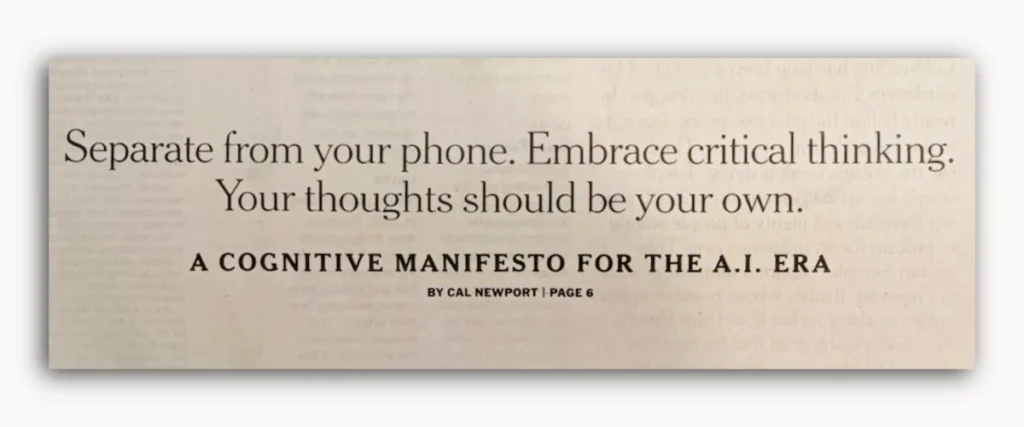
Ten years ago, Cal Newport, a computer science professor at Georgetown University and a prolific author, published his seminal work, Deep Work: Rules for Focused Success in a Distracted World. The book, which has since sold over two million copies and been translated into more than forty-five languages, emerged from a period of lower expectations following his previous title, So Good They Can’t Ignore You. This perceived freedom allowed Newport to craft a more introspective and unconventional exploration of focus, distraction, and the profound value of sustained cognitive effort. Today, Newport reflects on the book’s enduring legacy and, in a recent New York Times essay, issues a stark warning: the problems he identified a decade ago have not only persisted but have significantly worsened, prompting his call for nothing less than a "revolution in defense of thinking."
The Unconventional Genesis of a Modern Classic
Published in 2016, Deep Work was Newport’s second mainstream hardcover "idea book." Its predecessor, So Good They Can’t Ignore You: Why Skills Trump Passion in the Quest for Work You Love, published in 2012, had not met initial sales expectations, setting a lower bar for the follow-up. This environment, Newport now recounts, proved to be unexpectedly liberating. It allowed him to write Deep Work primarily for himself, delving into the conceptual edges of issues surrounding distraction that genuinely captivated his intellect.
Newport’s fascination stemmed from a dual perspective: the economic and the philosophical. He was struck by the paradoxical reality that many knowledge work organizations systematically undervalued deep focus, a critical resource in an increasingly complex economy. He theorized that this systemic oversight presented a massive, untapped opportunity for individuals and entities willing to deliberately cultivate and protect their capacity for sustained concentration. He likened this insight to "Moneyball for the cubicle class," suggesting that superior performance could be achieved by recognizing and leveraging an overlooked asset. Concurrently, Newport held a firm belief in the intrinsic value of thinking itself, viewing it as fundamental to the post-Paleolithic human experience, the wellspring of humanity’s greatest ideas, deepest satisfactions, and even moments of transcendence.
This fusion of pragmatic economic observation and profound philosophical conviction distinguished Deep Work from the typical productivity literature of its era. Readers might have anticipated a narrative replete with breathless anecdotes of overworked executives, followed by recycled statistics on interruptions and a series of easily digestible, non-challenging tips. Instead, Deep Work offered a far more intense and idiosyncratic journey. Newport deliberately eschewed conventional approaches, weaving in diverse, often unexpected, narratives and examples. He cited philosophers of religion, chronicled the dedication of a blacksmith forging swords using ancient techniques, profiled a memory champion, and delved into chavruta, the Jewish practice of studying sacred texts in pairs. Rather than opening with the struggles of a frustrated corporate manager, he began by examining Carl Jung’s deliberate efforts to distance himself from Sigmund Freud’s intellectual capriciousness to forge his own path of profound thought. This eclectic approach was not merely stylistic; it was a direct reflection of the ideas and sources that most deeply resonated with Newport, allowing the book to articulate a fundamentally true, albeit unconventional, perspective on the problematic state of work and attention at the time.
From Niche Insight to Global Phenomenon
The unconventionality of Deep Work did not hinder its reach; quite the opposite. Its distinctive approach to a universally felt problem – the struggle to focus in an increasingly fragmented world – quickly resonated with a broad audience. The book’s sales trajectory proved remarkable, eventually surpassing two million copies and reaching readers in over forty-five languages, solidifying its status as a touchstone in discussions about productivity, professional development, and cognitive well-being. The success of Deep Work also provided a retrospective vindication for Newport’s earlier work; So Good They Can’t Ignore You quietly found its stride in the wake of its successor, selling over half a million copies and establishing itself as a complementary resource for those seeking meaningful career paths.
The widespread adoption of Deep Work‘s principles signaled a growing global awareness of the challenges posed by pervasive distraction. Its concepts—distinguishing between "deep work" (cognitively demanding, high-value tasks performed in a state of distraction-free concentration) and "shallow work" (non-cognitively demanding, logistical tasks often performed while distracted)—entered the lexicon of business, academia, and personal development. Organizations began to experiment with "deep work blocks," "no-meeting days," and stricter communication protocols, attempting to carve out spaces for the concentrated effort that Newport argued was increasingly rare and valuable.
A Decade of Escalating Cognitive Erosion
Despite the book’s success in highlighting the problem and offering solutions, Newport’s recent reflections paint a disquieting picture of regression rather than progress. In a comprehensive essay published in The New York Times over the weekend, Newport directly addresses the question of how the cognitive landscape has evolved since Deep Work‘s 2016 release. His answer is unequivocally pessimistic: "The problems I focused on in Deep Work, and in my writing since, have been getting steadily worse. In 2016 my main concern was helping people find enough free time for deep work. Today I think we’re rapidly losing the ability to think deeply at all, regardless of how much space we can find in our schedules for these efforts."
This alarming assessment is grounded in the dramatic intensification of digital distractions across multiple fronts.
The Hyperactive Workplace
The professional environment, already grappling with email overload in 2016, has since undergone a profound transformation. The proliferation of instant messaging tools like Slack, Microsoft Teams, and other similar platforms, coupled with low-friction digital meeting programs such as Zoom and Google Meet, has created what many describe as a "hyperactive hive mind" work culture. Data from various studies underscores this shift:
- Communication Overload: Research by platforms like RescueTime indicates that knowledge workers check email or instant messaging apps every 6 minutes on average. A Microsoft study found that employees spend approximately 57% of their workday in communication and collaboration tools, often context-switching hundreds of times a day.
- Meeting Fatigue: The rise of remote and hybrid work models, accelerated by the COVID-19 pandemic, led to an explosion in virtual meetings. Surveys by platforms like Otter.ai reveal that the average employee spends significant portions of their week in meetings, with many experiencing "Zoom fatigue" and a reduced capacity for focused individual work.
- Context Switching Costs: Academic research, notably from the University of California, Irvine, has consistently shown that constant interruptions and context switching—the act of rapidly shifting attention between tasks—can lead to a significant drop in productivity, increased error rates, and heightened stress levels. It can take an average of 23 minutes and 15 seconds to return to the original task after an interruption.
These tools, while designed to enhance collaboration and flexibility, have inadvertently created an environment of constant digital presence and expectation of immediate response, making sustained, deep concentration an increasingly elusive luxury within the workday.
The "TikTok-ified" Slurry of External Distraction
Beyond the workplace, the landscape of personal digital consumption has also deteriorated significantly. In 2016, social media platforms like Facebook, Twitter, and Instagram were largely viewed with admiration for their connectivity potential. Fast forward a decade, and Newport observes a stark evolution, describing social media as having "morphed into an addictive TikTok-ified slurry of optimized brain rot."
- Exponential Growth in Usage: Global social media penetration has surged, with billions of users spending hours daily on these platforms. Data from Statista indicates that the average daily time spent on social media worldwide reached 151 minutes in 2023, up from 120 minutes in 2016.
- Algorithm-Driven Addiction: Platforms like TikTok, with their highly sophisticated algorithms, are engineered to maximize engagement through short, rapidly consumable content, creating powerful feedback loops that hijack attention and reward superficial engagement. This constant bombardment of novel stimuli rewires neural pathways, diminishing the capacity for sustained focus on single tasks or long-form content.
- Impact on Attention Span: Anecdotal and some scientific evidence suggest a societal shortening of attention spans, with younger generations, particularly, exhibiting a preference for quick, multimodal information over linear, deep engagement. This "cognitive shallowness" extends beyond entertainment, affecting reading habits, learning capabilities, and critical thinking.
The Double-Edged Sword of AI
Adding another layer of complexity to this challenge is the rapid emergence and integration of new Artificial Intelligence (AI) tools. While offering unprecedented capabilities, AI also presents a potential new threat to deep cognition. Newport highlights that these tools often offer "quick-fix shortcuts to whatever intellectually engaging work activities remain."
- Automation of Cognitive Tasks: AI models like ChatGPT can generate text, summarize information, brainstorm ideas, and even write code, automating tasks that previously required significant human cognitive effort. While this can boost efficiency, it also risks deskilling individuals and reducing opportunities for the very deep thinking that leads to genuine understanding and innovative breakthroughs.
- Erosion of Problem-Solving: If individuals increasingly rely on AI to solve complex problems or generate creative solutions, their own capacity for deep, independent problem-solving may atrophy. The temptation to offload mentally demanding work to AI, rather than grappling with it directly, could further diminish the "cognitive muscles" essential for deep work.
- Ethical and Educational Concerns: Educators and employers are already grappling with the implications of AI on learning and skill development, raising questions about how to foster critical thinking and original thought in an era where AI can provide instant, albeit often superficial, answers.
A Call for a Revolution in Defense of Thinking
The confluence of these factors—hyperactive communication tools, addictive social media, and the alluring shortcuts of AI—paints a concerning picture for the future of human cognition. Newport argues that simply recommending individuals read Deep Work or buy copies for others, while helpful, is no longer sufficient. The scale of the problem demands a more robust, systemic response: "we launch a revolution in defense of thinking."
While the original text leaves the specific actions of this revolution unlisted, Newport’s broader body of work and the spirit of his New York Times essay suggest a multi-pronged approach that extends beyond individual habit changes to encompass organizational, educational, and societal shifts:
- Organizational Reimagination of Workflows: Companies must move beyond simply adopting new tools and fundamentally rethink how communication and collaboration are structured. This could involve implementing "deep work hours" or "no-meeting days," establishing clear boundaries for digital availability, and valuing asynchronous communication over constant, real-time interruptions. The goal would be to design workplaces that actively protect and promote sustained focus.
- Individual Digital Discipline and Re-skilling: While the systemic problem requires systemic solutions, individual agency remains crucial. This includes consciously reducing reliance on distracting technologies, cultivating intentional digital habits, practicing "digital minimalism," and actively engaging in cognitively demanding activities to rebuild attention spans. Education and training programs could focus on "attention literacy" and the conscious development of deep work skills.
- Educational Reforms to Prioritize Cognitive Rigor: Educational institutions, from K-12 to universities, need to critically assess how they prepare students for a world where deep thinking is both increasingly rare and highly valued. This might involve re-emphasizing reading comprehension, critical analysis, and sustained project-based learning, while also teaching students how to effectively manage digital tools without succumbing to their addictive qualities.
- Societal Reassessment of "Progress": At a broader societal level, Newport advocates for a cultural shift away from the uncritical embrace of every new technology and "hyperactive communication style." This involves questioning the perceived benefits of constant connectivity against its documented costs to mental well-being, productivity, and the capacity for profound thought. It’s a call to re-evaluate what truly constitutes "progress" in a technologically advanced society.
Newport’s concluding declaration in his Times op-ed encapsulates the urgency and personal commitment driving this call to action: "I’m done ceding my brain — the core of all that makes me who I am — to the financial interests of a small number of technology billionaires or the shortsighted conveniences of hyperactive communication styles. It’s time to move past fretting about our slide into the cognitive shallows and decide to actually do something about it."
Implications for the Future of Work and Society
The implications of this escalating cognitive crisis, and the potential for a "revolution in defense of thinking," are far-reaching.
- Economic Competitiveness: Nations and organizations that successfully foster environments conducive to deep work may gain a significant competitive advantage. In an economy increasingly driven by innovation and complex problem-solving, the ability to generate novel ideas and execute intricate strategies—hallmarks of deep work—will be paramount. Companies that fail to protect their employees’ cognitive resources risk falling behind.
- Innovation and Creativity: True innovation often springs from sustained periods of concentrated thought, allowing for the synthesis of complex information and the incubation of novel ideas. A society that loses its capacity for deep thinking risks stifling its wellspring of creativity and progress, potentially leading to a stagnation of groundbreaking discoveries and artistic expressions.
- Individual Well-being and Mental Health: The constant barrage of distractions and the pressure to be perpetually "on" contribute significantly to stress, burnout, and a pervasive sense of overwhelm. Reclaiming the ability to focus deeply is not just about productivity; it’s about restoring a sense of control, fostering intellectual satisfaction, and improving overall mental health and well-being.
- Educational Paradigm Shift: Educational systems will need to adapt rapidly. Beyond teaching technical skills, the emphasis must shift towards cultivating metacognitive abilities—the capacity to understand and control one’s own thinking processes—and fostering the discipline required for sustained learning and problem-solving in a distracting world.
- The Future of Human Agency: At its core, Newport’s argument touches upon the essence of human agency. If individuals increasingly cede their cognitive control to algorithms and the demands of digital platforms, what becomes of independent thought, critical discernment, and the unique human capacity for profound reflection? The revolution he advocates is ultimately about safeguarding the very essence of human intellect and self-determination in the digital age.
Cal Newport’s decade-long reflection on Deep Work serves as a powerful testament to the book’s enduring relevance and an urgent warning about the accelerating erosion of our collective capacity for focus. His call for a "revolution in defense of thinking" is not merely a plea for individual productivity hacks, but a comprehensive vision for reclaiming our cognitive faculties and, in doing so, safeguarding the future of innovation, well-being, and human intellectual vitality. The stakes, he suggests, could not be higher.